Cody Englander
Staff writer
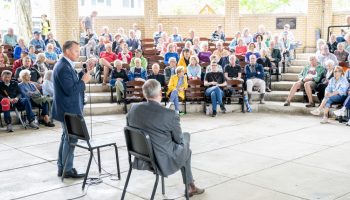
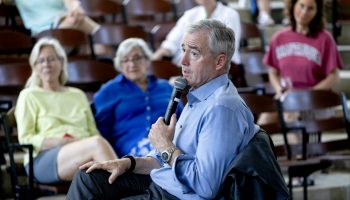
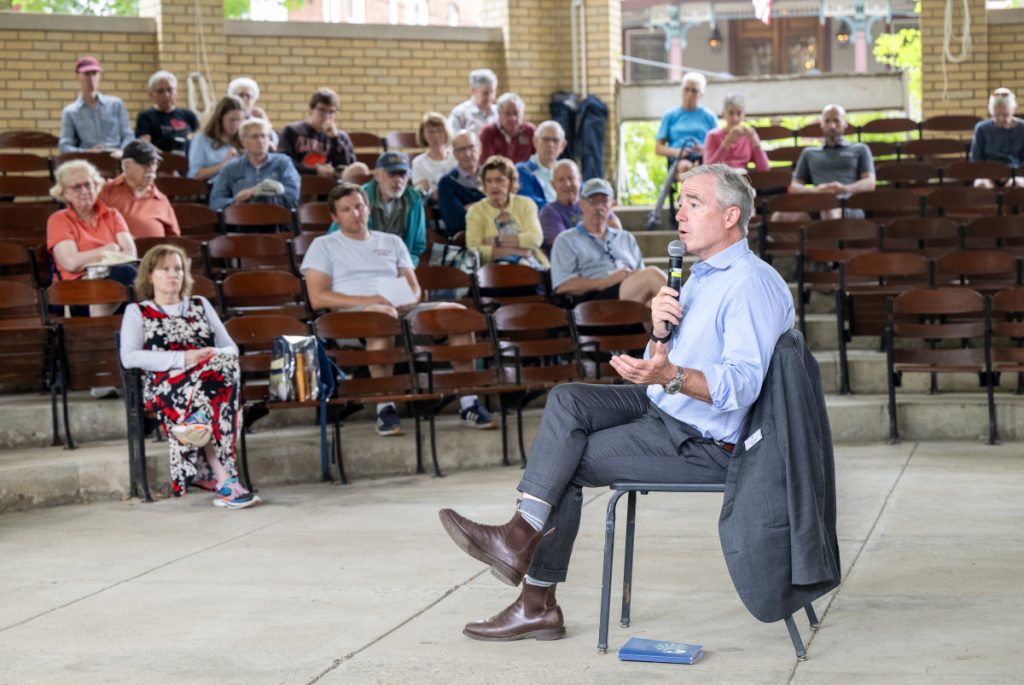
During the weekly “Conversations with Kyle,” Interim Chief Executive Kyle Keogh reflected on Chautauqua’s patron housing status.
“We have seen about a 10 to 20% decline, if not greater, in rental housing since [COVID-19],” he said. “If we look at the census, which we consider as anyone who comes and buys a season ticket, we count that as 63 days. If you come for a week, we count that as seven days. Our attendance has been plus or minus 5% for about 25 years, but it looks like we’ve structurally reset 4% lower than [where we were] pre-COVID.”
On Aug. 17, Chautauquans gathered in Smith Wilkes Hall for Keogh’s weekly discussion forum about on-grounds issues. This meeting was specifically focused on patron housing within Chautauqua Institution.
The first topic of conversation in the forum was the proposed plan to evaluate new housing options, including new denominational housing, condos and single-family homes previously mentioned by Keogh. However, he noted implementing these changes would not come without challenges.
“[We’ve] now used a fair amount of land, and that tends to be the spots where you’d actually have to tear down trees, right? You’d have to build fresh, and so those are trade-offs,” Keogh said. “If we were strictly trying to be a real estate investment firm and we were trying to maximize the immediate return, we would probably build a lot more houses. But we were trying to maximize the long-term return and the impact on the community of Chautauqua.”
Another Chautauquan suggested University Park as an area for new housing developments.
“We partnered with outside folks to do this. When we look at it, single-family homes would be the easiest to do because it’s a non-financial thing for folks,” Keogh responded. “You don’t buy a single-family house here at Chautauqua [thinking], ‘I’m going to make a business.’ You buy it because you think it’s going to transform your family, and it will, and that you’re going to hold it for 50 years, and you’re not really worried about the price of it too much. A condo is probably not that same way. You’re actually going to buy it, thinking, ‘I will probably sell this at some point.’”
While houses can ensure more longtime Chautauquans, Keogh noted condos as an improvement for Chautauqua’s density.
“I would say we probably prefer more to have [denominational housing], like the Presbyterian House, which is more housing then less programming space, versus, I believe, the Everett Jewish [Life] Center, which only has six or eight rooms,” Keogh said. “So we’d like to probably have three floors and have a lot more rooms.”
However, Keogh said he will not put forward any housing strategy to the board by the end of his tenure.
“I’m not now recommending to the board before I leave that they’d action any specific plan,” he said.
As a basis to launching the project, Keogh noted that any changes made will be done in consultation with the Institution’s current master plan, which incoming President Mark Coolidge Johnson will evaluate early in his tenure.
“[So], 12 to 18 months to get to a master plan that we wanted to bring out and share with the community, and then we would refine it after that,” Laurie Branch, chair of the Board of Trustees, said. “Ideally, we might have some frameworks to share next summer and some more concrete things to share the summer after.”
Keogh concluded the forum with a reflection of the season at hand as his tenure reaches its conclusion.
“I think we’ve hopefully, as a staff, gotten this culture experimentation the same way you would in a good strong business, and hopefully we as a community have come around to the idea that we’ll try these things, and some of them will be permanent because some of them will work, and we’ll make them permanent, and others won’t, and we’ll go back and readjust those,” Keogh said. “Historically, we occasionally hear, ‘Oh, you changed this, and no one consulted me,’ and I hopefully got to the point that said, ‘Hey, we can’t consult everybody in every decision, but a lot of these are two-way doors. We can exit back out, and hopefully, we can have this culture of experimentation that continually improves on the amazing places here.’ So, with that, thank you very much …”