Rocco Prioletti
Staff writer
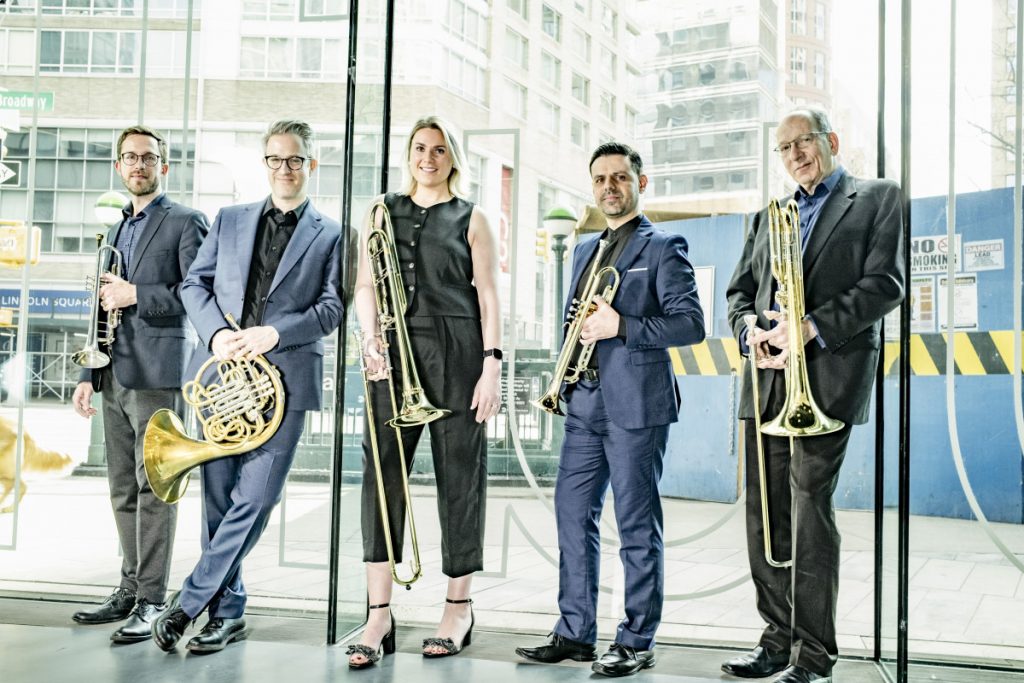
For Eric Reed, American Brass Quintet’s french horn player, beginning a concert by harkening back to early music has become akin to a ritual for the group.
“There’s something about it — that we come out and we play something super cohesive and homogeneous and uplifting and beautiful — that I think defines us in a way,” Reed said. “It, right off the bat, shows the audience that we are on the same page and we’re playing in tune and really well together.”
Despite opening with a mashup of two John Dowland pieces by the quintet’s trumpet player Brandon Ridenour, the group offers an eclectic variety of works, ranging from the English Renaissance to American contemporaries.
“I think this program fits more into what you might consider a contemporary view of what brass is capable of. … Variety is part of that — that we can, and we will, show a lot of different colors and different sounds and different characters,” Reed said.
Their contemporary pieces — ranging from a commissioned piece from Juilliard friend Anthony Barfield and his spiritual wheel-of-life-inspired “Samsara,” to a fast movement from Jennifer Higdon’s “Book of Brass,” which they felt proud to commission, to Osvaldo Lacerda’s exploration into traditional Brazilian dances — each offer something distinct.
“The goal for us is to play music that is accessible and has a lot of variety,” Reed said. “Even though not a lot of the music that we play is stuff that people will be familiar with, we want people to leave the concert being curious to find out about the composers that we played.”
At 4 p.m. today in Elizabeth S. Lenna Hall, American Brass Quintet will deliver the Chautauqua Chamber Music Guest Artist Series’ final performance of the season.
Reed grew up in a musical household. He began by singing in choirs and playing the xylophone during music class. In fifth grade, he picked up the french horn. After playing in marching band and orchestras, he decided to study the instrument in college.
What distinguishes brass from other instrument families is its inherent festive traits; he noted that most performers initially start because it is simply fun. Whether triumphantly backing a football game in a marching band or with a professional quintet in a concert hall setting, for Reed, this quality has not dissipated.
“There’s a social aspect to it. It’s not like a lot of string instruments — especially violin, I’d say, and pianists, you know? They start like [at] age 5 or something, and they start out by playing alone,” Reed said. “But this is a little different. We are all used to playing in small and large groups from the very, very beginning. And so, this is us celebrating that.”
Despite the revolving personnel throughout the group’s history, for more than 65 years, American Brass Quintet has showcased the capabilities of brass music through a variety of accessible, often underrepresented repertoire of works both new and old. Since 1987, the quintet has served as the ensemble-in-residence at The Juilliard School. The group’s current lineup all serve as faculty members.
“It’s sort of like family in a way,” Reed said of their relationship performing onstage. “We get to know each other’s idiosyncrasies quite quickly in this kind of setting.”
Without a conductor, the quintet is strengthened by an “autonomy of musical expression.” For Reed, large gestures and even eye contact are not required to dictate a concert’s musical journey. Instead, American Brass Quintet is united by each member’s individual nuances.
“… If you’re paying attention, you know what your colleagues’ ears do when they breathe; or, you know what they are going to do based on how they change their posture slightly, just move a little bit,” Reed said. “… We know what is going to come out. We know what’s going to happen when we all breathe together, when we move together.”
The concert will conclude with a commissioned piece by a friend of the group, David Biedenbender, titled “Sacred Geometry.” The distinct four-movement piece revolves around intrinsic designs found in both nature and architecture; one movement is even dedicated to the “bizarre” and “whimsical” work of Catalan architect Antoni Gaudí.
Reed said the piece is a “tour de force” they are proud to present, often placed at the end due to its “powerful” nature. In the third movement, titled “Nautilus,” Reed highlighted a particularly moving, beautiful-sounding passage for him. Here, amid a chorale of low brass, a muted trumpet blends against it, sounding not too dissimilar to “backward-sounding music.”
“I think it does exemplify us as a group in a way, because there is that homogeneity of the chorale, but also this funky, almost like, ‘I-don’t-know-how-you’re-doing-that’ kind of sound at the same time, and somehow it works,” Reed said. “It’s super powerful. I love that moment.”