ROCCO PRIOLETTI
Staff Writer
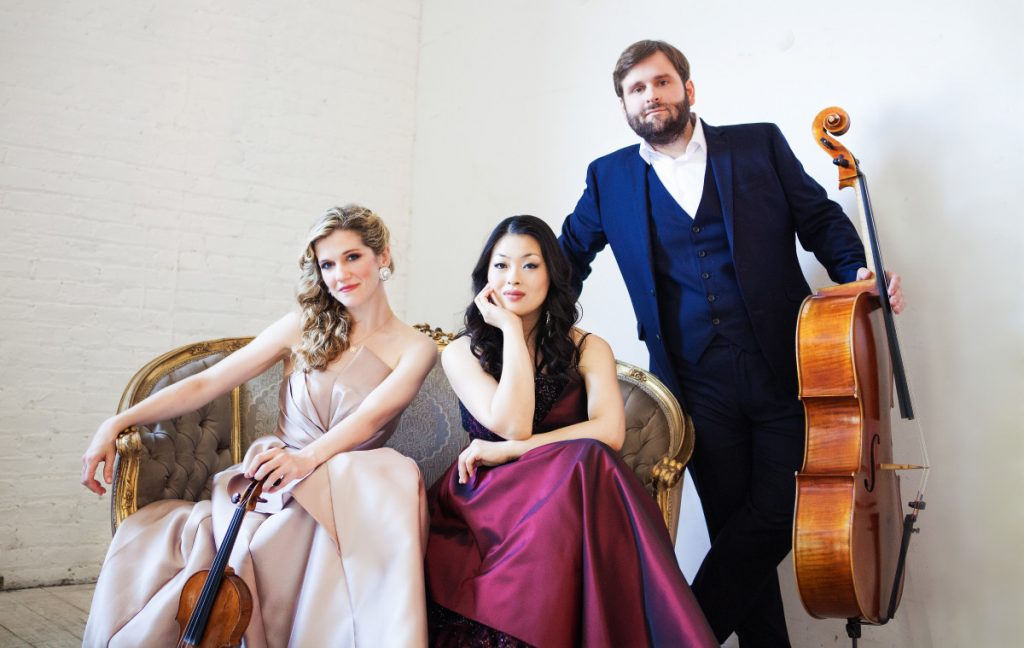
When violinist Anna Williams and cellist Mikhail Veselov met on their first day of graduate school, they were “musically set up” playing a string quartet together. As they became friends, the two bonded over their shared passion for the medium and repertoire of the piano trio as a shared “pie-in-the-sky kind of a dream.” Afterward, they met pianist Eri Nakamura over hot fudge sundaes when playing at a music festival together.
The very first piece Neave Trio read together was Johannes Brahms’ Trio No. 1, Op. 8. In 2023, the trio received their first Grammy nomination for their performance of that very piece.
Since their formation nearly 11 years ago, the trio’s relationship as a group has grown.
“I think we have [a] great relationship making music always together, and there’s so much trust. I feel like we’re really connected at the soul level. Like, things that we don’t talk about, we can just kind of get, and that really helps our music,” Nakamura said.
Williams and Veselov both laughed as they detailed that they’re now married with a three-year-old son; laughter and inside jokes play an integral role in the group’s dynamic.
“We laugh a lot. We’re really, truly ourselves when we’re in the rehearsal room,” Veselov said. “It’s a very special relationship that is just getting more and more sort of deepened and connected. And I think you have to have it for music-making, you know? They feel that sense of comfort and …” Williams finished his sentence, saying “connection,” to which Veselov agreed.
At 4 p.m. today in Elizabeth S. Lenna Hall, Neave Trio will make their Chautauqua Institution debut by exploring how personal experiences become universal through each composer’s interconnected artistic statements.
Veselov said he feels most present with both the trio and concertgoers when the physical logistics of performing fade away onstage and allow the music to envelop the room. Whether at Lincoln Hall or in an intimate setting, the music itself allows these favorite moments for Veselov to remain ever-present.
“I think having the audience there is, really, an additional layer to feeling that mutual presence of this incredible music that we’re so lucky to get to play,” Veselov said.
Williams felt honored to connect to audiences through music. She recalled how concertgoers have approached her after a performance in tears, saying how a piece reminded them of a certain memory or person. This was a fundamental motivation behind the trio’s formation.
“… We were playing for someone who was hospitalized, and that sense of connection where we would play for him, and he would talk about his daughter in those moments, and her name was Neave,” Williams said. “So, that sort of sense of how it can connect us to one another is really what makes it such a sort of mini-miracle every time it happens.”
The trio said they felt privileged to both premiere and commission a new piece by Pulitzer Prize-winning composer Jennifer Higdon, titled “A Vast Palette.” The two-movement work conceptualizes colors through music, offering insight into personal perspectives. For Williams, Higdon’s movement titled “Majestic Green” is a highlight in the program. Thematically, it conjures memories of walking in nature for the composer.
“I feel that sense of, like, ‘Wow.’ This is really almost a convening with Jennifer and us and the page, and just that sense of intimacy that she’s kind of created in her beautiful, lyrical writing,” Williams said, noting how Higson takes the musicians she is writing for into account during composition.
Neave Trio encompasses a wide variety of works, each offering insight into the composer’s interior self. From Samuel Coleridge-Taylor’s newfound connection to the African American spirituals linked with his African British heritage to Astor Piazzolla’s intrinsic connection to nuevo tango, each piece shares a different experience.
Williams highlighted the importance of Clara Schumann’s story, urging those to remember her, not only as a composer, but as both a mother raising eight children and as a muse and mentor to Robert Schumann and Brahms. At the same time, she dealt with mental health and familial struggles — and still persisted.
“She was able to persevere and make this music for herself and bring it to the world. [It] is insanely incredible,” Williams said.