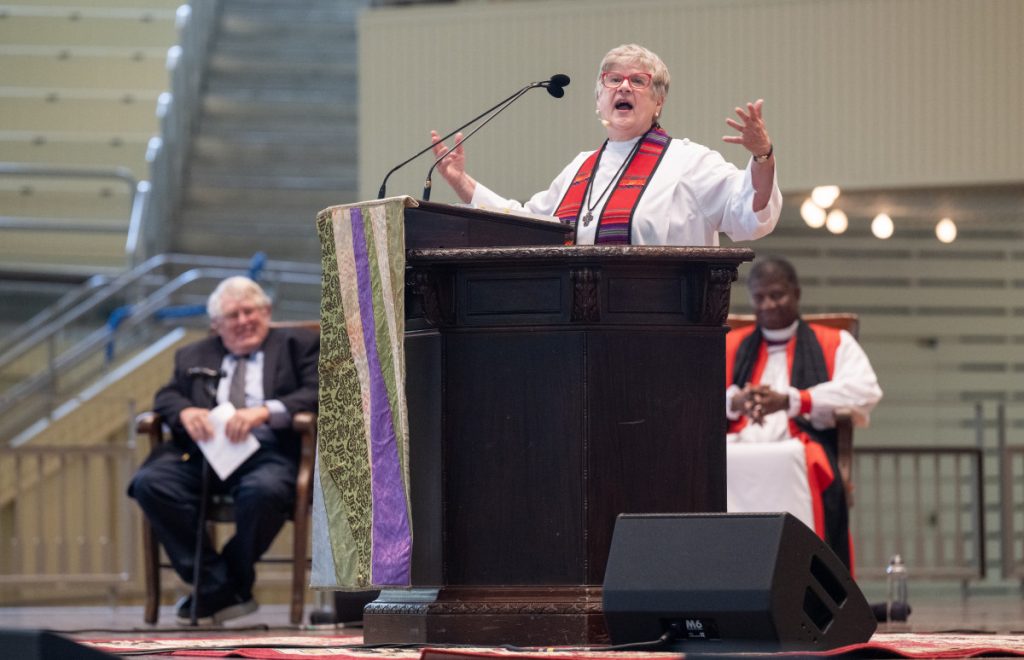
The Rev. Natalie Hanson delivers her sermon “Invitation to a Feast” during morning worship Sunday in the Amphitheater.
Column by Mary Lee Talbot
“So, Chautauqua, can we talk? I am not a published author, not in a national pulpit or a powerhouse in the denomination, but I am yours and have lived among you and walk with you still,” the Rev. Natalie Hanson said. “Life here at Chautauqua lets us be, grow, rejoice and come together.”
Hanson preached at the 10:45 a.m. morning worship service in the Amphitheater. Her sermon title was “Invitation to a Feast,” and the Scripture readings were Luke 5:33–35 and Matthew 22:1–10.
She said, “Imagine a long, long dining room table set with porcelain, crystal glasses and fine linens. There is one person at one end of the table and another at the other end. There are servants standing in the shadows and the whole scene is one of richness and ostentation. This is not a feast. It might be Downton Abbey, but it is not a feast. It might be a state dinner at Buckingham Palace, but it is not a feast.”
Hanson continued, “A feast is when, at the end of term, students gather all their leftover food and sit in the hallways and tell stories and share the food, even the moldy Jell-O. There is joy and a spirit of connectedness. There is abundance, and because they have community, this is a feast.” Think of a street fair or a block party where there is noise, laughter and people rejoicing in being with each other. Bestor Plaza is like this some days, where improbable connections are made and there is mutual care, community building and diversity.
In Matthew’s Gospel, the king is going to have a wedding feast for his son. It is a community event and it is about connections and the largesse in relationship to the king. The king sends out messengers to come, but the invited guests turn away.
“They are not coming, so the king tries again. They are not interested and brutalize and kill the messengers. The king kills the invited people because it is impossible for there to be reconciliation,” Hanson said. “The king’s revenge may seem harsh, but this is a parable, and the king’s harshness mirrors us when we reject what God offers us. The feast is set, but we don’t partake, and we begin to starve, to die and we kill ourselves.”
The king did not give up but sent out new messengers to invite everyone, saints and murderers. “Just say yes — say yes because everyone is invited,” she said.
At Chautauqua Institution, there is a large circle of all Chautauquans, but there are lots of little, tribal circles. These may be musicians or sailors, golfers or lecture enthusiasts. “This is healthy, as long as these groups are porous and overlapping,” she said. “If they close up, pull in or are less welcoming, if they begin to reject one circle or another, this is destructive.”
She continued, “Chautauqua is a wonderful place, but it could be more wonderful. Since 2022 we have been at odds with each other. We rejoice over someone’s loss, feel a sense of victory over someone’s pain. We judge people’s lifestyles, and staff are on the firing line; we become grumpy and shut people out. We cut ourselves off from the feast and starve ourselves and others.”
Chautauquans miss out when this happens. “We need to remember that when we look in the face of another, they are called beloved, no matter what,” Hanson said.
Hanson said she does not miss the programs when she cannot be here. “The programs, the symphonies, theater, dance, lectures and art are marvelous appetizers, often called amuse-bouche. I can go to the symphony in other places, but I miss all y’all. You are the embodiment of the feast.”
She told the congregation, “You bring the gifts even as you come from different situations, classes, where you grew up. This is a feast; embrace it. Beloved, will you embody God’s feast for each other? This is a quiz — will you?” The congregation answered with a quiet “Yes.” She said again, “Will you?” “Yes,” the congregation said a bit louder. “Will you?” “Yes,” came the roaring reply.
The Rt. Rev. Eugene Taylor Sutton, senior pastor of Chautauqua, presided. The Rev. J. Paul Womack, retired United Methodist pastor and husband of Hanson, read the Scripture. For the first part of the prelude, Owen Reyda, organ scholar, played “Allegretto” by Percy Whitlock on the Massey Memorial Organ. The second part of the prelude was “A Simple Song,” from “Mass,” with music by Leonard Bernstein and text by Bernstein and Stephen Schwartz from Psalm 121. The song was sung by soprano Symone Harcum, a Denyce Graves Foundation Generational Voices Artist who serves on the faculty of Norfolk State University in Virginia. She was accompanied by Sonya Subbayya Sutton, interim director of Sacred Music, on the Steinway piano. Harcum also sang “Prayer,” music by H. Leslie Adams and text by Langston Hughes; Sutton accompanied her on the piano. The Chautauqua Choir sang “i thank you God,” with music by Gwyneth Walker and text by e.e. cummings. The Choir was directed by Sutton, and Reyda provided accompaniment on the Massey Organ. The postlude was Fugue in G Minor, BWV 578, by Johann Sebastian Bach played by Sutton on the Massey Memorial Organ. Support for this week’s services is provided by The Samuel M. and Mary E. Hazlett Memorial Fund. Support is also made possible by Week Eight Presenting Sponsor Highmark Blue Cross Blue Shield, AHN Westfield Memorial and HealthNow Administrative Services.