
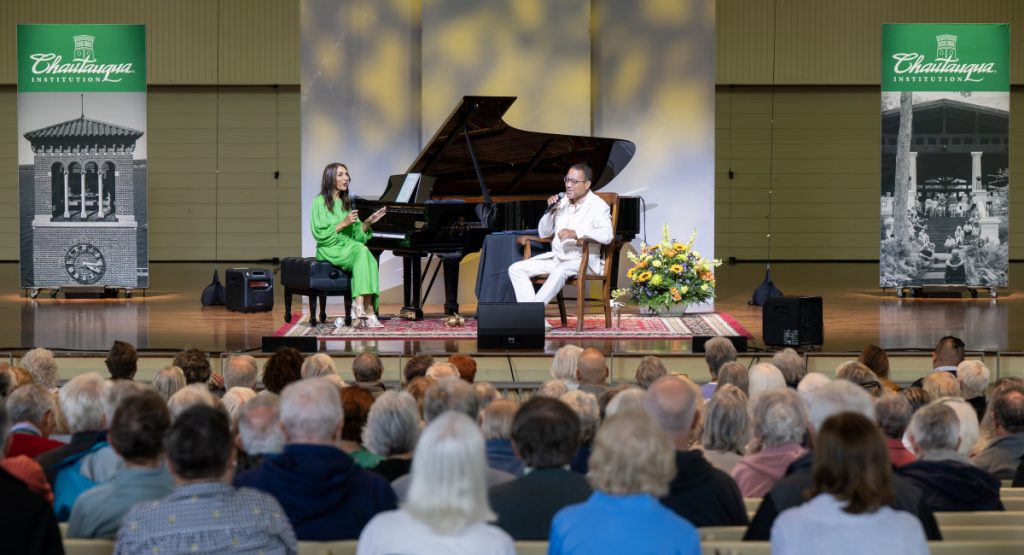
Lara Downes, pianist and host of NPR’s “Amplify with Lara Downes,” joins in conversation with Associate Professor of Linguistics at Columbia University John McWhorter on the optimism of American music Tuesday in the Amphitheater.
ROCCO PRIOLETTI
Staff Writer
With the introductory ivory twinkles of pianist Lara Downes playing Harold Arlen’s 1930-composed “Get Happy,” Chautauquans were invited to tune into American history. Despite soundtracking a tumultuous time for the country — following the stock market crash and the Great Depression — the song nonetheless prevailed in households nationwide.
“I have been investigating American music and American history on this 250th anniversary milestone here, and it dawned upon me at a certain point that, when you look back at our history and all the hard times we’ve had, that music has surfaced again and again as this joyful noise — as this noise of hope, as this noise of the sun will come out tomorrow and things will get better, and also we can make things better. And that feels very meaningful right now,” Downes said.
Joined in conversation by linguist and scholar John McWhorter, the two explored how optimism arose in American music from its very beginning. This emotional facet is something that uniquely distinguishes the U.S. from the “wonderful music,” as McWhorter joked, of Germany and Russia.
“America is a very difficult place in many ways,” McWhorter said. “But, I think it’s easy — because we’re fish that don’t know we’re wet — to miss how happy American music often is, compared to music that you hear from other countries.”
The first music made on the land that is now the U.S. came from Indigenous people. Afterward, people who were brought to the country through enslavement laid the inseparable groundwork for American music to come. Sacred music, the blues and jazz would not be possible without work songs and the spirituals.
“I look at that music — that music that was created out of the darkest, most terrible circumstances — that started this thread of constantly advocating for, insisting upon, something better,” Downes said. “These spirituals that were always about the hope, for freedom, hope for joy, the hope for a better life, whether here or in another place.”
H.T. Burleigh, a Black American composer in the late 19th and early 20th century, established himself by producing the first music that Downes sees as being “American-made.” Before Burleigh’s reworking of traditional spiritual songs for a concert music setting, there was no national representation of the American concert music tradition.
Downes played Burleigh’s arrangement of “My Lord, What a Mornin’ ” on the piano. Despite being well-versed in the advocacy and performance of American music, Downes still said she finds it difficult to articulate and define precisely the components that make American music sound American, besides one hearing it for themselves. This difficulty is due in part to the melting pot of backgrounds that compose American music.
“You have this African American influence from the beginning. But then, also, everyone who’s coming here is always bringing their music, which to me, is the most beautiful thing,” Downes said. “ … You’re bringing your recipes and your stories and your music. And the music starts to come together in such a beautiful way. Every American song has a story.”
McWhorter imagined the music Abraham Lincoln would have heard during his lifetime. Though he would be familiar with the spirituals, white music such as jigs, polkas and marches would have been more popular with Lincoln. He noted that in 1865, musical “jamming” did not exist.
“American music that represented everyone who was here simply didn’t exist,” McWhorter said. “… There was no music that basically combined what all of us are like in the way the song ‘Get Happy’ does it.”
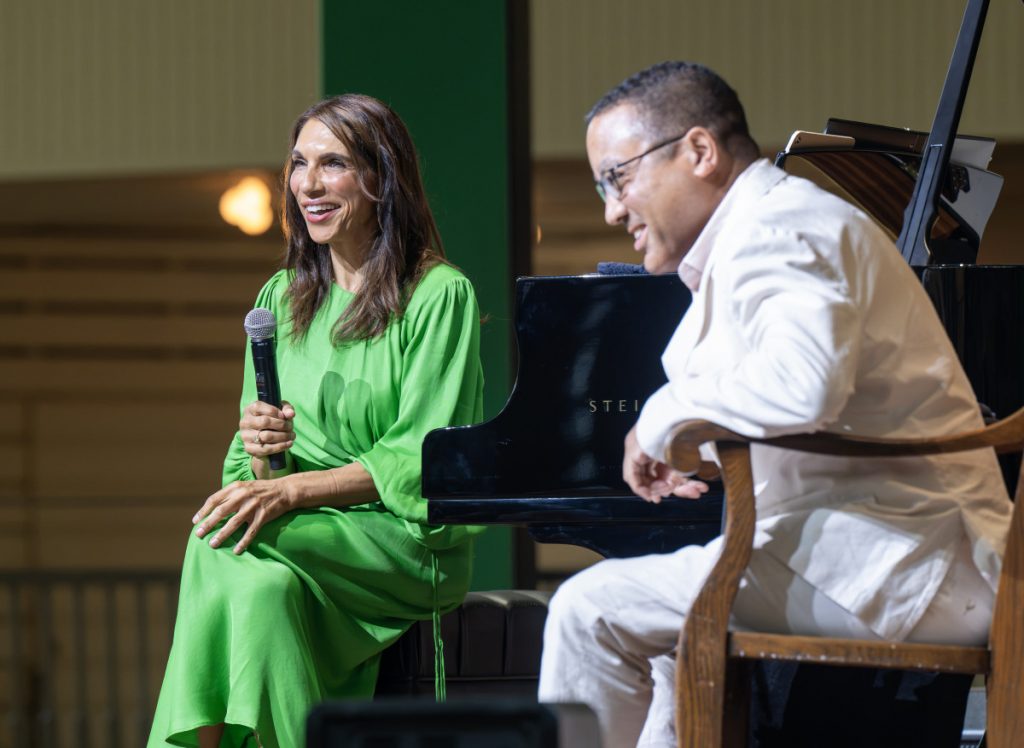
Lara Downes, pianist and host of NPR’s “Amplify with Lara Downes,” joins in conversation with Associate Professor of Linguistics at Columbia University John McWhorter on the optimism of American music Tuesday in the Amphitheater.
“Shenandoah,” as performed by Downes on the piano, was a song Lincoln would be familiar with, according to McWhorter.
Throughout Lincoln’s presidency amid the Civil War, composer Stephen Foster rose to prominence as the first “pop music star in America” in Downes’ perspective. McWhorter saw the composer as a troubled but genius man.
“About 10 of [his songs] have that special thing that the only occasional song has, which is that you feel like it’s always existed. It can be told that a certain Foster, Stephen, penned this song probably in some attic, drunk and angry,” McWhorter said. “But, it seems, basically, like God wrote it. And that God-like music, when it comes to American music, has that combination of looking downwards and upwards at the same time.”
Despite being written amid a tumultuous marriage, financial troubles and alcoholism, Foster’s song acted as an anthem, reaching both sides of the war as a national reminder of hope. Downes performed it unaccompanied on the piano, similar to how it would have been heard around the campfire during wartime.
In the 19th century, Black music began to merge into more commercial and conversational avenues. For instance, Scott Joplin’s introduction of ragtime for the masses saw audiences tapping their toes to his convergence of Black and white music.
McWhorter described the meaning behind the genre’s name, which he said was discovered only three years ago. The name originated from a dance called a “rag” — characterized by tapping one’s foot on beats two and four, instead of one and three. He noted journalists at the time struggled to convey how “devilish” the rhythms were, fully detached from their societally accepted jig counterparts. As time progressed, though, ragtime stopped being colloquially associated solely with its dance component and eventually represented piano music.
Joplin began taking piano lessons with a German Jewish immigrant who recognized his musical talent from a young age. Therefore, his musical background was placed within the world of German classical music. Downes said, “It was the tragedy of his lifetime. He really had this outsized ambition to write, not only an opera, but the first great American opera and the first great African American opera.”
McWhorter joined Downes on the piano for a surprise performance of Joplin’s iconic rag “The Entertainer.” Though Downes prefaced the rendition, saying it was not supposed to be good, by its conclusion, the two were both smiling and laughing.
“Raise your hand if you think [McWhorter] should quit his day job,” Downes laughed.
During the 1920s, the tunes that comprise the joyous Great American Songbook were created under global distress, coinciding with events like the Great Depression. Downes said that the advent of jazz in New Orleans is when “everything changed forever.”
McWhorter highlighted prominent Jewish composers like George Gershwin, Irving Berlin and Jerome Kern who, through their differing musical traditions, brought “truly magic music” to Americans. These composers, often first-generation Americans, delivered music that was imbued with American hope. Despite the anti-immigration policies of 1924, composers like Gershwin instilled America’s “kaleidoscope” or “melting pot” into song.
Berlin’s “Cheek to Cheek” came to mind in particular for McWhorter.
“Think about what a magic thing that song is, right down to its lyric, and how closely it fits the melody. And then get in a little plane and fly around the world and try to find anything comparable,” McWhorter said. “There are incredible things the rest of the world has created that America could never pull off … Only here did that happen is because of this remarkable interethnic fusion.”
Downes performed “On the Sunny Side of the Street,” written by lyricist Dorothy Fields; she joked that she would like to be reincarnated as Fields. McWhorter remembered his father playing the song during his upbringing. The day of the lecture marked the birthday of Leonard Bernstein, a prolific figure who inspired Downes to venture into radio broadcasting.
Downes concluded the lecture with a song from Arlen, who composed the opening song, “Get Happy.” The melody came to Arlen spontaneously in a cab.
“[These were] dark times, hard times in America. And this is a song that has been making generations of us feel better, hope for better, feel even better, and I think it always will,” Downes said.