
Lily Reslink
Staff Writer
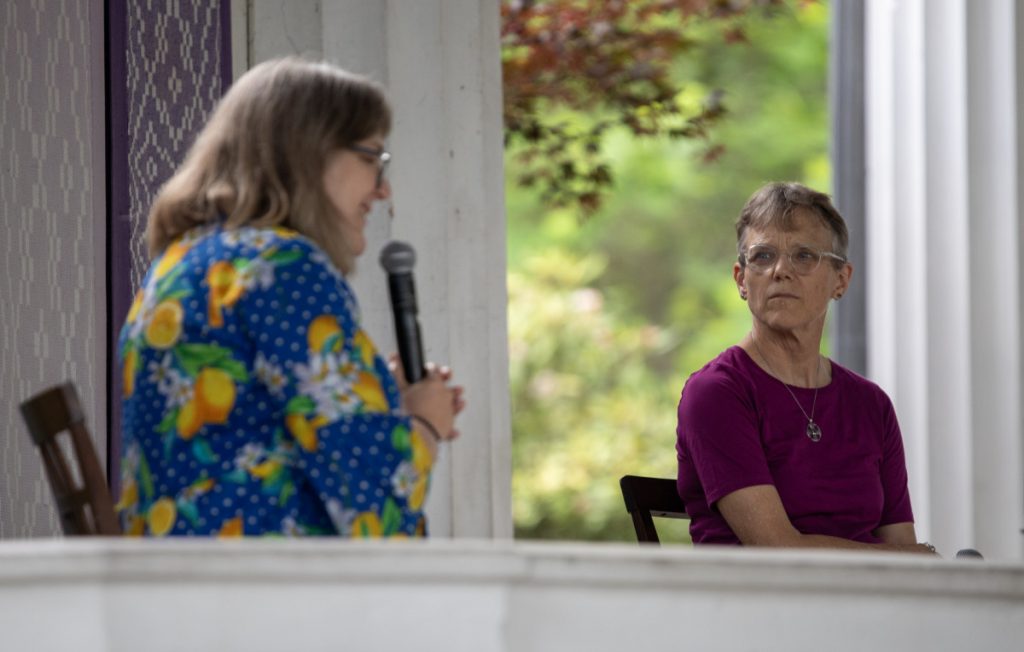
A long and winding route led to spiritual leaders Diana Butler Bass and Mariann Edgar Budde falling into their respective roles, crossing paths and joining one another in conversation for Tuesday’s Interfaith Lecture Series conversation. Complementing one another, Bass showed passion for the past and Budde, for the emerging future.
Their shared journey is rooted in personal histories that have shaped their respective understandings of their responsibilities. With personal narratives, the duo charted complexities in their spiritual roles. The joint reflection centered on their perceived responsibilities to peace and truth.
Returning from her lecture Monday, Bass, author and preacher, brought historical perspective to the lecture and an emphasis on the “intuition” of truth. Budde, Bishop of the Episcopal Diocese of Washington, brought the perspective of a both a spiritual and administrative leader within her congregation.
Bass said she knew from age 5 that she would end up studying the past. “Historians are tremendously intuitive human beings,” she said, adding that much of history begins with intuition that the stories we are told may in fact be untrue or incomplete. Alongside truth and facts, Bass emphasized interpretation; she said interpretation of the past that speaks meaningfully in our own times is important.
Budde sees intergenerational cooperation as necessary for a unified future. She said predominant white culture posits that eldership is something shameful because youth-oriented values override it. This contrasts other cultures, where “eldership is to be revered.”
Tied to a project that she said has recently propelled, “eldership vocation” was a main point for Budde. She said moving past the stage of “holding up the universe” lends itself to a sense of “displacement” for elders.
“But what if the vocation is actually not exiting, but being on the side, or being behind as wind in the sails?” Through observation, reflection and groundwork research, Budde is interested in the benefits of an intergenerational congregation that leans into each individual’s respective strengths.
“It did occur to me, if we were to take that seriously, all of us together, our churches that are mostly made up of elders would be the greatest places for young people to come and thrive,” Budde said.
Even when the generational divide is confusing and isolating, Budde called for elders to adopt the mindset of, “I have no idea what you’re talking about … and I’m curious and want to support you.” She said this approach would aid the concern that many have expressed to her about bringing young people to the congregation.
During the conversation, the lecturers discussed embracing uncertainty and error, rather than diluting and concealing challenges and traumas that would otherwise go unaddressed. Bass posed the question: “How do you heal inherited trauma?” She said the answer is not avoiding hard topics of discussion.
The two were also candid about previous disputes, agreeing that they ultimately treasured their relationship over holding steadfast in perspectives that divided them. Through their Christian lenses, both look to a future where people actively seek to replace division with understanding.