
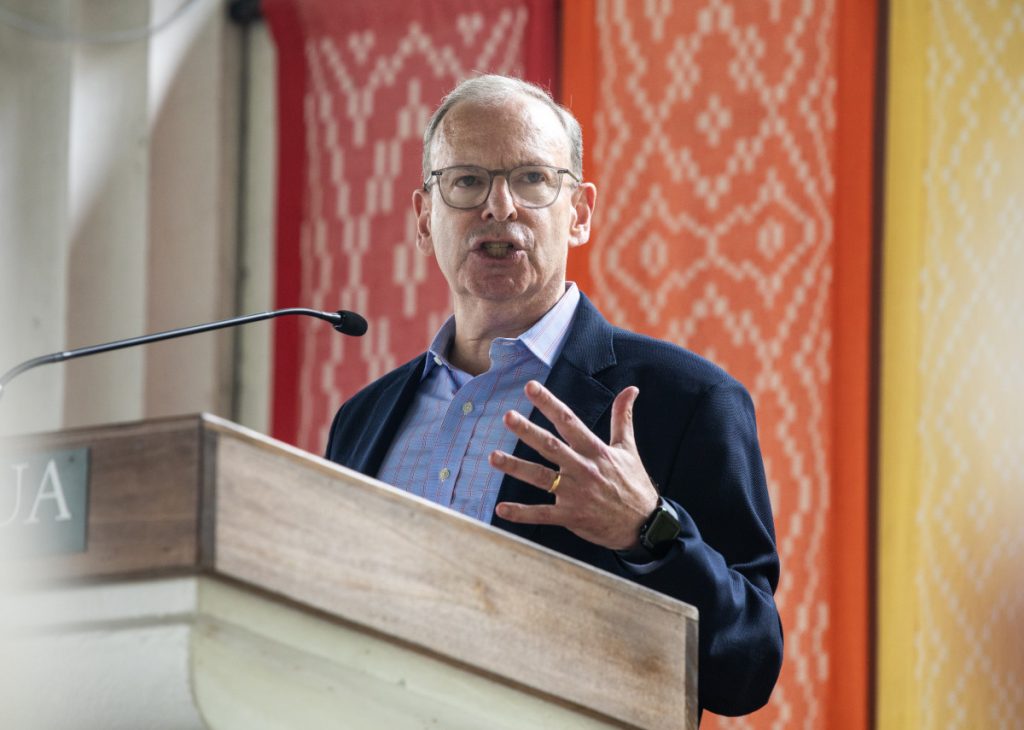
Jeremy Ben-Ami, founder and president of J Street, speaks on his vision and hope for the future of the Israeli-Palestine conflict Tuesday in the Hall of Philosophy.
LILY RESLINK
Staff Writer
During his 2 p.m. Interfaith Lecture Tuesday in the Hall of Philosophy, J Street Founder and President Jeremy Ben-Ami pitched the question of what percentage of the earth’s land surface is occupied by Israel and Palestine. The answer, he said, is less than 0.02%.
“The tiny strip between the infamous river and the infamous sea, it occupies such a disproportionate share of the real estate of our politics, of our news, of our family dinner tables. It affects and moves energy markets, religious identity, academia. It affects elections, careers, student life on college campuses,” Ben-Ami said. He said this “tiny little strip of land” has become a central focus to the U.S., and he posed the question of how one place so small has cast such a large shadow over so many lives.
In all the conversations he has had related to this topic, including ones with political leaders, he said he is able to find only one thematic tie: “People disagree.”
There is one agreement he sees, which is “recognition that American policy and policymakers have been bound together by one rulebook, one political rulebook, that governs how to approach this conflict for a very long time,” he said.
Ben-Ami explained the four elements of the rulebook that he said no longer apply to the modern world.
First, he said, is the waning expectation to recognize Israel and the U.S. as having a “special relationship” described as “unbreakable” and “unshakeable.”
Second, he said, is the previous bipartisan support for Israel. “It was a rare issue that Republicans and Democrats could agree on. And you weren’t supposed to use it as a political football.”
The third point concerned the expectation of limited investment from people in the U.S. surrounding the conflict.
Fourth, he said, is the view that the tools for American foreign diplomacy were not applicable to Israel and Palestine.
He said these rules were previously off-limits to debate, but that has changed in more recent years. In what he called “a political earthquake,” Ben-Ami acknowledged the fears surrounding this shifting ground.
He said, “I would argue that every big crisis offers an equally big opportunity.” This guided him to expand shifts underlying the opportunities for different trajectories amid the current conflict.
As the first important shift, he said that Israel is a fundamentally different country today compared to “the one many in this audience grew up knowing.” He said while there had been some continuation from American policy makers “still operating within a relationship grounded in shared interests and values,” as of August 2026, he would argue that Washington, D.C., is aware of this shift.
He said the second shift relates to U.S. public opinion, and how he said it is now unfavorable toward Israel as “a regional superpower.”
“[Americans] weren’t looking any longer at a vulnerable young democracy fighting for survival against overwhelming odds, but rather at a regional superpower with one of the strongest militaries in the world that was exercising indefinite control over another people,” he said.
He noted the war in Gaza as an accelerator of these shifts in public opinion.
He said he does not believe these shifts in opinions mean Americans are becoming anti-Israel “in the sense of opposing the existence of a national home for the Jewish people,” but rather, he said he sees “a widespread readiness to critique Israel and specifically the Netanyahu government.” He also noted the impact of what he said is AIPAC’s weakened influence in Washington.
The third shift he noted regarded the “Arab world and the attitudes of Arab regimes toward Israel.”
“Arab states see Israel as strategically on the side in the fundamental conflict they have in the region. And that’s with Iran,” Ben-Ami said.
He said the Arab world views Israel “not as a permanent outsider, but as a meaningful potential partner.”
Regarding diplomatic approaches by President Trump’s Administration, Ben-Ami said, “their vision left out Palestinians.” He spoke about the impact of the Oct. 7, 2023, attack, including its role in disproving presumptions about how Palestine configures into the relationship between Israel and the Arab world. Contrary to what some believe, Ben-Ami said regional integration and Palestinian self-determination are increasingly parts of the same strategic vision.
“The notion that Israel can actually be integrated into the region is something that the founders of Israel in 1948 could never have allowed themselves to dream about, and it now, today, is actually on the table.”
This led him to expand on the opportunity he sees to reshape the U.S. approach to engaging with the Israeli-Palestinian conflict and the Middle East, which he broke down into three principles.
The first, he said, is “Stop managing the conflict. Start trying to resolve the conflict.” He said this looks like an improvement in economic conditions and security cooperation. He criticized previous approaches to the conflict.
“Principle number one for American policy must be to lay out a vision for full conflict resolution and make clear nothing less is the goal of all our efforts,” Ben-Ami said.
He said the second principle is “think regionally, not bilaterally.”
He described what he calls “the 23-state solution.” Ben-Ami said, “For decades, we have spoken about a two-state solution. Ironically, I believe that phrase has become part of the problem.”
Realistically addressing the regional problems, in Ben-Ami’s perspective, requires regional engagement. He explained how the 23-state solution is a “win-win-win.”
“Sometimes the only way to solve a seemingly impossible problem is to make it bigger,” he said.
The third principle, he said, involved a “recalibration of both sides.” He said a partnership with Israel must be grounded in accountability, reciprocity and shared objectives, as he said other U.S. partnerships are.
“America should have stable, mature relationships with both countries, subject to the same rules and conditions as all other countries around the world,” Ben-Ami said.
Ben-Ami said he is often asked if he holds optimism toward a peaceful future for Israel, and his response to that is, “Optimism is not a strategy, but today, I see a ray of hope after all of this horrific darkness.”
To conclude, Ben-Ami said, “The changes I have described suggest that our imagination need no longer be so constrained. The old rulebook is gone. The question is whether we have the courage to write a new one.”