
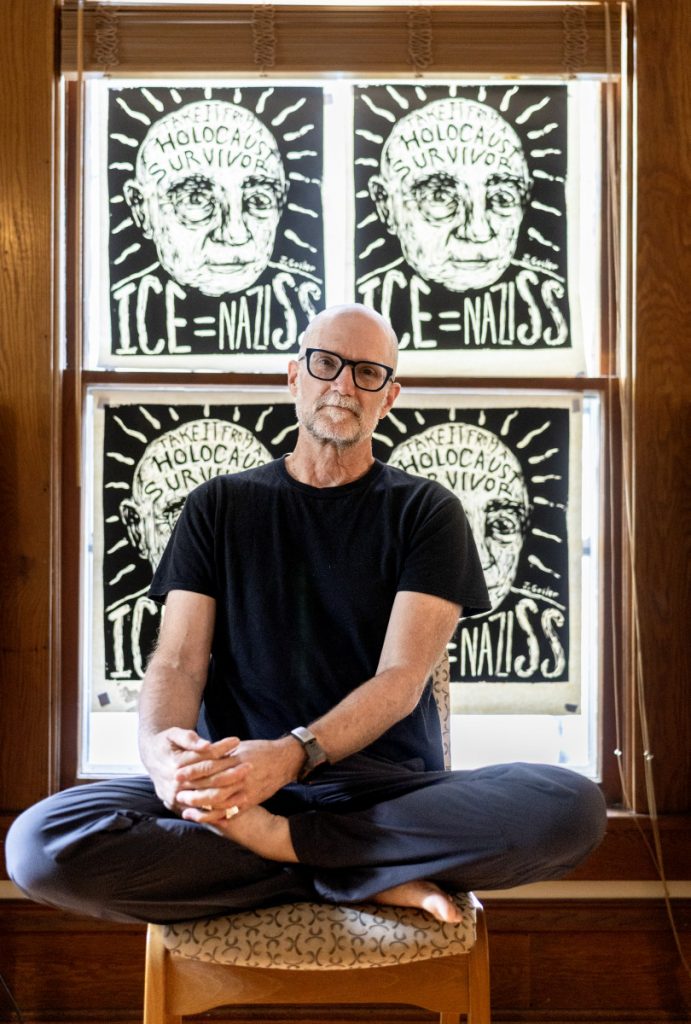
At top, artist Todd “Quaker Pirate” Drake is shown with print graffiti artwork he created depicting author and Holocaust survivor Joseph Gosler containing messages comparing U.S. Immigration and Customs Enforcement to the Nazi party July 31 in the Quaker House.
SAM HUFFMAN
Staff Photographer
Artist Todd Drake always believed humans are born to help others. Although he initially ignored his artistic inclinations, Todd now uses his art, shaped by his Quaker faith, to make a difference in his community.
Todd was invited to visit the Quaker House as a guest speaker July 30, during which he discussed his artistic journey spanning 40 years, his work in social activism and how he strives to educate aspiring creatives. He was compelled to visit Chautauqua Institution upon learning of three of the four pillars — Science, Religion and the Arts, which he believed to be core foundations of his life’s work. However, he made sure not to neglect the fourth pillar, Recreation, either; in his time here, he enjoyed exercising on the grounds and swimming in Chautauqua Lake.
“Finding this community is like being part of the best intentions of humans,” Todd said. “I know the place isn’t perfect by a long shot, but there’s a lot of good intentions here that have come to fruit, and it’s just wonderful to be a part of that.”
In his home state of North Carolina, Todd’s passion for social activism was awakened upon hearing accounts of animal abuse while participating in a meeting at his local humane society. He later deepened his understanding of global struggles outside the U.S. during his college years, when he decided to pursue a career in medicine.
“I wanted to be a doctor and go to places where people were starving or in need of medical care,” Todd said. “When I was in the medical school path, I went to Haiti and saw what life was like outside the United States, and that was a real awakening.”
Todd spent two years in medical school, but experienced burnout and decided to return to his early passion for the arts.
“I really felt like I’d been given a set of gifts as an artist that God wanted me to use,” Todd said. “Why would [God] give me these gifts if they weren’t to be used?”
It took some time for Todd to find synergy between his activism and his art. This changed when he began photographing the untold stories of immigrants in his community. He produced a book with author Hannah Gill titled Going to Carolina Del Norte, which presented stories of North Carolina immigrants from Celaya in Guanajuato, Mexico, through photographs and oral histories. He then moved to Brooklyn, New York, where he continued his art activism and explored societal struggles through printmaking and other artistic mediums.
As his most recent artistic endeavor, Todd ventured into the world of street art and graffiti. After becoming inspired by street art he found throughout the city during the COVID-19 pandemic, he decided to begin putting up his own graffiti and prints, displaying messages of perseverance, empathy and anti-war sentiments. Todd would later adopt his street art alias “Quaker Pirate,” inspired by the Obadiah series of children’s books by Brinton Turkle, in which the main character is told to be “a good quaker pirate.”
“When I heard that phrase ‘quaker pirate,’ I was like, ‘That’s what I’m doing,’” Todd said. “I’m putting up work that comes out of my Quaker faith, but I’m doing something illegal, like a pirate would do.”
This series of works has garnered recognition, leading to solo exhibitions in museums across the country that display Quaker Pirate’s print graffiti. While his challenging yet empathetic images struck a chord with community members, some of his works have also been vandalized or taken down, most of which have been related to the ongoing Israeli-Palestinian conflict and the recent Immigration and Customs Enforcement crackdowns in major cities across the United States. Despite Todd’s messages facing criticism, he said the roots of his Quaker faith compel him to project what he believes to be the right truths, whether they are popular or not.
“Graffiti is democratic, it’s uncensored, it’s free speech made visible,” Todd said. “I feel a weight with that. I want to make sure that if I’m going to go to bat, and get that kind of criticism, it’s got to be the right truth.”
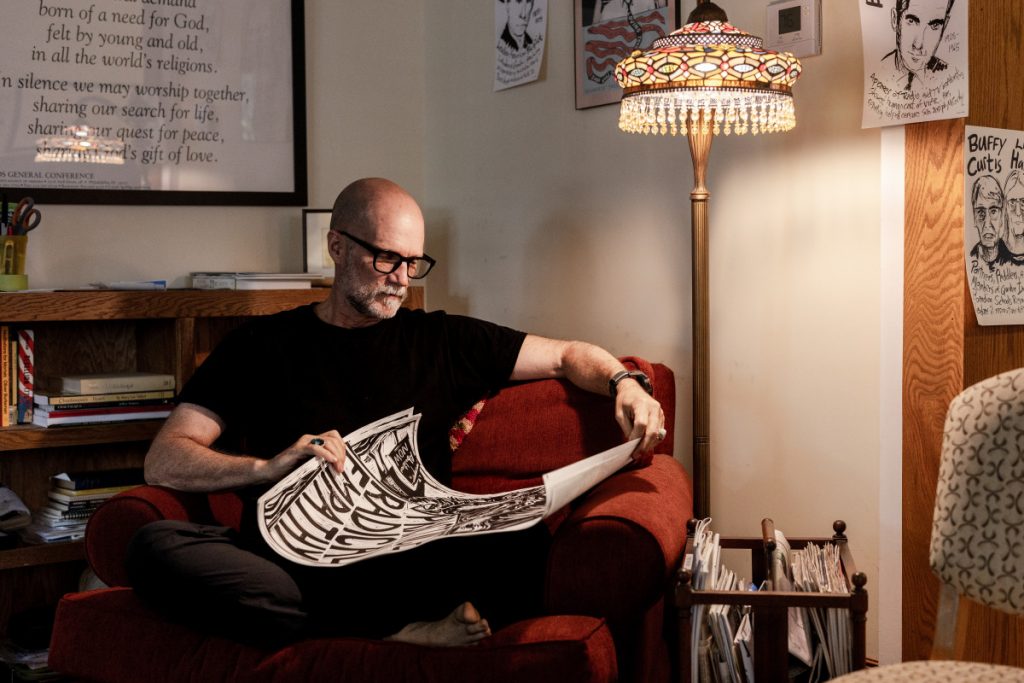
Drake views print graffiti artwork he created containing messages of perseverance and empathy.
In the 40 years since he began his artistic career, Todd initially saw his role as an artist as being a “fisherman” of sorts, in which he sought sales, exhibitions and fame. He later realized being an artist was more akin to being a “boat builder,” meaning his art supported him through his toughest trials and brought him closer to his family and community. Through this realization, Todd now stays local to care for his family while still dedicating himself to his artistic passions.
The Drake family raised a home that strongly encouraged art and creativity, in which Todd would take his wife, Robin Drake, and his two children, Shaw and Robin Reid Drake, to as many art museums as he could find during his children’s youth.
“I think art teaches nuance and teaches being comfortable with not knowing something immediately,” Todd said. “There’s all kinds of things that the brain is trained with when you’re viewing art, and so I think that has been infected in the whole family.”
It was this strong foundation of arts education that would help the Drake family forge their own paths and serve their local communities. After being inspired by his father and mother’s work with the Montagnard peoples in Vietnam in his childhood years, Shaw grew up to become an attorney focusing on immigration issues. He served as a lecturer of law for Stanford University’s International Human Rights and Conflict Resolution Clinic and worked as an attorney for the American Civil Liberties Union.
Growing up playing in Todd’s studio, Robin Reid would follow in their father’s footsteps to become an artist, poet, filmmaker and educator. Robin Reid has had works published by outlets such as Foglifter, DREGINALD, UnderStory Quarterly and Poetry Magazine and currently teaches in Chicago public schools with Young Chicago Authors and teaches a creative writing course at the School of the Art Institute of Chicago.
Outside of his artworks, Todd has also worked as a professor at various colleges in North Carolina. In 2019, he and his wife also managed the Bayard Rustin Residency, a Quaker residential community with the goal of empowering BIPOC citizens and working to promote a society of anti-racism and intersectional equality.
Now, the couple plans to settle down in Todd’s home state of North Carolina, where he will continue making art. Despite the occasional struggles of an artistic career, Todd remains determined to endure to speak on human rights through his art while always putting his family and community first.
“When my heart breaks about something, or I’m deeply worried about something, I have a venue to act on that,” Todd said. “I’m not rich, I’m not famous. I can’t instantly cause change, positive in the world, but I’m a single individual, and I can make something with my hands, and I can share that, and that process gives me hope and keeps me afloat. That keeps me going.”