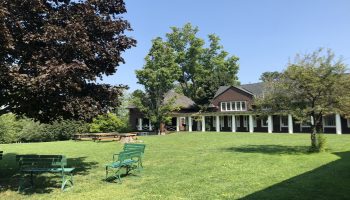
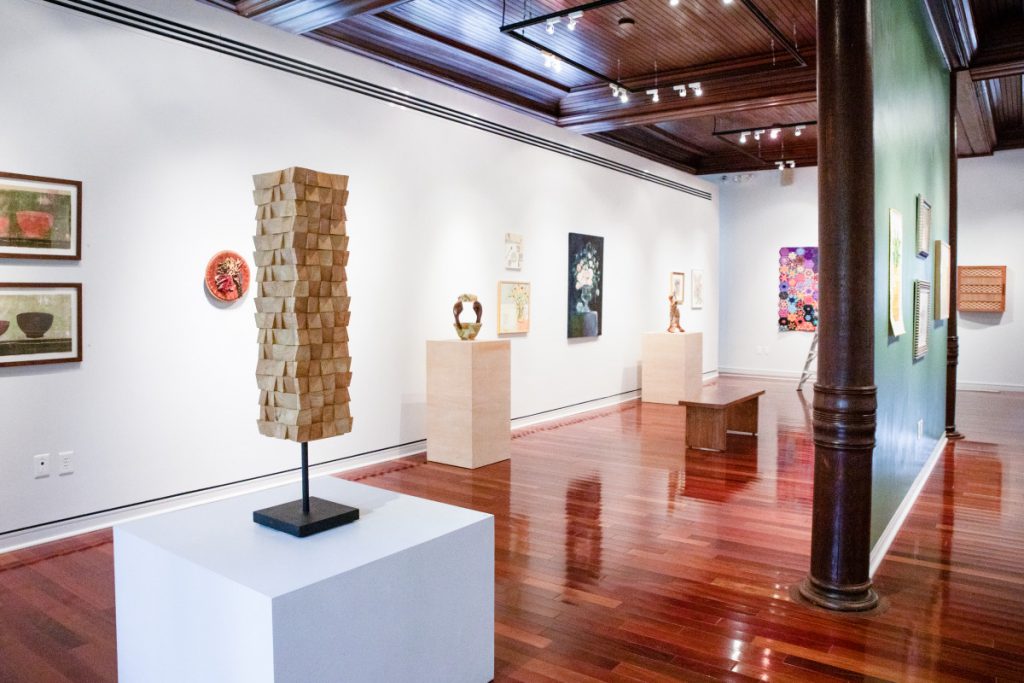
Pieces are displayed in the open members exhibition “Setting the Table” Tuesday in the First Floor Galleries and the Angela Fowler Memorial Gallery in Fowler-Kellogg Art Center.
JENELL TAYLOR
Staff Writer
From 3 to 5 p.m. today at Fowler-Kellogg Art Center, Chautauqua Visual Arts will hold the opening reception for its annual members’ exhibition, “Setting the Table.”
Through Aug. 26, visitors can view paintings, sculptures, fiber art pieces and glassworks from new and returning CVA members in the First Floor and Angela Fowler Memorial Galleries of Fowler-Kellogg.
The exhibition is presented in conjunction with Chautauqua Institution’s upcoming Week Eight theme of “The Future of Food: Climate, Technology and the Next Agricultural Revolution.”
This year, Associate Director of CVA Galleries Erika Diamond and Susan and John Turben Director of CVA Galleries Judy Barie were joined by Carnegie Mellon University interns Kinsey Gebhart and Elsie Marshall to sift through submissions and select the works for “Setting the Table.”
Some of the works on display reflect on the role of sustainability in the future of food production, while others “celebrate the everyday rituals of gathering, sharing meals and cultivating a connection to the natural world,” Gebhart and Marshall said in a joint statement for the exhibition.
“These artists explore where our food comes from, the hands that grow and prepare it and the traditions and memories that surround it,” the pair said in their exhibition statement.
Quilters Susan Davis-Gillis and Amit Taneja model sustainability through their works by striving to keep traditional crafting techniques alive.
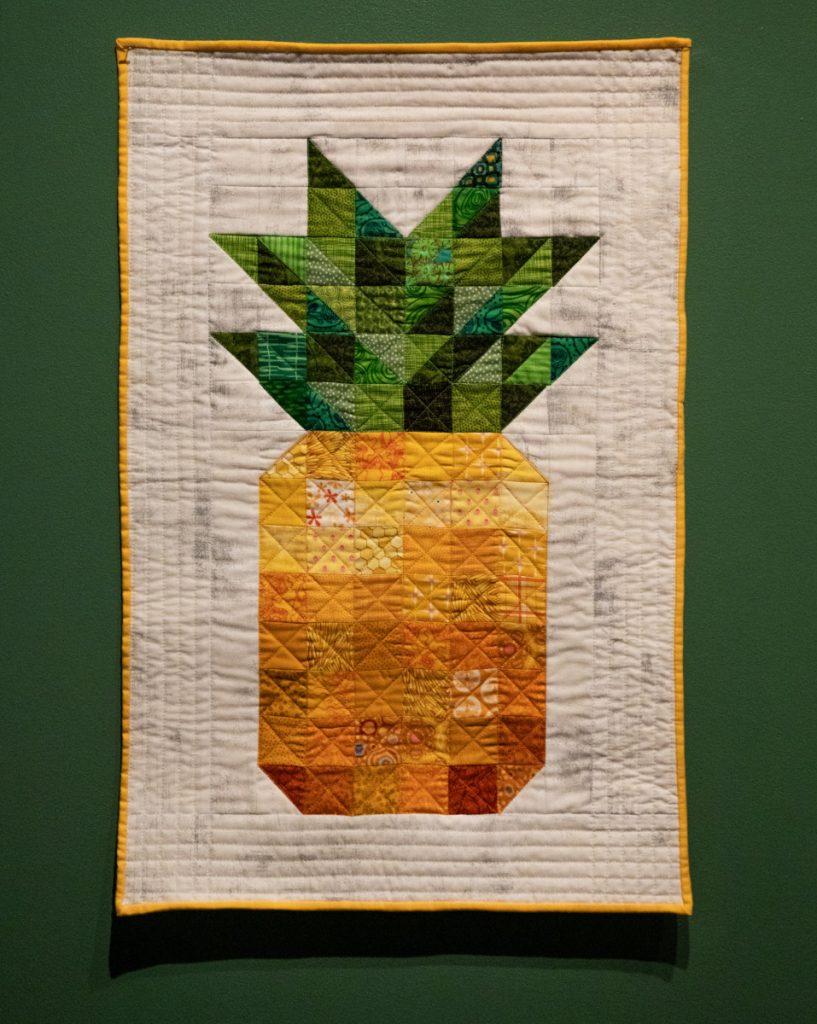
Gillis is an experienced seamstress and member of the UpcycleCHQ Maker Program. She created Nutmeg Hollow, a small business that specializes in upcycled materials and project kits that give new life to used materials.
For “Setting the Table,” Gillis created a quilt from upcycled fabric scraps. Focused on pineapple imagery, the quilt calls viewers to inspect the history of the “iconic symbol of hospitality,” Gillis said.
After developing an anaphylactic allergy to pineapple, Gillis set out to learn more about its history and symbolic roots.
“I’d traveled to Asia regularly for work over the decades, and pineapple was everywhere I went,” she said. “When I suddenly couldn’t eat it anymore, I found myself wanting to understand this food I’d taken for granted.”
Gillis said she was struck to learn that the spread of pineapple around the world was tied to a difficult history of colonial trade, exploitation and plantation labor. At the same time, however, she said the fruit came to symbolize hospitality, having been carved into doorways and printed onto teacups and tablecloths.
Gillis described a strange tension in its story and explained how pineapple is “a symbol of welcome with roots in a much less welcoming history.”
That contrast is what drew her to create the quilt shown in the exhibition. “I wanted to set the table, literally,” Gillis said. “For us to look at that fuller history honestly, and then ask what a more inclusive, thoughtful version of hospitality could look like moving forward.”
For Taneja, quilting allows free movement and exploration. In 2016, he began sewing his own bowties, which has since blossomed into the creation of his online quilting guild — now with more than 2,000 participants.
Taneja uses fabric to endow his quilts with interesting designs, “much like a painter would use paint to create a painting,” he explained.
In one of his quilted designs, Taneja said he made use of small pieces of fabric that typically go to waste to create circular dinner plate patterns.
“It was such a happy creation to see all the colors working together to create shape and texture,” he said.
For his quilt “Frida’s Dinner Party,” Taneja was interested in how repetitive fabric patterns arranged in a hexagonal shape could create a color story.
“That wall hanging uses 648 triangles meticulously arranged and sewn together to make the whole piece look like it’s one continuous piece of fabric,” he said.
Taneja said he believes that quilting is an art that can be touched and felt. “It connects the artist and the viewer, having the same experience of feeling the fabric in their hands,” he said.
Sculptor Passle Helminski creates sculpted knitted works to express her
creativity.
Her piece “Berry Me” is a mixed media sculpture of an oversized energy chew that Helminski said is “beyond chewing, because it is huggable.” She said energy chews fuel her practice, and “Berry Me” represents her sense of humor through its vibrant colors and blends of texture.
Her second submission is an oval sculpture covered in newspaper wearing a pair of glasses titled “Goodtimes Food Critic.” She said the idea came from looking at hard-boiled eggs that were resting on a newspaper clip that read “Goodtimes.”
As Helminski engaged in mileage, the amount of hands-on practice spent with a particular medium, she said the image kept floating around in her mind.
“After my mileage, I made a large egg and added ‘Goodtimes’ from the newspaper,” Helminski said. “I remember a critic gave me those glasses, which made me smile, so I added glasses to the egg.”
Helminski said her art is meant to bring her joy. For this exhibition, she said, “‘Berry Me’ will be on the table,” and “‘Goodtimes Food Critic’ will lend an eye in setting the table.”
For fused-glass artist Wendy Cohen, her focus is on practicality and utilitarian use. Over the course of the 18 years she has worked with glass, she has found beautiful objects with practical use intrigue her more than pieces meant solely for viewing.
Cohen makes dishware, jewelry, cheeseboards and other items that are meant to be used, worn and felt in daily life.
“I stick with mainly usable forms,” she said. “I always consider myself more of a craftsperson and not a true artist.” She said the enjoyment of utilization is what she aims for.
In “Setting the Table,” Cohen will present a fused glass sushi set because it deviates from the ordinary. She said it felt more exciting and rewarding for her than making a simple bowl or plate.
The set is made of several pieces, and the nice thing about groupings is that “each thing can be used for so many other things,” Cohen said.
Her process typically begins with entering her studio and looking around until a piece of glass catches her eye, which then primes her to create.
“I like the idea of being able to mix and match,” she said. “The glass that I had — it’s primarily orange and red — really spoke to me as a sushi set.”
Before glass, Cohen worked as a potter. She said clay has a mind of its own and taught her a valuable lesson that she’s since carried into her practice with glass.
“There really is a zen of clay,” she said. “One of the things you learn is patience — you learn to accept failure.”
Cohen said her practice brings her joy, and she looks forward to entering her studio each morning to see the product of her work inside the kiln. Part of the excitement is the unpredictable nature of glass as a medium, Cohen explained.
“That’s been a constant throughout all my work,” she said. “Some of them are ‘ahas,’ and some of them are exactly as I wanted them to be.”
Painter Sally Hootnick employs various techniques to visualize the atmosphere of loved ones gathering for a meal at dinnertime.
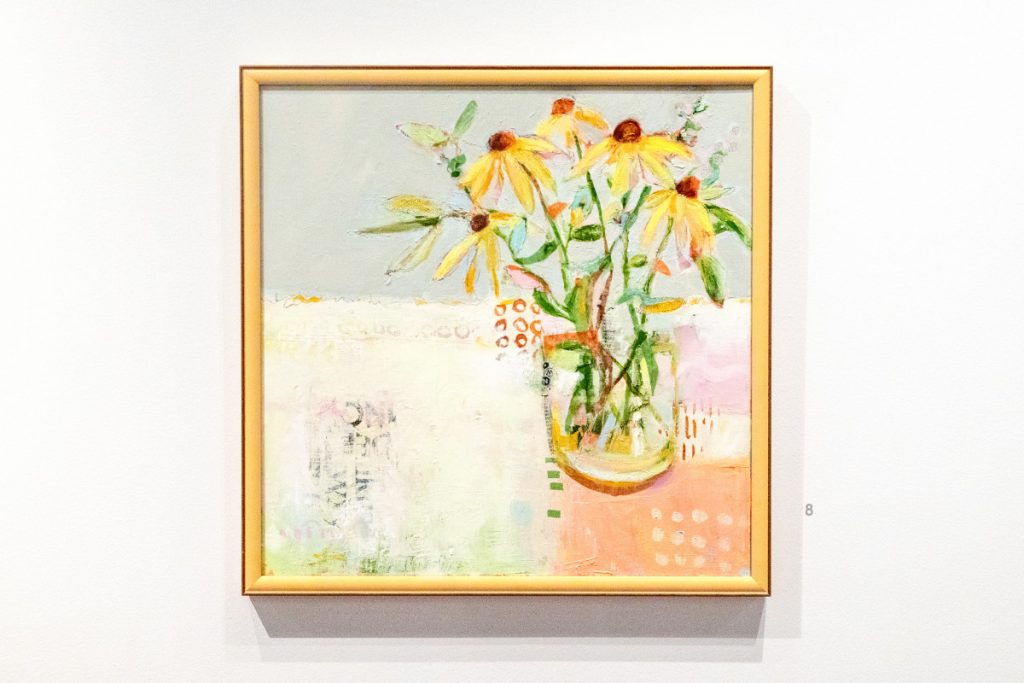
She used cold wax for her piece “Yellow Coneflowers,” which is a medium made from beeswax, resin and a solvent used for softening.
“It thickens the paint until it has almost the consistency of cake frosting,” Hootnick said. “Because it’s too thick for a traditional paintbrush, I apply much of it with silicone kitchen tools.”
In addition to oil paint, Hootnick also works in encaustic — an ancient painting technique that uses melted beeswax mixed with damar tree resin and colored pigments. Her piece “Yes Please” was done using this technique.
As she built up the painting’s surface, she said each layer was fused using a blowtorch. “I also embedded drawings of a tablescape into the wax and finished the piece with silver leaf,” Hootnick said.
As a longtime Chautauquan, Hootnick maintains a studio in the CVA Arts Quad each summer and pulls inspiration from the Institution’s scenery.
“I grew up in the area,” she said, “and the colors and textures I’ve known all my life here continue to find their way into my work.”
Like Cohen, wood artist Subagh Khalsa makes pieces rooted in functionality and practical use. For “Setting the Table,” Khalsa created hanging wall cabinets intended to slow the process of daily tasks, such as preparing a meal.
Khalsa said he wanted to create a space that reminds viewers to slow down and recognize that awareness and appreciation can be found in moments that appear mundane on the surface.
“I’d like my work to engage the consciousness of the user,” he said. “So that when you open it, you can’t just grab a big doorknob — you have to open it with a couple of fingers, you know?”
Khalsa’s process is a slow one, beginning with an amorphous mental image.
“My way of working is not necessarily very efficient,” he explained. “I start out with an idea, an image that has occurred to me of what something might look like, then I tend to create the defining line of the piece.”
When thinking about his wall cabinets, Khalsa investigated practical utilitarian objects and described how they are made for ease of use. From his perspective, these objects don’t typically offer an experience that engages the user’s mind.
“You pick up a spatula, and it has a handle on one end and a flat thing on the other end that sort of tells you to go ahead and use,” he said. “If the piece is designed, not as a mechanical object, but as an aesthetic object, it causes one to appreciate what they’re making.”
Above all, Khalsa believes humans are makers. He explained how much of humanity’s daily life is handled absentmindedly and without consideration.
“We started out making our entire physical culture — whether it be a spear, a stone ax, shelter, food or clothing,” Khlasa said. “So much of our life now is manufactured for us, and one of the few places that’s left where we are makers is food for many people.”
Over the span of his career, Khalsa has learned the importance of taking his time.
“My spiritual progress and my woodworking process have converged at this place where I’ve learned to never hurry,” he said. “That gives me tremendous joy at this time in my life.”
He said when he began his spiritual practice more than 50 years ago, that sentiment was already floating around. “So it’s not a matter of learning something,” he said. “It’s a matter of remembering.”
At one point, Khalsa built houses and boats, but over time, his works have become smaller in scale. Now, he sees slowing down as a gift.
Khalsa said he’s proud of his process, and reiterated the joy he feels in being “forced into slowness by an aging body.”
Marshall and Gebhart say “Setting the Table” is intended to speak to the fleeting moments in life that are “deeply intertwined with identity, memory and community.”
As Chautauquans make their way through the exhibition, they are encouraged to consider the many ways eating, preparing and sharing food can shape worldly perception and unite diverse perspectives.