
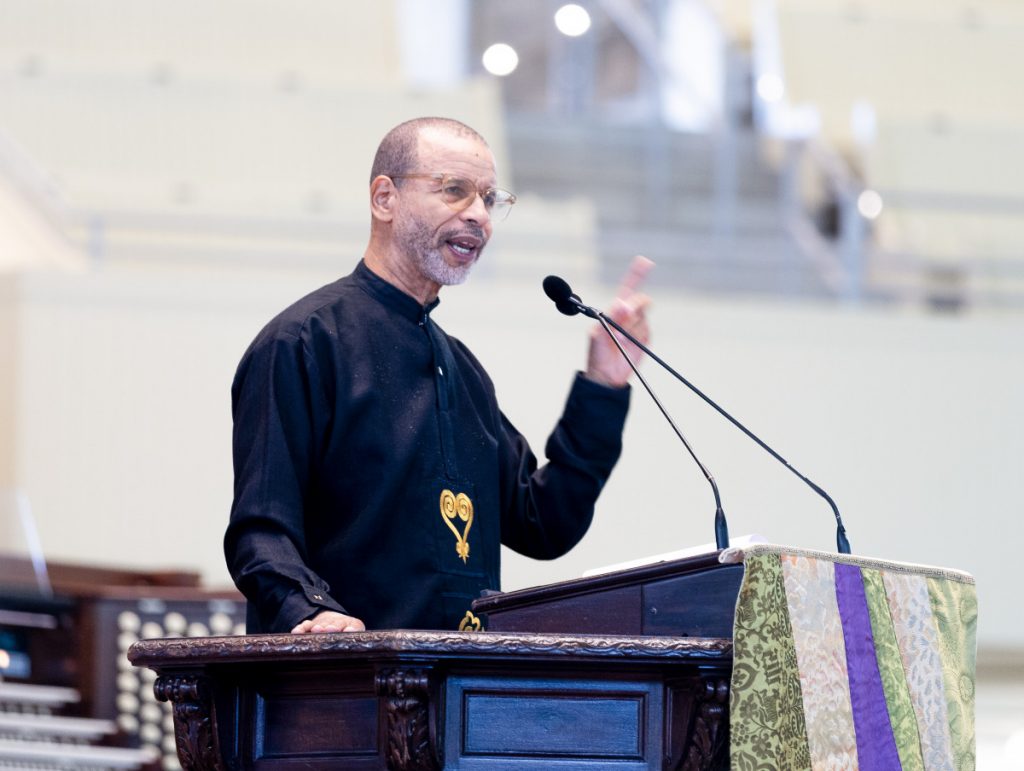
The Rev. Frank A. Thomas delivers a sermon about practicing loving kindness to foster peace during morning worship Sunday in the Amphitheater.
Column by Mary Lee Talbot
“We don’t want to see the end of Jerusalem, every empire, every nation dashed to the ground with not one stone standing. This is hard stuff, but if we want to be honest, brave and kind, we have to take the journey of self in God’s House of Visitation. We have to enter the story,” the Rev. Frank A. Thomas, Ph.D., told the congregation.
Thomas preached at the 9:15 a.m. Tuesday morning worship service in the Amphitheater. His sermon title was “The Journey of Self into God’s House of Visitation,” and the Scripture reading was Luke 19:41–46 from the Common English Bible. The influence for this sermon came from “Interview with James Baldwin on Henry James” by David Adams Leeming.
Jesus invites us into the House of God’s Invitation, but are we willing to go in, Thomas asked the congregation. “No, we would rather stay on the porch. Why? Because after seeing Jesus weep, his indictment of Jerusalem and words of judgment, I think I have heard enough. I’ll take a raincheck, Jesus.”
If we do accept the invitation to go in, the room Jesus will show us is the end of things, Thomas continued. “I don’t want to see the end of things. I don’t want to see my last sermon; I have been preaching since 1982. I don’t want a last time to kiss my wife or see my daughter’s or granddaughter’s faces. As the spiritual says, ‘I want to die easy when I die, to shout salvation as I fly.’”
Author Henry James was a great influence on James Baldwin. The two American writers shared an essential theme — the failure of Americans to see through to the reality of others. “Our assumptions prevent us from seeing and entering into the stories of others,” Thomas said.
He continued, “This is not true of all Americans, but it is a majority mindset, to not be able to see the reality of others. We search for receptacles to dump our troubles in, as Baldwin says, ‘Someone to pay our dues for us.’ Native Americans, African Americans, European immigrants, Jews, the Japanese, negative and vicious view of Black women as welfare queens. Particularly the trans community and, dare I say it, diversity, equity and inclusion. Let me say it again. Diversity, equity and inclusion. (We need) a multi-racial, multi-ethnic, multi-gender and a multi-religious America.” The congregation applauded loudly.
Americans refuse the invitation to enter the story of others. The most important aspect of the American personality is freedom and innocence, Thomas said, but “freedom is the end of innocence; with freedom, we have finally entered the picture.” As an example, he cited people in Minnesota, who reacted to the tactics of Immigration and Customs Enforcement by entering the story and saying no. There was more applause from the congregation.
In his play Joe Turner’s Come and Gone, August Wilson told the story of Herald, who was snatched by Joe Turner and put in a chain gang. In real life, Joe Turney was the brother of a governor of Tennessee, who snatched Black men off the roads and illegally impressed them into chain gangs for seven years. W. C. Handy, the father of the blues, wrote the song, “Joe Turner’s Come and Gone,” with the chorus “They tell me Joe Turner’s come and gone / They tell me Joe Turner’s come and gone / (Oh, Lordy) Got my man and gone / He come with forty links of chain / He come with forty links of chain / (Oh, Lordy) Got my man and gone.”
Thomas said, “Joe Turney went out like a hunter and rounded up 40 men at a time. Why did he think these Black men did not want to go home? Turney is innocent because he stands outside the story, without paying his dues, without entering the scene as a victim.”
He continued, “There is no way Turney can snatch people and break up families if he enters the story. You want to go home (Thomas said, referring to Turney), and this man wants to go home too, but he is not a man because you see him as a receptacle to dump garbage on. We look for scapegoats, like immigrants.”
Thomas told the congregation, “We have to take the journey of self. This is hard stuff. There is a general failure to touch, see and feel others.” On that journey, we enter the room in God’s House of Salvation and exchange innocence for freedom.
One of Thomas’ mentors said, “There is a little house inside of me. Windows not made of glass, doors through which no one can pass. I go there, just me and my God, and my God introduces me to me. Open doors that I might see this is the house of God’s visitation, the actor showing you the end in the house of visitation.” Thomas said, “There is left only mirrors. There are no windows for you to look out and see, to search for; there is only you and God.”
It is easier to run than stay in that room with all the stench you brought in with you, but this is what happens when you end your innocence, Thomas said. “When we face up to ourselves, when we tell the truth about ourselves, we vomit up the truth. If you don’t tell the truth about yourself or if you don’t make the journey, then you fail to see through to the reality of others.”
He continued, “This is loving kindness: to face the horrors of the past, to be honest, brave and kind to yourself, to be honest, brave and kind to others. Otherwise, we will be dashed to the ground with no stone on top of another.”
Thomas concluded by praying “A Prayer of Loving Kindness” for immigrants, particularly those with brown skin, then for LGBTQ+ people, then for transgender people. “This is the Word of God for the people of God.” The congregation stood and applauded.
The Rt. Rev. Eugene Taylor Sutton, senior pastor of Chautauqua, presided. The Rev. Mary Kitchen, a retired Presbyterian minister and one of the fiddle players on Bestor Plaza in the afternoons, read the Scripture. Owen Reyda, organ scholar, played Prelude in D Minor, Op. 109, No.1, by Camille Saint-Saëns, on the Massey Memorial Organ. The Motet Choir, under the direction of Sonya Subbayya Sutton, interim director of Sacred Music, sang “At the Still Point of the Universe,” by Al Fedak, for the morning anthem. Reyda accompanied the choir on the Massey Organ. There was no postlude due to time constraints. Support for this week’s chaplaincy and preaching is provided by The Rev. Leonard J. Ebel Chaplaincy.
Morning worship services for Thursday, Friday
The 9:15 a.m. Thursday worship service in the Hall of Philosophy will include a conversation between this week’s chaplain, the Rev. Frank A. Thomas, and Chautauqua’s senior pastor, the Rt. Rev. Eugene Taylor Sutton. Audrianna Hughes, a Chautauqua Opera Company young artist who is at Chautauqua with the Denyce Graves Foundation Generational Voices program, is the soloist, and she will sing two spirituals, both in settings by 20th-century African American women: “My Soul’s Been Anchored in the Lord” by Florence Price and “He’s Got the Whole World in His Hands” by Margaret Bonds. The prelude music will be Bonds’ piano work, “Troubled Waters.”
The Rev. Julie Wilson-Black, pastor of the Fairlington Presbyterian Church in Arlington, Virginia, will be the preacher at the 9:15 a.m. Friday ecumenical communion service. The service will feature music for congregation and choir. Music by G.F. Telemann for oboe, violin and piano with musicians Rebecca Scarnati, Maura Giannini and Willie LaFavor. The prelude will be “Metamorphosis” by Philip Glass, played by Interim Director for Sacred Music Sonya Subbayya Sutton. The Motet Choir will sing settings of “Gift of Finest Wheat” and “Taste and See,” and lead the congregation in songs from around the world.