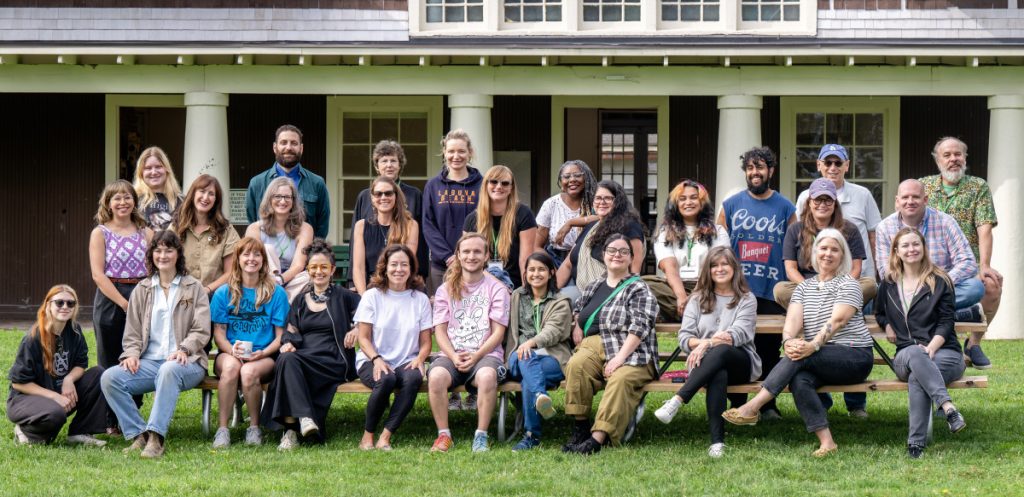
The 2026 Chautauqua Visual Arts School of Art two-week artists-in-residence.
JENELL TAYLOR
Staff Writer
Throughout the past two weeks, Chautauqua Visual Arts has supported the School of Art’s two-week artists-in-residence as they engaged in deep practice and personalized creative exploration to create the works presented in this season’s Open Studios.
From 4 to 5 p.m. today in the North and South wing studios of the CVA Arts Quad, guests can see the physical fruit of the residents’ labor as they view their original artworks, speak with them about their craft and visit their workspaces.
The two-week residency is geared toward established artists seeking time and space away from distractions to fully dedicate their attention to the development of their practice. The program is self-led, offering artists unrestricted studio access and one-on-one feedback from leading arts professionals.
A few artists-in-residence spoke about their work and experience in the program, highlighting the benefit of independent study, access to SOA facilities, faculty collaboration and the friendships that have blossomed as a result of the residency.
According to painter Lee Ann Heltzel, Open Studios promises to be a very special day for both artists and guests alike. She said this season’s residents are remarkably diverse in background and practice, having brought fiber artists, photographers, multimedia artists, ceramists and more to the Institution grounds.
“Each of us has arrived here with a distinct creative vision,” she said.
Open Studios will provide Chautauquans with a “rare chance to step inside of those worlds, meet the people behind the work and witness the creative process in its most honest and unfinished form,” Heltzel said.
Her ongoing work, a series of paintings called “Presence,” is influenced by the deep cultural history of the Institution. As the creator of MetaArt and Ocular Meditation — a contemplative practice in which viewers use sustained, eyes-open visual attention to enter states of expanded awareness — Heltzel said her practice sits at a unique intersection.
“The paintings I create are received through deep meditative channeling rather than conventional design,” she explained. “They function as portals rather than objects.”
Heltzel hopes Chautauquans will take the opportunity to visit the studios and experience firsthand the palpable energy of “seeing art in the space where it was made.”
Painter Gillian Stoneburner said the residency has given her the chance to meet other dedicated artists and revel in their shared passions.
“Oftentimes, we artists are isolated in our own thoughts — and worlds — and opportunities to discuss, converse and share [are] sometimes a rare opportunity,” Stoneburner said.
Her paintings merge abstract and representational forms by investigation of the gray area between real and imagined worlds — studying “control, decontrol, order and non-order,” she explained. In childhood, Stoneburner said she would often hang upside-down to “see what the world would look like if the sky were the floor.” Perspectives that were once recognizable became skewed, she said, “offering familiarity with an air
of unsettlement.”
Stoneburner’s pieces place an emphasis on “the play of deformation, perspective, palette and ratios,” and have steered her goals toward “reimagining the physical world and analyzing landscapes and its extractive translation to painting.”
For abstract painter Sarah Hessinger, “the observation of atmospheric phenomena” informs her work.
“My art is about color, light and how they work together,” she said. “Through the physical act of folding canvas, hope and ritual are embedded in the canvas.”
As a self-taught artist working remotely in the coastal town of Hāna, Hawaii, Hessinger said she “relies on community engagement to grow [her] practice.” As her time in the program comes to a close, she said she recognizes the residency as a significant stepping stone in her creative journey.
“Being a part of one of the oldest visual arts programs in America is a chance to experience an environment rich in history and creative energy — a living archive of artistic presence,” she said.
Maggie Meiners is a multi-disciplinary artist whose work draws from cultural artifacts, domestic rituals and art history. Through her use of photography, film and mixed media, she explores the connection between personal memory and collective memory.
“Growing up amid magazines, media and family tradition, I became acutely attuned to how visual narratives shape identity — particularly for women,” Meiners said. Her work acknowledges this and focuses on how “images influence notions of gender, selfhood and societal expectations,” she said.
During her time in the residency, she has been focused on a long-term project called “Beast of Burden,” which involves weaving, needlepoint, photographs and short films.
“Through denim weavings, photographically collaged quilts and woven to-do lists, I translate personal narratives into tangible form,” Meiners said.
Her work centers on three ideas: deconstructing perception and media, reshaping identity within social norms and reconstructing cultural icons to reveal truth and contradiction. Meiners said by way of deconstruction and reconstruction, she “exposes the glittering yet unsettling surfaces of consumer culture and mines personal memories to create vibrant, frenetic compositions that blend tenderness with critique.”
Painter Beth Bailey explores similar concepts of identity; however, her work details her lived experience as a mother navigating postpartum mental health struggles. She said the residency has given her the space to be alone with her thoughts and to truly focus on her craft.
“If I get four hours of studio time in one week at home, I’m thrilled,” she said. “To be constantly focused in the studio has been a gift because I really feel like my work is in a place where it exists in another realm or in the back of my head somewhere.”
As mother to an 8-year-old and a 5-year-old, Bailey said she felt the isolation and challenges that accompany caring for young children, noting the sleep deprivation and intense loneliness many mothers face.
She found gardening gave her a reprieve that has since found its way into her paintings.
“In my work, I’m painting me in my gardens,” she said.
Bailey described the lack of support for mothers dealing with postpartum mental health struggles and how vital it is to the entire family unit that these challenges are not dismissed.
“We were designed to raise our families in community and in villages,” she explained. “There needs to be an open dialogue and cultural shift so that everyone can look in their little corner of their community and see what they can do to contribute.”
Bailey’s work, which features paintings of landscapes, gardens and floral imagery, is her way of unraveling her mind in search of healing.
“My work shows my home gardens — and often, there will be a children’s swing set in the background,” she said. “I’m working on another landscape where I’m laying in the grass looking up at multiple suns — just honestly in a dissociative state, which I was in last month.”
Bailey hopes her work will allow for productive conversations to take root and bloom into active support and understanding of postpartum mental illness.
“I always wanted to be a mother and I have so much privilege and so much support — it’s my dream and I tell my children that all the time,” she said.
Bailey described how, although her struggles have been painful and confusing, she still finds joy in motherhood and expresses that duality within her pieces.
“My paintings are colorful and bright and show joy,” she said. “But then there’s these little snippets of this figure, you know — or the empty swing set.”
CVA’s Open Studios gives Chautauquans an opportunity to view a multitude of artworks, but also offers the unique experience of speaking with the residents, hearing their stories and being a part of the long-standing community that has made creating so powerful and special for artists and viewers alike.