Cody Englander
Staff Writer
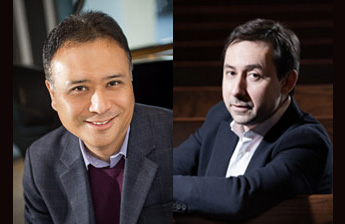
Jon Nakamatsu and Alexander Kobrin have been colleagues for about a decade, and both are gold medal recipients in the Van Cliburn international piano competition. In the ten years they’ve worked together, today is the first time they will share a performance.
“I first heard him play with the Rochester Philharmonic and he played Mozart. I thought it was really beautiful, but I didn’t have the opportunity to meet him until Chautauqua put us together,” Nakamatsu said about Kobrin.
At 4 p.m. today in Elizabeth S. Lenna Hall, Nakamatsu will perform a piano recital including a Bach-Busoni chorale prelude and Beethoven’s Pastorale Sonata, Op. 28. Kobrin will then join Nakamatsu to play the Sonata for Two Pianos in F minor by Johannes Brahms.
Nakamatsu is a classical pianist who is known for a career of recording, education, arts administration and public speaking. Ahead of his performance, he reflected on the background of the pieces he will perform during today’s recital.
“The program begins with a very short transcription of an organ chorale by Johann Sebastian Bach,” Nakamatsu explained. “The composer, (Ferruccio) Busoni, later transcribed for solo piano. It was a piece originally written for the organ. I think it’s a wonderful, quiet piece to
a program.”
The recital then will transition into a performance of Beethoven’s Pastoral Sonata, which Nakamatsu notes as one of the most lyrical and serene works of the 32 piano sonatas.
“It evokes a sort of peaceful bucolic and wonderful atmosphere, especially in the last movement,” Nakamatsu said.
The final crescendo of the afternoon is Sonata for Two Pianos in F minor by Johannes Brahms, in which Kobrin will play the second piano.
The Heintzelman Family Artistic Advisor for the Chautauqua Piano Program, Kobrin has earned the moniker of the “Van Cliburn of today” by the BBC. Kobrin has taken the top prize in many international piano competitions and is also a professor at Eastman School of Music.
Ahead of the performance, Nakamatsu reflected on the power of classical music in his perspective as a performer.
“It’s less important you know the rules, than it is that you soak up something you respond to in your own private way,” he said. “… No matter what your level of familiarity, there is something that can be gleaned, joyed and inspired by being there.”