NORA SMITH
Staff Writer
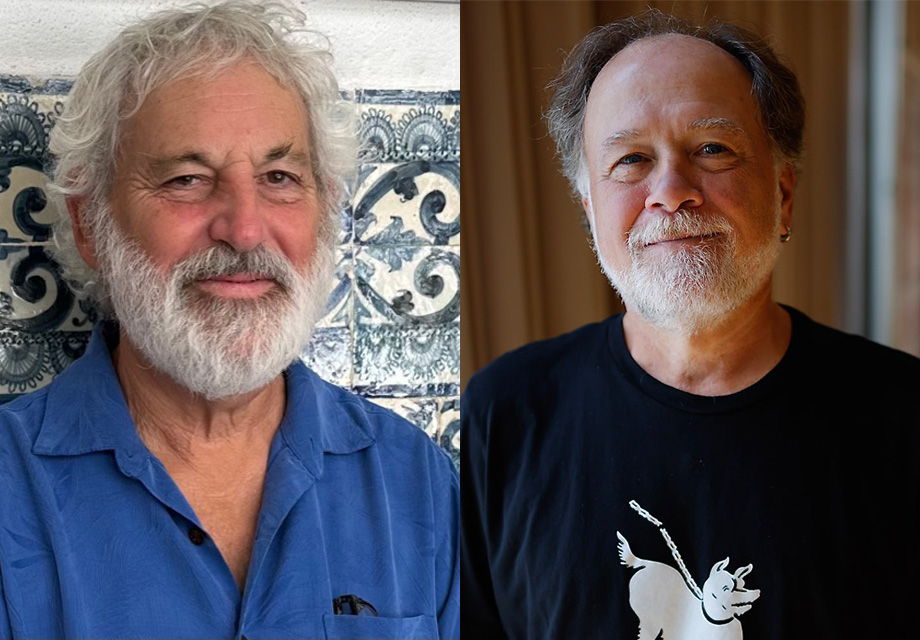
Poet and Professor of English at East Carolina University John Hoppenthaler and Roy Hoffman, novelist, journalist and faculty member of Naslund-Mann Graduate School of Writing in Louisville, Kentucky, return to Chautauqua for Week Six, “America at 250: In Partnership with The Colonial Williamsburg Foundation.”
“Each of their work speaks to American experiences at different levels …” Interim Michael I. Rudell Director of Literary Arts Stephine Hunt said. “It’s the reading itself that I think is going to bring it out for us.”
Hunt said she is excited to hear Hoppenthaler and Hoffman’s readings together, and Chautauquans are in for a treat.
“John’s work in particular — he’s done some incredible work with writers like Toni Morrison and built some incredible friendships that just cross different experiences of the American experience,” Hunt said. “His poetry reflects that in a lot of ways, so I’m very excited to have him here to share that work.”
As Hoppenthaler returns to the Chautauqua Writers’ Center for the fifth time, he said he is pleased several of his workshop participants from over the years have now published poems and even books.
Reflecting on Chautauqua’s history, the important historical figures who have graced the grounds and his own past experiences with the Writers’ Center, Hoppenthaler said, “I just love being part of [Chautauqua’s] history.”
Hoppenthaler said the state of poetry today is the strongest it’s ever been, and despite constantly being under scrutiny, it remains resilient.
“When we talk about politics, … even if you’re writing a poem that isn’t political per se, you’re a political body writing in a political space, and even the decision to write a poem where you know 90% of America thinks that’s a worthless thing, is a political act,” Hoppenthaler said.
Hoppenthaler said particularly in cultural terms, poetry is the most appreciated it’s ever been. He added that the barriers of who can be a poet and a reader have been broken down.
“There’s space for queer poets, Black poets and mixed-race poets,” Hoppenthaler said. “You name it, we’ve got it, and that to me is great. That’s democracy. That’s this week’s theme, that’s what democracy looks like.”
Hoppenthaler plans to read some of his more historical poems at the Free Faculty Reading at 3:30 p.m. Sunday in the Hall of Philosophy.
“I’ll try to mix in some of the older [poems] and some of the newer [poems], and that’s what I usually do,” Hoppenthaler said. “I try to create a narrative arc whenever I give a reading.”
In addition to crafting a smooth narrative when selecting poems to read, Hoppenthaler also pays attention to how poems sound and feel in his mouth and body. He especially honors how poetry originally came from an oral tradition, and although he acknowledges reading as a performance, Hoppenthaler views it less as performative poetry and more as connecting with an audience and meeting them where they are.
“I really want that transition from poem to poem to matter, and it all be a part of a piece …” Hoppenthaler said. “I’m much more interested in the way poetry works on the page and on stage.”
Hoppenthaler’s flexible workshop, titled “Writing and Revising the Sensuous Poem,” will run from 8:30 to 10:30 a.m., Monday, Wednesday and Friday from Aug. 3 to Aug. 7 in the Alumni Hall Poetry Room with an enrollment fee of $145 and a maximum of 15 participants.
“For me, ‘sensuous’ is a writer engaging the readers’ senses through attention to the use of imagery, auditory texture, the music of the poem — and I’m not talking about meter or necessarily end rhyme, I’m talking about other things that go into creating a musical texture,” Hoppenthaler said.
Throughout his workshop, Hoppenthaler said he plans to focus on how poets draft and revise poems toward sensuousness, which in turn generates an intimacy between the poet and reader.
“… Thinking about what a poem looks like on the page, where you’re breaking lines and why you’re breaking lines, seeing a poem itself as a body that’s throbbing and alive,” Hoppenthaler said, is what he hopes to get across during his workshop.
In conversation with Hoppenthaler’s work, Hunt said Hoffman’s work mainly focuses on the American South while working within and challenging the common stories people know and, in turn, complicating those stories beautifully.
“He’s been hoping to come back for the past few years, and I was just delighted to be able to offer him the opportunity to join us at Chautauqua again,” Hunt said.
As Hoffman returns to Chautauqua Writers’ Center for the fourth summer, he said he himself is delighted, and with each visit comes new discoveries and experiences — especially when working with writers at the Writers’ Center.
“It’s inspiring for me to be immersed in a community dedicated to ideas and the arts, and, as a teacher, to be with writing students of all levels nurtured by that, too,” Hoffman said.
Hoffman, a journalist for two decades before he turned to novels, still uses some strategies he used throughout his career in journalism, such as “to hear other people’s stories, to develop and embrace the philosophy that everyone has a story to tell,” Hoffman said.
Hoffman said it is important in writing, whether fiction or creative non-fiction, to conduct “body research” and venture into or experience what one may be writing about so that one can better tell the story.
When writing his most recent novel, The Promise of the Pelican: A Novel, in addition to conducting in-depth research, Hoffman traveled to Honduras to collect images, experiences, stories and scenes firsthand.
Because Hoffman’s workshop class will consist of both nonfiction and fiction writers, he plans to read both genres of his work during the free faculty reading at 3:30 p.m. Sunday in the Hall of Philosophy.
Growing up, Hoffman was surrounded by a variety of cultures. His grandparents were immigrant Jews from Eastern Europe who settled in the Deep South, which led Hoffman to write across cultures and focus on immigration experiences.
During his journalism career, he wrote about Holocaust survivors, World War II veterans and participants in the Civil Rights Movement.
“To tell their stories continued my interest in, as I call my workshop, ‘All Our Voices,’” Hoffman said. “There is a lot of question[ing] now about what’s called ‘appropriation,’ you know? Going outside of your own experiences to tell somebody else’s story. So, I think we have to be very sensitive to those concerns. We have to be very careful about how we tell those stories.”
Hoffman said that people can exhaust their own stories, and telling others’ stories is important.
“Through interviewing, through listening, through readings and research and through empathy, we can — as best possible — follow the dictate of Atticus in To Kill a Mockingbird when he tells young Scout, ‘You have to learn to walk in another person’s shoes,’” Hoffman said.
Hoffman’s flexible workshop, titled “All Our Voices,” will run from 3:15 to 5:15 p.m. Monday, Wednesday and Friday from Aug. 3 to Aug. 7 in the Alumni Hall Prose Room with an enrollment fee of $145 and a maximum of 15 participants.
Hoffman wrote his workshop “emphasizes that we celebrate our diverse voices as writers. Whatever your origins, age, background — fledgling writer or greatly experienced — we welcome your words on the page, and in a non-competitive environment, celebrate your creativity …”
Further, Hoffman said he hopes to nourish a space in which participants feel free to create without fear and specifically use the encouragement of prompts.
“That’s what’s great about an art institution and a community like Chautauqua is that we’re surrounded by people who are making objects, aesthetic objects, right?” Hoffman said.
Although these “aesthetic objects” vary from physical objects like pottery, sculptures, sheets of music to performances like dance or written work on a page, Hoffman said it’s about celebrating the fact that someone who might’ve come in with nothing leaves having created something.
“In a world where there’s a lot of destruction and disintegration and ruination, people who are creating things, or the people who aren’t in classes but are significantly there as audiences …” Hoffman said. “My words only come alive to the person who hears them and makes an image in their mind or reads them on the page and makes it real. So that’s important too, it’s that dialogue. It’s healthy, it’s heightening, it’s revitalizing.”