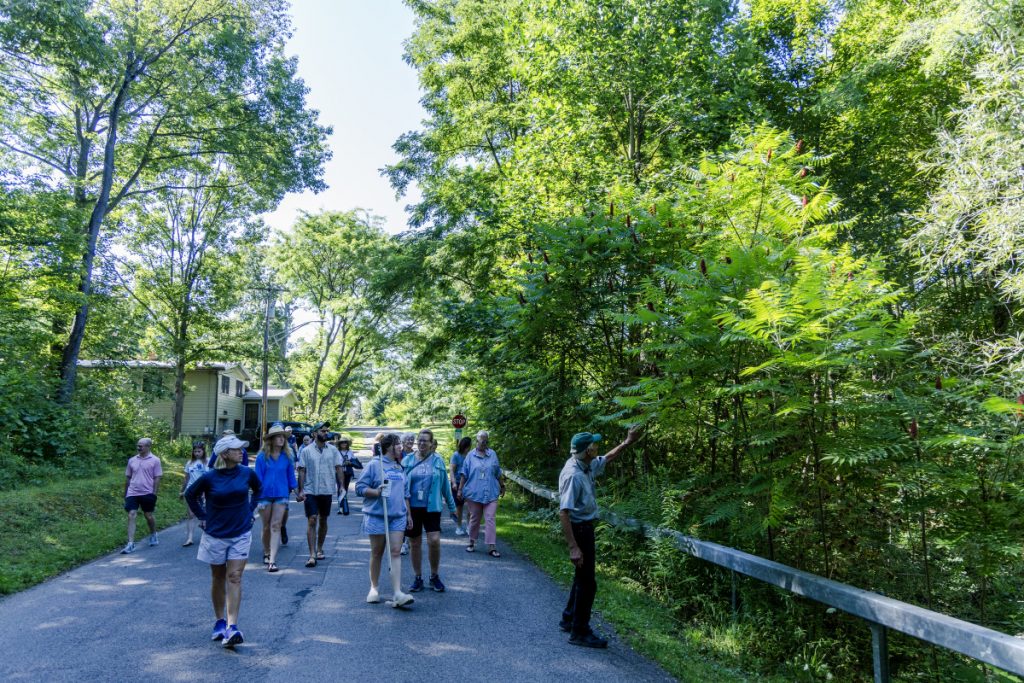
Bird, Tree & Garden Club naturalist, forester and purple martin expert Jack Gulvin leads Chautauquans Friday on one of his weekly nature walks.
JENNA OUTCALT
Staff Writer
To be accredited as a Level I Arboretum, an area needs at least 25 different identified species of trees and woody plants. Chautauqua Institution’s original arboretum, established more than a century ago, easily passed that threshold once each species was identified and labeled. To become a Level II Arboretum, however, the Institution needed to reach 100 different species.
Betsy Burgeson, supervisor of Gardens and Landscapes, said she didn’t think they’d be able to make it to Level II until the Bird, Tree & Garden Club stepped in.
“They marked and labeled almost every tree we have throughout the grounds now,” Burgeson said. “And because of that, we were able to get the Level II accreditation.”
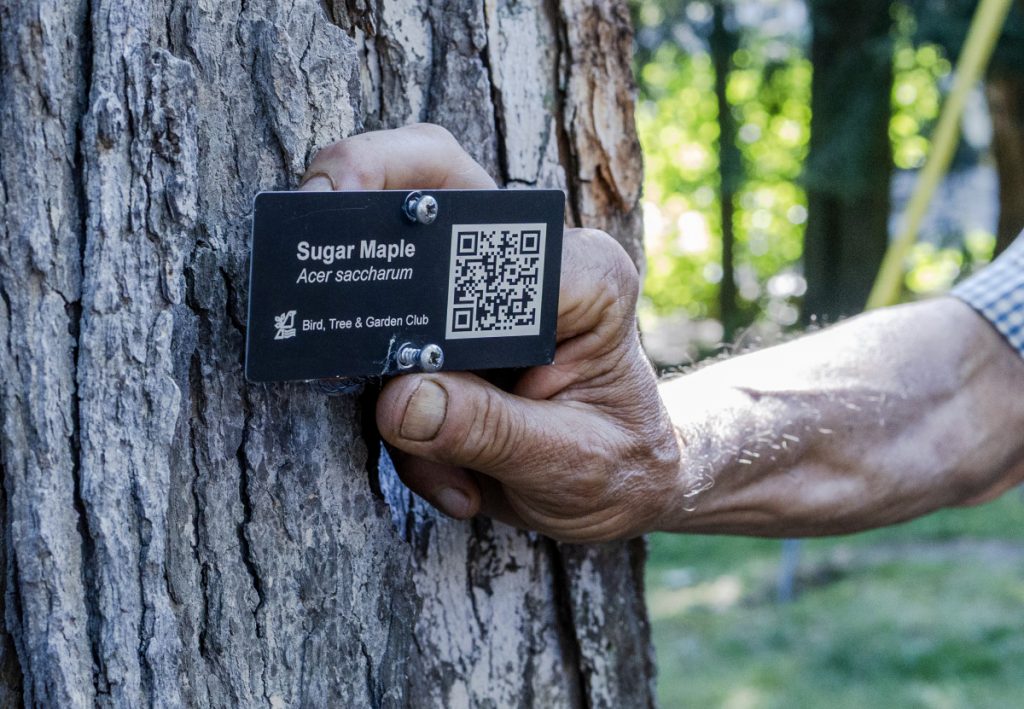
Trees across the grounds have been labeled by the club, contributing to Chautauqua Institution’s classification as an Level II Arboretum.
Burgeson noted the QR code labels on trees, which lead Chautauquans to information about each tree’s species and history. The labeling project started in the original arboretum and has expanded throughout the entire Institution. Burgeson said the labels help people “really notice the trees.”
ArbNet, an international arboretum accreditor, certified the original arboretum as Level I in 2019. When the arboretum was up for accreditation renewal in 2024, the BTG applied to make the entire grounds — more than 200 acres — an official arboretum. In 2029, Burgeson said she hopes to shoot for Level III.
“Until we did this ArbNet stuff, I had no idea all the resources that are out there,” Burgeson said.
According to Burgeson, a higher accreditation level “opens up doors to different grants” and collaboration with other arboretums.
“Instead of reinventing the wheel, [we would] be able to see all the different things that different towns and cities have done,” she said.
A Level II Arboretum also needs to have enhanced public and educational programs. The BTG hosts curated tree tours and weekly environmental programs like Jack’s Nature Walk, Garden Talks, “Gloves on Gardening” sessions and weekly lectures. The BTG opens the arboretum to local and regional schools for educational programs throughout the year, and also has an app, ExploreCHQ, which contains information about the grounds.
Burgeson said the educational programs help people notice when trees are diseased or need trimming to stay healthy.
“I want to go out there and make sure people become aware of that stuff, and then it helps me because I have 5,000 eyeballs out there,” she said.
Lynda Acker, a former board member of the BTG, emphasized how important it is for people to know about their surroundings.
“It helps them to better understand their world, which leads to appreciation, which leads to protection,” she said. “And we’re in a place right now where protection is tantamount.”
To become a Level III Arboretum, Chautauqua needs a designated curator on staff and at least 500 different species of trees and woody plants labeled. Burgeson said she believes the grounds already have or are close to 500 labeled species, and she hopes a curator could join the staff to maintain the arboretum, especially in monitoring “where the trees are age-wise” and with intense winds and weather posing threats.
“We’ve had a lot of emergency tree issues come up, and it’s not something that I see going away,”
Burgeson said.
The BTG and grounds staff already fulfill the other requirements to advance to Level III, according to Burgeson.
“Tree science, planting, conservation activities, we’re already doing a lot of these, and we have policies around trees already,” she said, “so it comes down to staffing.”
She noted ongoing projects such as the 150 trees campaign for the 150th anniversary of the Institution that started two years ago. Though the campaign is ongoing, Burgeson said it is moving at a strong pace.
“We’re pretty darn close to that 150 mark,” she said.
Jennifer Francois, president of the BTG, said trees are one of the club’s most critical focuses because of their importance beyond being a physical resource.
“There’s so much evidence now about the overall health value of just having trees in your environment,” Francois said.
Burgeson said the BTG provides much-needed support with outreach and community education about the native flora and fauna of the Institution’s grounds; she called the organization “the voices for the trees.”
According to Burgeson, when people see arboreal care and education, they can pass that knowledge along.
“People come through, and they see us doing it, and then they learn why we’re doing it, then they do it at their own house and then they take that to their other houses and tell their neighbors,” Burgeson said. “… The impactful networking would be the best part of it.”