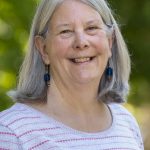

The Rev. Robert W. Henderson delivers his sermon during morning worship Sunday in the Amphitheater.
Mary Lee Talbot
Staff Writer
There are people who believe that perfection can be achieved in life. In bowling, a perfect game can be achieved. “But life is less like bowling and more like golf; you can have your best round but not perfection. You will have good days and seasons and bad days and seasons. So what do we do with Jesus telling us to be perfect?” the Rev. Robert Henderson said.
Henderson preached at the 9:15 a.m. Monday morning worship service in the Amphitheater. His sermon title was “Perfection?” The scripture reading was Matthew 5: 43–48.
The perfection Jesus talked about could be considered aspirational or inspirational. Jesus said not to resist evil but instead to turn the other cheek. “Go tell that in Gaza or to someone in a bad marriage,” Henderson said. Don’t worry about tomorrow, don’t just love your neighbor, but also your enemy. “Really?” Henderson asked.
Henderson noted that the Greek word for perfection used in Matthew 5: 48 is telios, meaning mature, whole or complete. “When Jesus said ‘I am the way, truth and life,’ he was offering an invitation to a full life, not perfection.”
In the game of golf, there are water hazards and sand traps, and when a golfer hits into one, they have to think about how to get back on course. “What is worse,” Henderson said, “is hitting the ball outside the white stakes. You have to take a penalty and start over. If you are smart, you will realign your feet to point in a new direction, change your grip or consult a professional.”
By making the change, you can find a new way to navigate life, Henderson told the congregation. By doing an honest assessment, looking at long-held assumptions about race, religion and economics, you can see some hazards and realize you need new teachings.
Henderson’s congregation, Covenant Presbyterian in Charlotte, North Carolina, “would be willing to entertain a new teaching and to hear a new voice and to see if it might help us walk in the way of life.”
The congregation asked Ann Morris to speak about her work with what she calls her linked descendents, African Americans whose parents and grandparents worked on Morris’ family farm in Virginia.
They spoke of their memories of the same place and of many of the same people. “They spoke from very different perspectives. And it was uncomfortable and significant. It was stressful and important,” Henderson said.
Next they invited the Rev. Mitri Raheb, who for three decades was the pastor of Christmas Lutheran Church in Bethlehem. He and his people lived their whole lives under military occupation. “When he spoke to our buttoned-down congregation, much of what he said was new for many in our congregation. And it was difficult and made a few people mad,” Henderson said. “They sent emails, and you know how that goes.”
Then the congregation invited Jemar Tisby, an evangelical working to challenge the assumptions of white Christian nationalism. His book, The Color of Compromise: The Truth about the American Church’s Complicity in Racism, “is compelling and speaks clearly about the compromises that Christian faith has made in our own country. He challenged our Southern, largely white, largely wealthy congregation to see things right and anew and to become more complete, maybe even perfect, as God is perfect,” Henderson said.
He admitted that there was much progress to be made. “Whether you are a member of a Christian congregation, a temple, a synagogue, a mosque, this teaching from Jesus is relevant because it’s a teaching about growing. It’s about becoming the people God desires us to be. It’s an admonition to stay on track and complete the mission.”
Henderson asked the congregation what life’s purpose is. The answer, he said, “is to look at this world and to see its brokenness and to let that brokenness break our hearts as well … not to become a victim, but to resist becoming the evil we see in another. And that’s an ethic that our world could really use right now.”
He continued, “God has concern for the lilies of the field and for us. This is what we are for. To remember it and to choose it is to be perfect as God is perfect. All thanks be to God.”
The Rt. Rev. Eugene Taylor Sutton, senior pastor for Chautauqua, presided. Sally Goss, active in the Episcopal Diocese of Maryland, read the scripture. Sonya Subbayya Sutton, interim director of Sacred Music, played “In Christ There is No East or West,” by Dale Wood and “I Want Jesus to Walk with Me,” by David Cherwein for the prelude on the Massey Memorial Organ. The Motet Choir, under the direction of Sutton, sang “Gloria Tibi from ‘Mass’,” by Leonard Bernstein. Owen Reyda, organ scholar, and Lexi Kunz, percussionist with the Music School Festival Orchestra, provided accompaniment. Reyda played Postlude in F by Charles Ives on the Massey Organ for the postlude. Support for this week’s chaplaincy and preaching is provided by the Geraldine M. and Frank E. McElree, Jr. Chaplaincy and the Harold F. Reed, Sr., Chaplaincy.