JENELL TAYLOR
Staff Writer
Since Melissa English Campbell participated in the Chautauqua Visual Arts School of Art residency program last year, her practice has only grown in ambition. In the close connections she forged with other artists-in-residence, she was encouraged to take greater risks in her practice. Now, as she returns to Chautauqua as an alum, she reflected on what drove her to artistic expression in the first place.
“Conceptually, my work has also become more personal, drawing more directly from my experiences as someone who immigrated between countries and language multiple times, a mother and someone whose sense of identity has been shaped by constant movement between cultures,” she said.
Campbell’s works exist at the intersection of painting and textile. She paints directly atop of unbound warp threads, and as they move through the loom, the image shifts and morphs, demonstrating the ways in which memory and identity are created.
“The physical structure of weaving — with thousands of individual threads crossing, separating and reconnecting — becomes a metaphor for those layered experiences of migration, adaptation and cultural exchange,” she said.
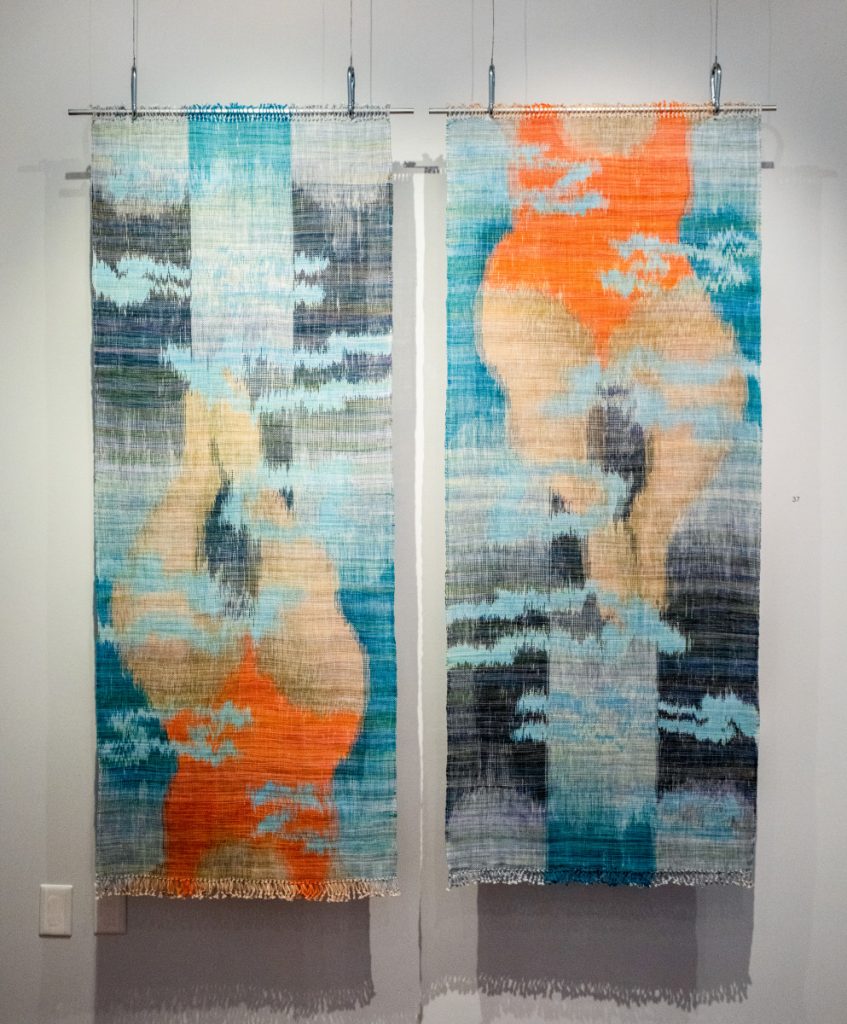
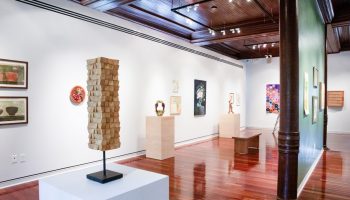
The exhibition in which her work resides, aptly titled “Homecoming: School of Art Alumni,” was co-curated by Susan and John Turben Director of CVA Galleries Judy Barie and Associate Director of CVA Galleries Erika Diamond.
The work that Campbell is showing in the exhibition reflects her interest in human lived experience. The woven surfaces ask that viewers allow themselves to be moved through time and space, changing with the image.
“I hope viewers experience a moment of curiosity and slow looking,” Campbell said. “I hope they recognize something of themselves in it and leave considering identity not as something fixed, but as something continually woven through our encounters with others.”
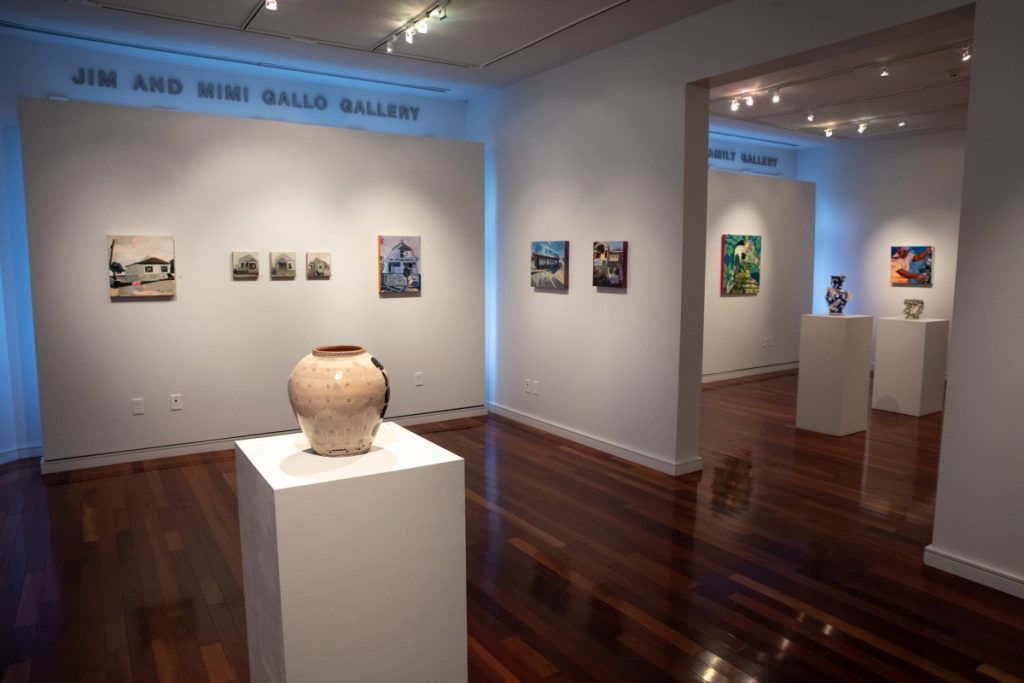
“Homecoming” features works by Campbell, Tina Williams Brewer, Jeremiah Ibarra, Brant Weiland, David Linneweh, Daphne Minkoff, Quinn Antonio Briceño and Kelly Rossetti. The opening reception will be held from 3 to 5 p.m. today in the Second Floor Galleries of Fowler-Kellogg Art Center and will remain on view through Aug 16.
Brewer reflects on the evolution of her craft through the symbolic imagery of textile work. Through hand-quilted and collage mixed-medium work, Brewer tells the stories of African American history, representation and identity.
According to her artist statement, Brewer’s pieces are “embellished with symbols drawn from African nations and rich colorful fabrics with patterns that allude to both cultural meanings and personal history.”
Brewer’s process creates a complex mosaic of blended cultures within the African diaspora, her own familial history and the past, present and future of Black history.
In conversation with his own heritage, Briceño uses painting and collage to speak to history. Coming from a Nicaraguan American household, he holds an identity that is shaped by two worlds.
Briceño’s works pull bright, contrasting colors across canvas to demonstrate the dedication that fills the daily lives of Nicaraguan workers and families. According to his artist statement, his work “gives dignity to the working class while expressing [his] own longing for acceptance from both worlds from which [he feels] excluded.”
Multidisciplinary artist Ibarra sheds light on cultural, societal and socioeconomic differences with his drawings and ceramic pots. His work examines the arena of commonplace by referencing growth, family and culture, thereby creating a dialogue between what one believes they know and what they can still learn from one another.
“My drawings, often allusions from North American pop culture, are meant to evoke a sense of nostalgia and familiarity,” he said in his artist statement.
In comparison to Campbell’s fascination with the seemingly mundane, Linneweh’s paintings explore the architecture and landscapes of America’s suburbs. Through observing shapes of color that were reminiscent of abstract geometric paintings, he developed an interest in exploring landscapes with heightened light and shadow, which resulted in the creation of images bursting with depth.
“These paintings are based on my experiences walking through local suburban neighborhoods that I photograph and use to create image transfers on wood panels that are painted over,” Linneweh said.
The ways that colors can be perceived and blended to enunciate a particular moment in time is where Linnemah’s love for painting stems from.
“The paintings are meant to elicit the experience I had in these spaces — at a distance they are ideal and beautiful — as they are seen up close, there is a tension created through the image and painted elements,” he said.
Linneweh said he finds his return to Chautauqua as a full-circle moment, recalling how an afternoon spent journaling during the residency solidified his internal calling to visual art. In his reflections, the work fulfills him by moving him to create even when he might feel as if a piece is finished.
“When a painting truly resonates, I think I learn to look more,” he said. “I’m able to step back and observe and wonder about what I’m seeing, to take that all in and reflect on myself, my life and my experience — then do it all again.”
In showing these works in “Homecoming,” Linneweh hopes to light a spark in the minds of viewers, connecting them to their own memories and feelings of nostalgia. As viewers inch closer to the works, the perspective shifts and the tension between printed and painted elements are revealed.
“My hope is that a viewer observes the painting as a construction and reflects on the idea of home or place, how it has evolved or changed over time and how that relates to ideas of the American Dream.”
Similarly, Minkoff combines painting with photographic imagery to depict everyday life in a new, more focused lens. Her work finds beauty in places that are consistently overlooked, such as porch fronts and street corners.
According to her artist statement, Minkoff’s paintings are a “search for stability, structure or a modest moment of beauty — like a worn surface or haphazard still life — in our crazed, unhinged world, revealing a quiet, humble truth that speaks to her.”
For landscape painter Rossetti, returning to Chautauqua has been an equally meaningful and rejuvenating experience. As a full-time artist and mother of two, her time in the residency program gave her full freedom of expression, uninterrupted studio time and an environment where she could fully immerse herself in her practice.
“That experience shifted something fundamental in my practice,” she said. “It reinforced the importance of staying with an idea longer than feels comfortable and allowing the work to evolve through experimentation rather than trying to arrive at a finished painting too quickly.”
Rossetti finds purpose in the repeated questioning of her work. In the layering, peeling back and relayering of her landscapes, she finds her pieces becoming more tactile and materially driven. Through that investigation, she finds reward in creating a body of work that feels the most conductive to her message.
“I became much less interested in protecting the work and much more interested in seeing what would happen if I pushed it further … even if that meant taking it apart.”
Rossetti’s paintings are concerned with abstracting memory, structure and atmosphere. She actualizes her vision using assemblage, collage, excavation and reconstruction, allowing the varied layers to remain visible to preserve the evidence of her previous artistic decisions.
“Lately, I’ve been asking when a painting stops functioning as an image and begins existing as an object,” she said. “Thick paint skins, layered fragments, exposed construction and accumulated surfaces all contribute to that shift.”
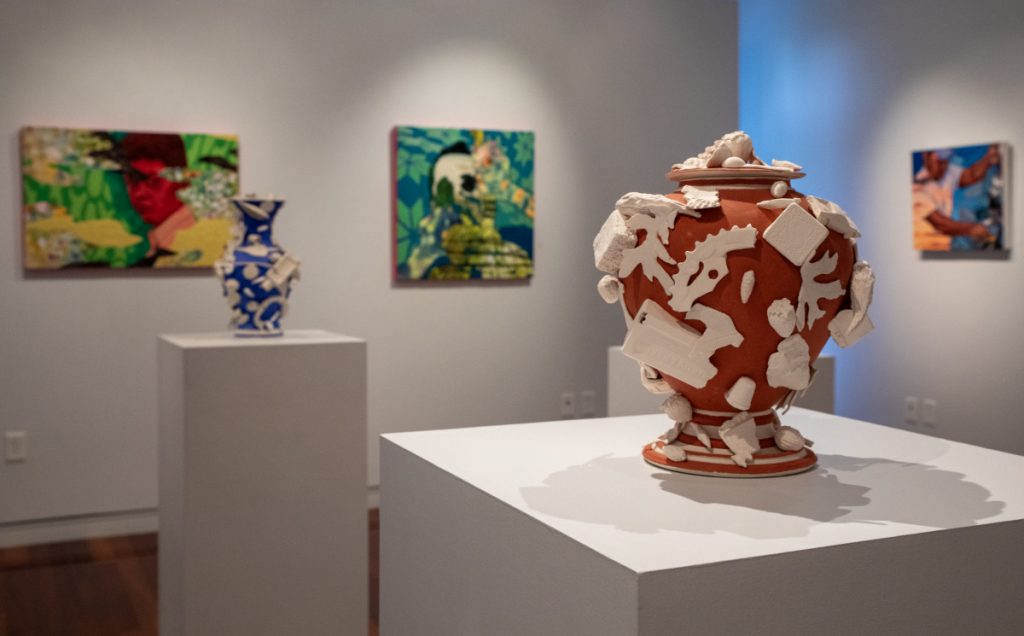
Sculptor Weiland is interested in the way objects influence the passage of stories that are tied to an individual’s perception of place, identity and history.
“I invite viewers to reflect on the role the effects of curation and preservation play within the artwork so we may understand them as contributing factors built upon layers of experience and chance, progressively interwoven to form a picture of today,” he said in his artist statement.
“Homecoming: School of Art Alumni” brings this collection of former artists-in-residence together once more to explore how their practices and artistic visions have evolved over time. The common thread that unites them is an unwavering love for Chautauqua’s spirit and a dedication to learning from each other and the community.
Campbell reflected on that dedication as she once again stepped foot on the grounds, remembering just how far she and her fellow artists have come.
“The residency gave me something that is often difficult to find in everyday life: uninterrupted time to think, experiment and connect with other artists,” she said.