
LILY RESLINK
Staff Writer
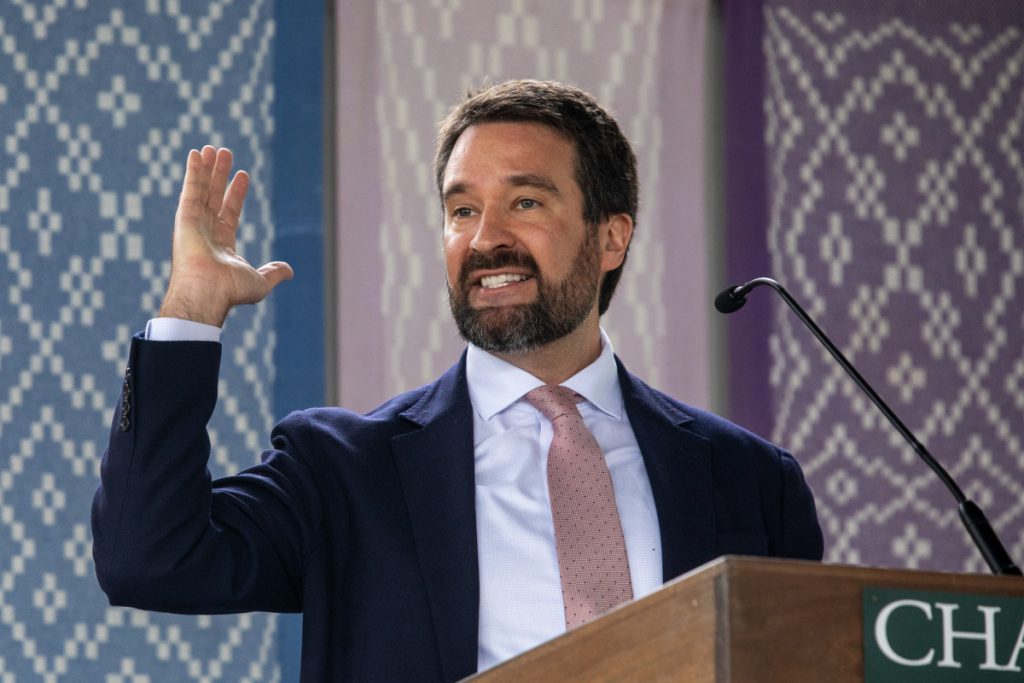
Joshua Stanton is a rabbi, author, associate vice president for Interfaith and Intergroup Initiatives at Jewish Federations of North America and self-proclaimed asker of hard questions, but he invites anyone to just call him Josh.
Returning to Chautauqua, Stanton used his Monday Interfaith Lecture appearance to build on his advocacy of religious pluralism by highlighting efforts to center religion and spiritual outreach on the human desire for community.
He emphasized that connection in this age of hierarchical structures is rooted in authority that is “earned relationally, not assumed institutionally.”
Stanton said, today, we are living through “a period of profound social and emotional and technological change.” Despite the feeling of unending conflict and the question, “How will we get through this?” Stanton said he is optimistic for the future of religion-based “spiritual entrepreneurs” and the success he’s seen from their work.
“They operate in looser networks that center the needs of people they serve and respond in new and innovative ways to those who feel spiritually homeless,” Stanton said of spiritual entrepreneurs, reading publicly from his forthcoming book Revival: Portraits of America’s Spiritual Builders.
He said approaches outside of convention and beyond religious labels include meeting people in parks, gyms, studios, living rooms and wherever else they are. Stanton said gathering around shared values rather than “dictation or dogma” is helping satiate the universal craving to fit in and find community.
“People are looking for a place where they fit in, can explore life’s big questions and can describe the hurt and pain in this particular moment for our world,” Stanton said, “which might be the one universal that every single human being is hurting right now, because changes are happening so quickly we can’t adjust to them.”
Stanton described historical events, such as the loss of federal and state subsidies for religion, that led to “a rush of new organizations trying to meet the new needs of human beings who are experiencing real change all around them.” He said his approach to religion buds from these moments, which parallel today’s polarization.
Religious people, Stanton said, have the opportunity “to change our offerings, to elevate new voices, to create new kinds of leadership and tiers of leadership that can answer the human needs of today.”
He spoke about the “Humanist Chaplaincy” at Tufts University, which offers a nonreligious gathering space for communal reflection on life’s greater meaning. The group has adopted the craft of candlemaking and donates their products to use for religious worship services on campus.
Embracing changes in perspectives of religion means taking opportunities to adapt and “remix” tradition in ways that help people regardless of the tradition they are a part of. Stanton used an example of native rituals meant to support healing from trauma.
He said people can and should gather and connect to meet each other’s needs, whether that be explicitly religious or not.