DEBORAH TREFTS
Staff Writer
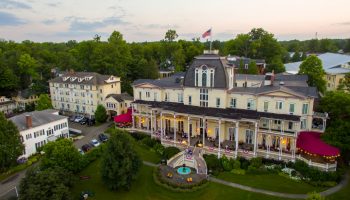
The Golding Cottage Hotel (circa 1877–1968) once stood where the Carnahan-Jackson Memorial Garden now flourishes along the southwest side of the Amphitheater and the Brick Walk next to Park Place.
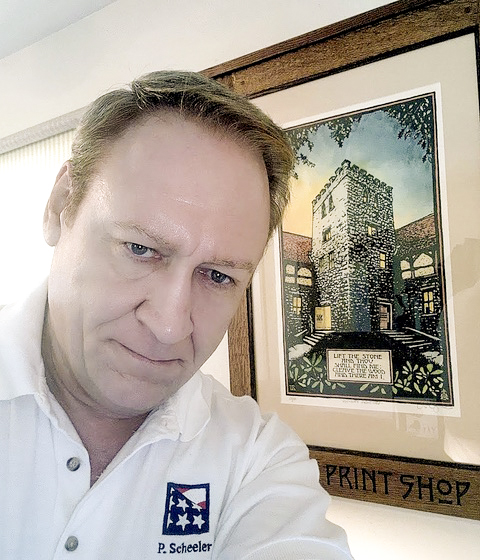
According to Paul Scheeler, this hotel was owned and operated by Nellie Golding and William Morgan, both of whom earned multiple degrees. Most notably, each was an osteopathic physician and chiropractor.
At 9:15 a.m. Tuesday at the CWC House, Scheeler will give a Chautauqua heritage presentation for the Chautauqua Speaks program titled, “Dr. Nellie Golding and Dr. William Morgan: A Chautauqua Love Story.”
Some genealogists refer to people like this married couple — for whom the paper trail is so scant it seems they resisted being documented — as “ghosts.” Nevertheless, after Scheeler’s curiosity was piqued, he persevered, setting in motion a project to uncover the mystery surrounding the couple, share it with Chautauquans and raise awareness among local genealogists.
“I was born in Buffalo (New York) in the mid-’60s,” Scheeler said. “My father opened the first real estate office in Orchard Park (New York). It was good timing because the [Rich] Stadium was built [and officially opened on Aug. 17, 1973]. … The coaching staff were his clients. I went to Orchard Park High School.”
For his allowance, Scheeler said he helped his father by cleaning, painting and landscaping houses to prepare them for sale. He also learned how to sail, was a Boy Scout and went to the YMCA. At Chautauqua, where his family had a cottage and a boat, he “came with a skill set, but maybe … wasn’t the strongest student.”
“I learned to water ski and went to a lot of events and programs that focused on academic things that my parents thought would be good for (my brother and me),” Scheeler said. “Chautauqua opened up the world to me — a world and opportunities existed outside of western New York. … It expanded my horizons.” Instead of playing video games, he read more.
“At Chautauqua in the mid-’70s, it was very noticeable that houses needed repair,” he said. “I knew from my father that historic properties were much more expensive to maintain than non-historic. Plus, there were additional fees at Chautauqua, (and) they were only seasonally occupied. I felt empathy for cottage owners and never forgot it.”
At State University of New York College at Fredonia — now SUNY Fredonia — Scheeler majored in government and economics. He studied regulatory compliance and earned his Master of Public Administration at Syracuse University’s Maxwell School of Citizenship and Public Affairs in Syracuse, New York, the oldest continuously operating MPA program at an American university.
Thanks to a renewable New York State public affairs fellowship, Scheeler then worked in Washington, D.C.
“I had student loan debt,” he said. “I wrote for the Congressional Record, transcribing what politicians said, not as an employee, but as a glorified intern with pay.” He also worked for the Federal Register and for a bank trade association.
“This was before the internet,” Scheeler said. “I was learning how to write and think fast, and about how bureaucracy works. In the trade organization, there were large sums of money and it was stable. … I’ve lived through several recessions — boom and bust. There were years when my father had fewer real estate sales. … Why I didn’t go into real estate is that it’s cyclical.”
Relocating to Chicago with the intention of staying there for just a couple of years, he worked for a consulting firm whose clients were senior executives of publicly traded companies responsible for annual reports, letters to shareholders, earnings releases and other financial documents.
Scheeler returned to western New York 20 years later, where he “works as a senior risk analyst for a global bank.”
Having seen too many “attics with keepsakes and heirlooms that were thrown out … protecting artifacts” became Scheeler’s hobby. It bothered him that “things that meant so much to people” were being tossed into dumpsters and ending up in landfills, so he “set aside money for acquiring and identifying historical artifacts.”
“One day I found a souvenir glass from the Golding Cottage Hotel, which no longer exists,” he said. “I thought, ‘What a great location for a 1800s Airbnb.’”
And so began Scheeler’s quest to learn, collect artifacts and produce a book about the fascinating couple whose hotel had the nicest historical souvenir glass he’d ever seen — one with a 24-carat gold rim.