

Lily Reslink
Staff Writer
From outrage to curiosity, journalist Naomi Riley has built a career on the questions she has about religion’s impact — with a scope of the world, but a focus on individual households.
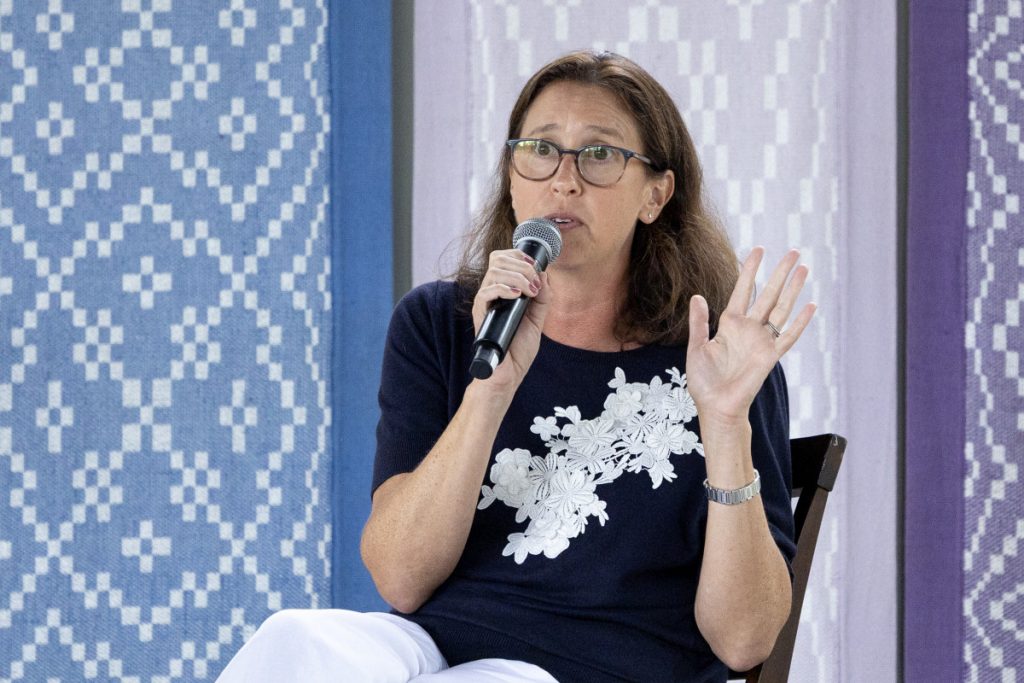
In conversation with Chief Program Officer and Senior Vice President Deborah Sunya Moore for the Tuesday Interfaith Lecture, Riley brought candid discussion of topics spanning religion’s supporting role in foster care, healthy negotiations in interfaith relationships, shifting trust in institutions, children’s welfare, her own parenting philosophies and coalitions of diverse groups who unite under shared concerns of drug addiction.
Riley’s journalistic path began in the internship for the Wall Street Journal editorial page she landed right out of college.
“Ther was a story … that outraged me, which is how a lot of journalism begins,” Riley said. The story covered two high schoolers who got their National Honors Society induction rescinded in their senior year upon having children.
She wanted to write about this, but her editor prompted her to explore this not as a column, but through the angle of religion’s impact.
“I said, ‘You want me to call a couple of people I don’t know and ask them about their religious beliefs? That’s insane.’ … He said, ‘You want to be a reporter, you better figure it out.’”
When she realized how this work could fulfill her fascinations, she knew she found the path for her.
“I could call people out of the blue and ask them about their innermost beliefs, like where they think they’re going in the next life,” Riley said.
Riley said she grew up in a conservative Jewish background with religion discussed minimally. Having also not taken any courses on religion while in college, she said this unexpected path has continued to strengthen her understanding of the religious complexities that impact relationships and family life.
Through her work, Riley said she looks at how religious institutions serve functional purposes, such as filling the gaps she has identified in child welfare. Much of her authorship and work as senior fellow at the American Enterprise Institute centers on this topic.
Rather than the state’s approach of broadcasting the need for foster parents, Riley emphasized the success in churches’ “narrowcasting” approach that speaks directly to their community and offers resources of support.
She identified this as a model of “recruit, train and support,” and said a question she started asking herself since reporting on religion’s institutional interplay is why successful models from faith communities do not spread.
“You need people who are actually going to raise their hand and say ‘… I’m going to take a child into my home,’ and I think in part you need a little bit of a lay-led organization in order to have that.” She said willingness to directly participate is a necessary characteristic, which is an enthusiasm that can be difficult to muster for foster care and the challenges associated with it.
However, she said exposure to the process destigmatizes foster families and adds to their support system, which motivated the approaches that institutions incorporated. “They said … ‘You want to be a foster parent? You should bring five people with you to training: your neighbors, your bible study partner, your relatives … and we’re gonna train them too.”
Riley covered the shifting trust in institutions of politics, marriage and churches. While she said trust and active participation has shown a decline, trust in local institutions remains.
“I think people are really putting their trust in the community that they can see,” Riley said, “not necessarily in the kind of overarching structure of religious denominations, but in their community churches and synagogues and mosques.” She connected this to broader patterns of desiring community.
On the issue of substance-exposed children, Riley spoke about the coalitions formed when she said existing medical institutions failed to take effective action.
“The idea that they’re sending you home with your Fentanyl addiction and a newborn baby to care for without any support is crazy to me,” Riley said.
She spoke on the Temperance Movement and coalitions of non-religious, religious, conservative and progressive groups all focused on the same goal of addressing the harm of drugs and alcohol on families.
In addition to her own interfaith marriage, Riley has experienced a nation of interfaith relationships through her personal and professional life — from which she said she has learned a lot about what types of communication has worked.
“There’s an element of patience,” Riley said, yet she said ongoing negotiations and openness make it possible.
Riley spoke to how heavily religion and family are intertwined. She said it’s very hard for her to offer one prescription for positive participation in institutions. Riley encourages marriage.
“If you get married and have children, you are more likely to join a religious institution. But also, if you join a religious institution, you may be more likely to get married and have families; but if you do neither one of those things, nothing is pulling you back into community and the obligations of community.” She said it is not that single people are not active community members in religious institutions, but rather that marriage and children are the triggers.