John Corigliano: Midsummer Fanfare
John Corigliano, American composer and son of the former concertmaster of the New York Philharmonic, was born on February 16, 1938 in New York City. His compositions have brought him several prizes, including a Guggenheim Fellowship, the Grawemeyer Award, the Pulitzer Prize, and an Academy Award for the score to François Girard’s film, The Red Violin. He also wrote an opera, The Ghosts of Versailles (1987) which was first performed at the Metropolitan Opera in 1991. John Corigliano’s music has been commissioned, performed, and recorded by many of the most prominent orchestras, soloists, and chamber musicians in the world. His honors include the Pulitzer Prize for Symphony No. 2, the Grawemeyer Award for his
Symphony No. 1, the Academy Award for Best Original Score (The Red Violin), and, of his five Grammy Awards, three for Best Contemporary Composition (Symphony No. 1, String Quartet, and Mr. Tambourine Man). His Midsummer Fanfare was commissioned, and first performed,by the Grant Park Festival Orchestra in Chicago under the direction of Carlos Kolmar on July 16, 2004. It is scored for piccolo, 2 flutes, 3 oboes, 3 clarinets, 3 bassoons, 4 horns, 3 trumpets, 3 trombones, tuba, timpani, percussion, harp, and strings.
Midsummer Fanfare is an exhilarating 6-minute composition that places the mysterious and spooky in juxtaposition with bold and triumphal writing for the brass. The composerprovided the following note regarding his Midsummer Fanfare:
Midsummer Fanfare, a reworking of an earlier effort, is actually an introduction and a fanfare. The introduction is ethereal and fragmented-sounding, and reveals the notes of the fanfare in a disguised manner. It slowly builds in both tension and texture until, by its end, the sound is wild and frenzied, pulsing with blurring energy. The fanfare that interrupts this climax is bright and clean-sounding, and like most fanfares spotlights the brass. Starting with the French horns, the melody is then heard in the trombones and finally in the high D trumpets. A short recapitulation of the introductory material and the fanfare itself leads to a furious coda that brings this short work to its climax.
Bohuslav Martinů: Concerto for Oboe and Small Orchestra, H. 353
The Czech composer Bohuslav Martinů was born in Polička, Bohemia, on December 8, 1890 and died in Liestal, Switzerland, August 28, 1959. While he lived outside of his native Czechoslovakia most of his career, history has placed him in the pantheon of great Czech musicians following in the footsteps of Smetana, Dvořák, and Janaček. His earliest music education was that of a violin student. Showing great promise, he enrolled in the Prague Conservatory in 1906. While his career as a student there was less than successful, Prague’s lively musical environment stimulated his creative spirit as a budding composer. His skills as a violinist earned him a position in the Czech Philharmonic from 1919-23. During this period he took composition lessons with Josef Suk. In 1923 he moved to Paris and began to fall under the influence of Debussy and Stravinsky, among others. In 1941 he emigrated to the United States to escape the ongoing Nazi conquest and resided here until 1953, becoming an American citizen in 1952. We decided to return to Europe, but because his native land fell under communism, helived in France and Switzerland until his death. The score calls for solo oboe, 2 flutes, 2 clarinets, bassoon, 2 horns, trumpet, piano, and strings.
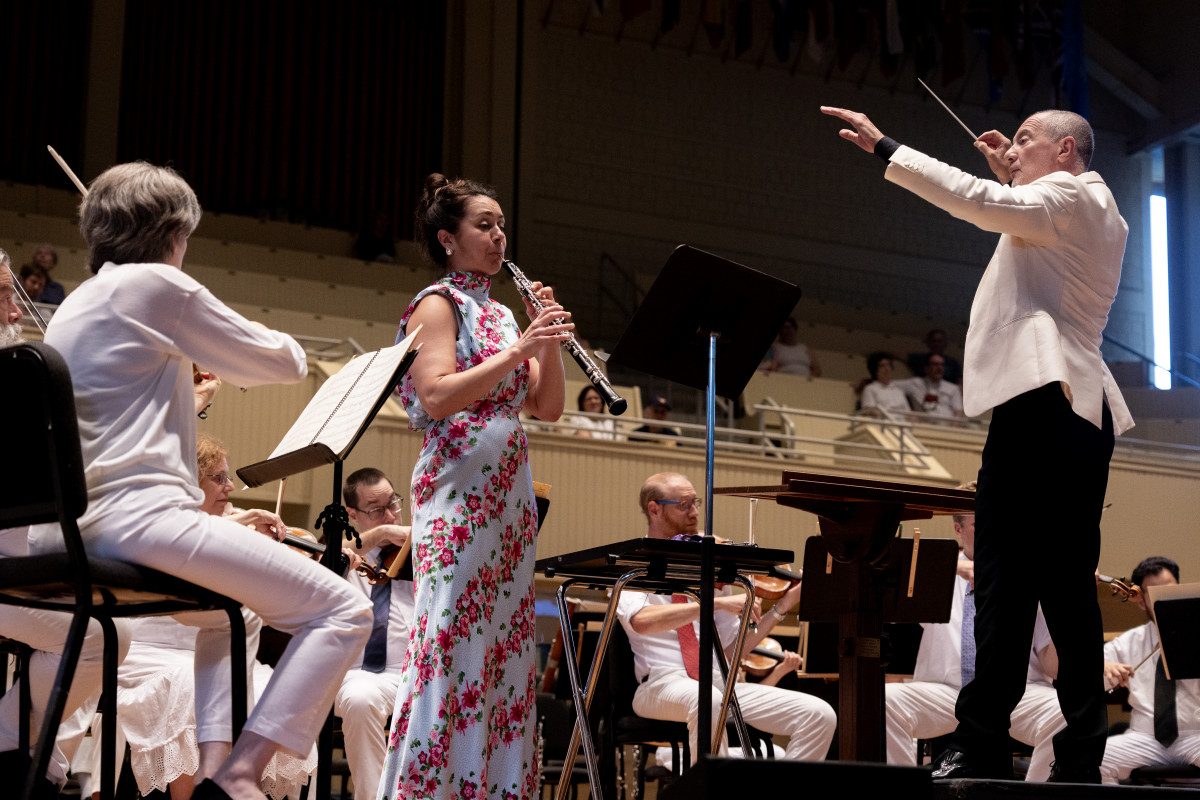
Martinů composed his Concerto for Oboe in 1955 for the Czech-born Australian oboistJiři Tancibudek, who gave the piece its world premiere in Sydney in August 1956 with HansSchmidt-Isserstedt leading the Sydney Symphony Orchestra. The work comprises three movements and is of ca. 17 minutes in length. Calling for considerable virtuosity on the part of the soloist, its style is quite accessible to audiences, showing the neo-classical influence of Stravinsky. While its outer movements (Moderato and Poco allegro) display a jaunty mien, the middle movement (Poco andante) is more introspective.
Antonin Dvořák: Symphony no. 9 in E Minor, op. 95 (“From the New World”)
The Czech master Antonin Dvořák was born in Nelahozeves, near Kralupy, on September 8, 1841; and died in Prague, May 1, 1904. His “New World” Symphony remains his most popular work. Composed during his residency in the United States in 1892-3, the work received its premiere on December16, 1893 in New York’s Carnegie Hall. It is scored for piccolo, 2 flutes, 2 oboes, English horn, 2 clarinets, 2 bassoons, 4 horns, trumpet, 3 trombones, tuba, timpani,percussion, and strings.
In early 1991, a three-story brick row house at 327 East 17th Street in Manhattan was declared a national landmark. A plaque above the first story declares that this was the New York home from 1892 to 1895 for the famous Czech composer Antonin Dvořák, who composed his Symphony no. 9 (“From the New World”) during a period from January to May 1893.Unfortunately, the brownstone was taken down to make room for the expansion of a nearby hospital and the corner near where it stood was renamed Dvořák Place. The composer moved to New York after Jeannette Thurber invited him to assume the directorate of the National Conservatory of Music. Shortly after taking up residence there, Dvorák communicated the following to a friend in Prague:
“We [the composer, his wife, and two children] live four minutes from my school in a
very pleasant house. Mr. Steinway sent me a piano, free, so we have one good piece of
furniture in the parlor. The rent is $80 a month, a lot for us, but a normal price here.”
Ever since it received its first performance in New York City on December 16, 1893 with Anton Seidl conducting the New York Philharmonic, Dvořák’s “New World” Symphony has remained an extremely popular orchestral work. The Czech master wrote two major works, as well as some smaller ones, during his extended visit to the United States, which included a short summer vacation spent with a colony of Czech immigrants in Spillville, Iowa. One of these compositions was the String Quartet, op. 96 (“American”), the other was this, his last symphony. Had Mrs. Thurber had her way, Dvořák also would have composed an opera based on Longfellow’s story of the Native Americans Minnehaha and Hiawatha, as she hoped that Dvořák would become the founder of a new American “school” of composition. As we shall see, at least some of Mrs. Thurber’s hopes found expression in his “New World” Symphony.
Folk music had always played a vital role in Dvořák’s music, and his “American” efforts serve to remind us that many folk musics have elements in common. The “New World” Symphony speaks its “American” with a distinctly Slavic accent. The title for the work, “From the New World” is the composer’s own, and he explained that it was inspired by “impressions and greetings” from his host country. Among these impressions must be counted the music of African-Americans, whose melodies he learned from one of his students at the Conservatory, Henry Thacker Burleigh. It is difficult to determine just how well-versed Dvořák was in the authentic musical idiom of Native Americans, but the famous Largo movement of the “New World” Symphony, was inspired, according to the composer, by a passage from Longfellow’s “The Song of Hiawatha.” The famous English horn theme of this Largo is still known by many people as a “spiritual” with the words “Goin’ Home.” The Symphony is filled with many such appealing folk-like themes.
Another important element in the “New World” Symphony is its cyclic construction, in which a motto theme, first heard near the beginning of the first movement, is brought back at strategic moments in the subsequent movements. A careful listener will discern that this motto itself is the progenitor of other themes, thereby strengthening the thematic unity of the entire work. Dvořák also provides many masterful moments of orchestration and harmony, none, perhaps, more beautiful than the succession of brass chords at the beginning and end of the Largo.
While the composer was still in America, he sent the manuscript for this symphony to his German publisher Simrock, who in turn showed them to Dvořák’s friend and advisor, Johannes Brahms. Brahms saw fit to make certain corrections, and even some wholesale changes—especially in the finale—where he altered some of Dvořák’s tempos.
Notes by David B. Levy © 2005/2016/2021