
ARIANNA NEVAREZ
Staff Writer
Natalie Merchant was exposed to the arts from a young age; her mother loved the symphonic orchestra and would bring her to Chautauqua Institution to experience the arts. Now, Merchant has created a legacy of advocating for early childhood arts education by volunteering with a school-readiness program for low-income families and creating Cabinet of Wonder, a multimedia children’s art and music project.
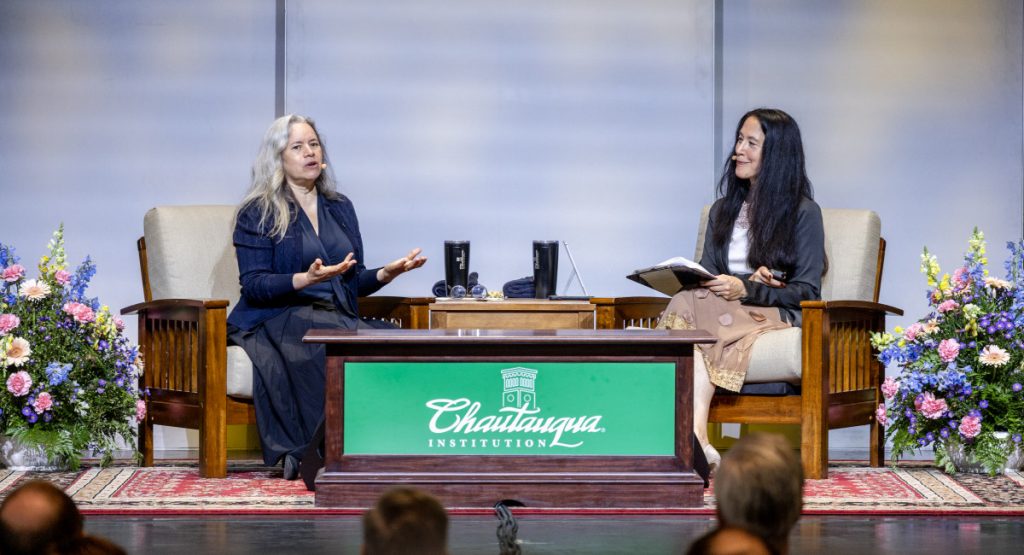
At 10:45 a.m. Wednesday in the Amphitheater, Merchant shared insight into her musical journey, her work in teaching and why the arts are important.
Growing up, Merchant said her “strong childhood memories” have been tied to Chautauqua, from being taken to the Chautauqua Symphony Orchestra performances at age 7 to seeing her first opera on the grounds.
During her teenage years, Merchant said, she started volunteering at an experimental therapeutic arts camp, where she worked with children from ages 5 to 18.
“I remember how powerful the arts were. You have children who were nonverbal, but you gave them a piece of clay, and they would get so excited,” Merchant said. “… It really shows the power of music and the visual arts for therapeutic purposes.”
While enrolled in Jamestown Community College, Merchant joined the alternative rock band 10,000 Maniacs as the lead singer. She said the band wanted to take a photo in front of the Jamestown sign for their first professional photoshoot because they were proud of being “Rust Belt poets and musicians.” She said the same sign now says “Home of 10,000 Maniacs.”
In 1990, Merchant joined forces with Scholastic Magazine for a campaign highlighting a nationwide poetry writing contest. She said they received 17,000 submissions, and the chosen author won a special performance from Merchant. When she visited the winning author’s classroom to perform, she said one of the students told her they had never listened to her music before until they found out she was coming to the school, but since then, they had already chosen a favorite song.
“That’s one of the things that people do is transcend those borders that people put around themselves,” Merchant said. “ … I just feel like music can be used so much more to bring people together than to disseminate the individual groups.”
When the band was at its peak popularity, Merchant took a break to work at a homeless shelter daycare where she hoped to do something “tangible to help.” She said she believes it is an artist’s responsibility and “everyone’s responsibility” to stay engaged and help society.
2003 was a big year for Merchant; she said she released her first solo album and had a baby. After the birth of her daughter, she decided she didn’t want to tour anymore, but she wanted to find a way to still be creative, so the day she got home from the hospital, she started writing Leave Your Sleep, which included adaptations of classic children’s poetry.
Merchant called this her most “ambitious project,” which was centered on nursery rhymes and the tale of Mother Goose.
“Mother Goose was my inheritance from my grandmother, mother, and it’s what I passed on to my daughter. It’s oral tradition,” Merchant said. “It’s been in existence for hundreds of years. It’s been in print for 300 years, and it’s powerful stuff. Children love it. … They learn about phonics. They learn about new vocabulary. They learn historical concepts, idioms and it’s just all around fun.”
Merchant has also taken on the role of a visiting teaching artist. She said it’s the role of the visitor not only to bring something new and incorporate different teaching methods, but also to allow the teacher “a moment to sit back and observe the children engaging with the art.” She said, “Going on tour is like vacation for [her] because [working in a classroom] was some of the most exhausting work [she] did.”
As she was teaching, Merchant developed the idea for Cabinet of Wonder. In the beginning, she was simply trying to instill a “love of language” in the preschool children she was working with.
Merchant said the students would start understanding the meaning of the poems, which set them up for topics they might study later in school. She also said there is not enough arts programming for preschool children.
“When they’re at their most impressionable, we ignore them,” Merchant said. “Most children in America don’t get any arts education programming until third grade, if they get it at all. You are completely forming as a person and as a human being before the age of 7, … so that seems like the moment to introduce them to all the instruments and symphony, and all the words you possibly can in the dictionary, and just show them the world.”
This lack of arts education pushed Merchant to create a project to uniquely engage these students in a collaboration with Chicago Children’s Theatre and the Chicago Symphony Orchestra. The three parties, along with help from artists who contributed their services for free or at an extremely discounted rate “all for the love of children,” created Cabinet of Wonder, she explained.
“What started as a project for a bored and isolated mother ended up now involving at least 1,000 people,” Merchant said.
Though Merchant mainly worked with preschool-aged students, she acknowledged the cuts to art programs being made at the K–12 level. She said without access to the arts, the next generation loses human connection and emotional intelligence.
“We lose our souls,” Merchant said. “The arts teach empathy and compassion. They foster community and affection. In this moment when everyone is really despairing over the lack of communication, everybody’s communicating and getting information all the time, but we’re not talking to each other.”
Merchant said she has always been drawn to helping children and is concerned about their welfare. Specifically, she said Head Start, which promotes the school readiness of young children from low-income families, is where she saw the most engaged parents and saw what nurturing a child in early education can do. But she said parents overall aren’t paying enough attention to their children.
“As a culture, we don’t respect children enough,” Merchant said. “We don’t respect their emotional and intellectual intelligence and sophistication. When you were talking about these aggressive education and entertainment products that are just bug-eyed and aggressive, and they’ve got rapid-fire editing — that’s not respecting children. It’s not giving people what they deserve, what they need or what they want. They want you to pay attention to them.”
In closing, Merchant said all her knowledge about songwriting, recording, working with musicians and singing has led her to be prepared for her lecture.
“To me, this feels like the peak of my career,” Merchant said. “ … It was my dream to be a puppeteer when I was young, and then my second dream was to be a preschool teacher… So I finally have achieved all my goals.”