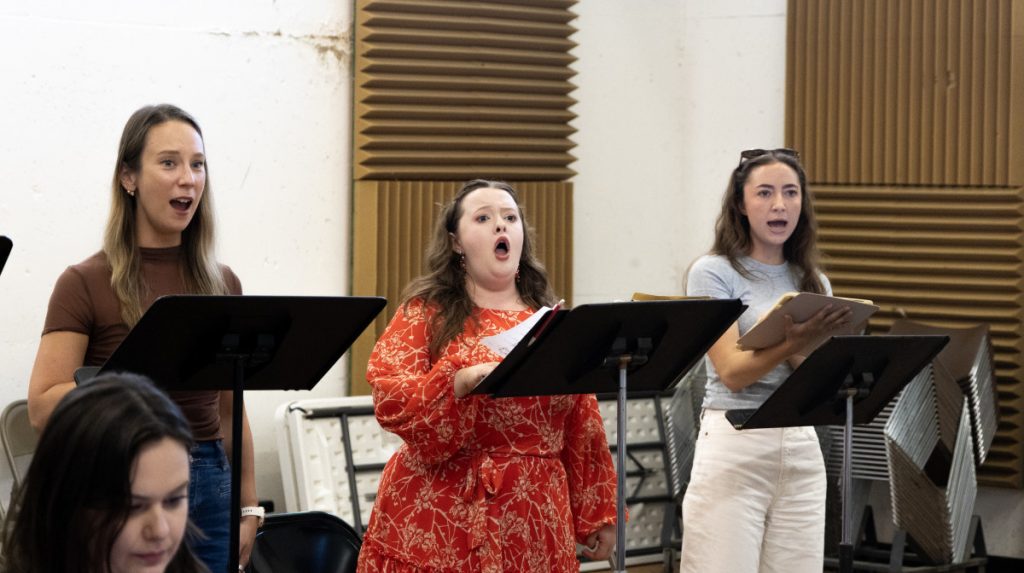
From left, SarahAnn Duffy, mezzo-soprano, Faith Adams, soprano, and Sydney Dardis, soprano, rehearse Tuesday for their performance of ‘Sarah in the Theatre’ in Jane A. Gross Opera Center.
LAYLA VINSON
Staff Writer
Amid bitter labor disputes of the early 1980s, National Medal of Arts recipient, founder of the Opera Company of Boston and first woman to conduct the Metropolitan Opera Sarah Caldwell was burned in effigy on Boston Common. Her trailblazing theatrical illusions, unconventional staging and eye for exceptional talent shattered social constructs and garnered international accolades; these qualities are exactly what internationally acclaimed composer and librettist Mark Adamo intends to honor in his newest opera, Sarah in the Theatre.
Commissioned by Odyssey Opera, Adamo has been in collaboration with Chautauqua Opera Company over the past weeks as they bring his piece to life. For their first workshop of the 2026 Summer Season, the Company will present approximately fifty minutes of excerpts from the developing opera at 3:15 p.m. today in Elizabeth S. Lenna Hall as a $20 ticketed event — including a new aria that has never before been heard.
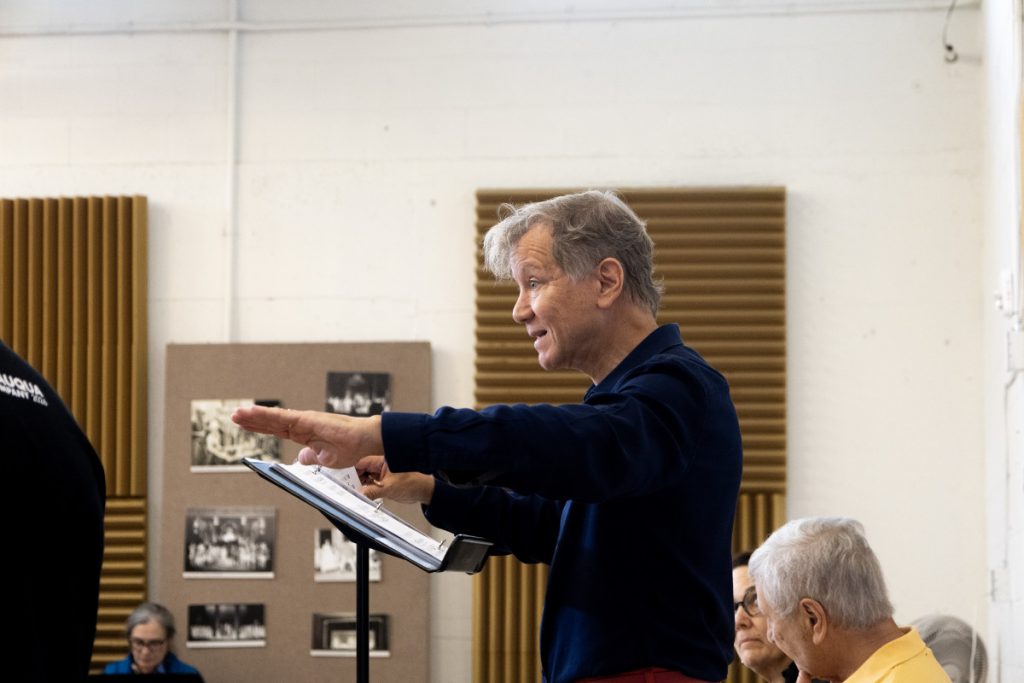
‘Sarah in the Theatre’ composer and librettist Mark Adamo helps guide the performers.
“It’s history because she existed, so there’s a little preface up front, but the fact that it’s somewhat hallucinatory gives me certain freedoms,” Adamo said, harboring a deep appreciation for theology, history and the human stories that fuel his innovative creations. “The game and fun of it has been to span something that on the one hand is granularly realistic and on the other hand is completely poetic and stylized.”
Part of that process has entailed a blending of historical figures Shirley Verrett and Beverly Sills, American sopranos who worked closely with Caldwell. Taking the liberty to morph certain elements of their backgrounds — Verrett’s experience as one of the earliest leading Black sopranos of the time and Sills’ marriage with a publisher funding the company — Adamo has had the freedom to fold two stories into a fictional character, Vera Terell.
Bringing the life and work of Caldwell from page to performance with his own twist has also provided Adamo with the opportunity to integrate visually exciting imagery rooted in the core of the narrative, such as the literalization of Sarah’s own demons and a fire motif threading through the entire show. These fantastical, hallucinatory elements are crucial to his desire of capturing the essence of a contemporary opera house in all of its glory.
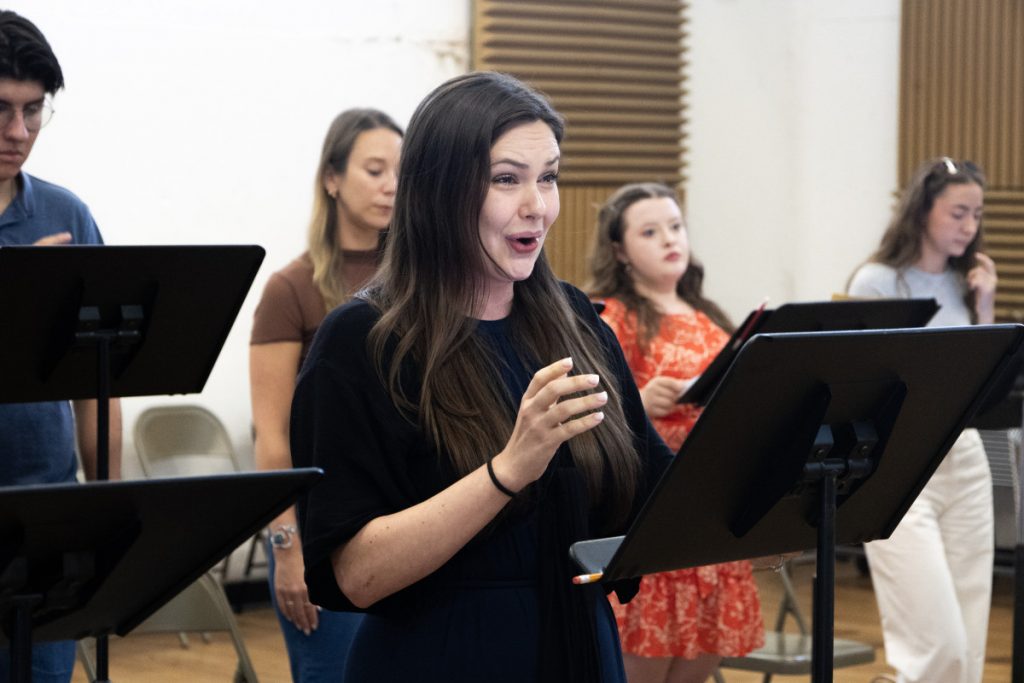
Sarah Dyer-Jones, mezzo-soprano, practices her role as Sarah Caldwell for Chautauqua Opera Company’s showing of ‘Sarah in the Theatre.’
“I wanted it to be as close a portrait of the way contemporary American operatic artists actually work, because there have been other pieces that have purported to be in our world and they’ve gotten all the details wrong and sort of pulled in elements of melodrama, the cliché of the badly behaved soprano and I thought, ‘I don’t want to do any of that,’” Adamo explained, tapping into his experience as a director. “I want this, in certain scenes, to feel almost like a documentary. This is how people work.”
Adamo expressed great reverence for all of the Company singers, each of them only having a limited time with the material and still making great strides in rehearsal — especially regarding the new aria set to debut in today’s presentation.
“There is a wordless character who haunts Sarah throughout the show. All of these moments of pressure and suddenly this — we don’t know if she is a ghost or a figment of her imagination — but she shows up singing very expressively, but without words,” Adamo revealed. “Only in the penultimate moment of the piece does Sarah restore to this figure the power of speech, and it’s in this aria that we understand who she has been throughout the previous two acts.”
Company mezzo-sopranos Sarah Dyer-Jones and SarahAnn Duffy, playing the roles of Sarah Caldwell and Leocadia/Anna Maria Lopez respectively, further endorsed the realistic nature of the piece.
“I’ve never felt so at home in a piece, like I’m invested in this now and I feel seen,” Dyer-Jones acclaimed. “And that’s what Sarah Caldwell is saying: ‘You’re not just a number, you’re an artist and we’re going to create together.’ And Mark is embodying that in how he talks to us and how he works with us.”
While the piece is centered on the operatic world, its contemporary setting allows its relatability to transcend past the exclusivity of those only familiar with the stage. Tackling a wide range of human emotions from vulnerability to addiction to failure, the presentation can offer something different for everyone.
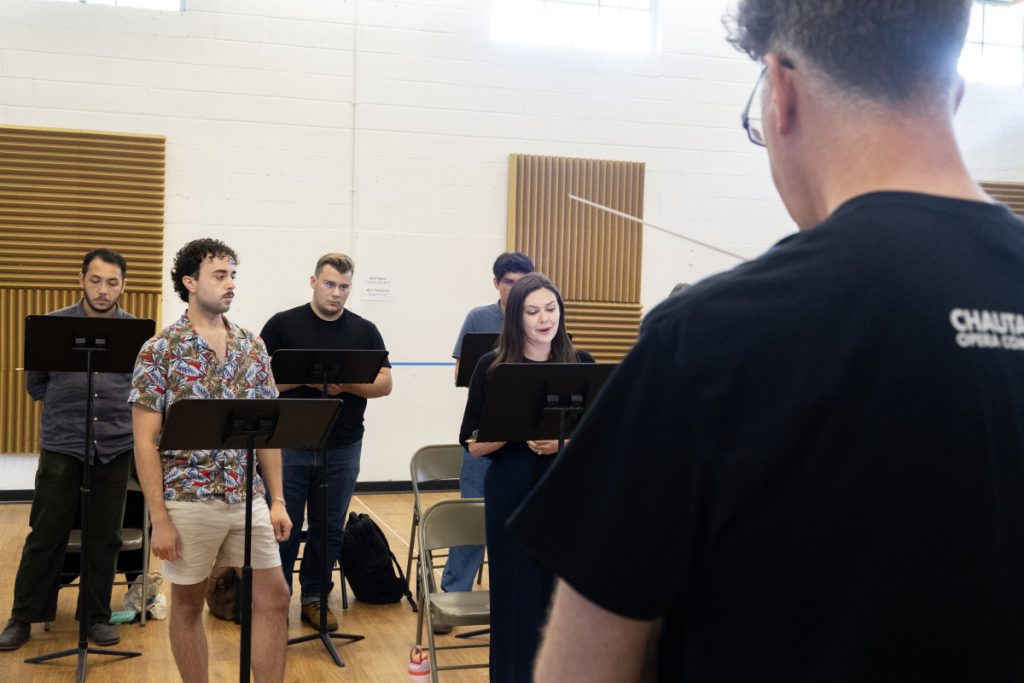
General and Artistic Director Steven Osgood leads members of the Chautauqua Opera Company during rehearsal.
“I had a coach tell me once that at the end of the day, you should be emotionally wiped because of how much you had to wear your heart on your sleeve,” Duffy recalled. “And this process, specifically this piece, has really shown me what that actually means. And I just think, for an audience — get ready to see vulnerability.”
Building on Caldwell’s belief that people can live on moments of magic, Adamo claimed those special instances unfold every day in his career.
“The moments of magic are, we have lots of them, but when little by little you hear people get what the meaning of the performance is, I find myself listening like I’m in an audience,” Adamo said. “I’m coaching them, but when they get what’s on the page and take it off of the page and turn it into an event, just standing there in the music stands — that’s why I’m here. That’s why somebody like me does what
he does.”
Adamo’s portrayal of the haunting obsession behind the success of such an ambivalent figure will conclude with approximately 45 minutes of conversation between himself and General and Artistic Director of Chautauqua Opera Company and Conservatory Steven Osgood.