
LILY RESLINK
Staff Writer
As an art lover, Natalie Wigg-Stevenson said she hates the question of what art means; rather, she is much more concerned with the question of what art can do.
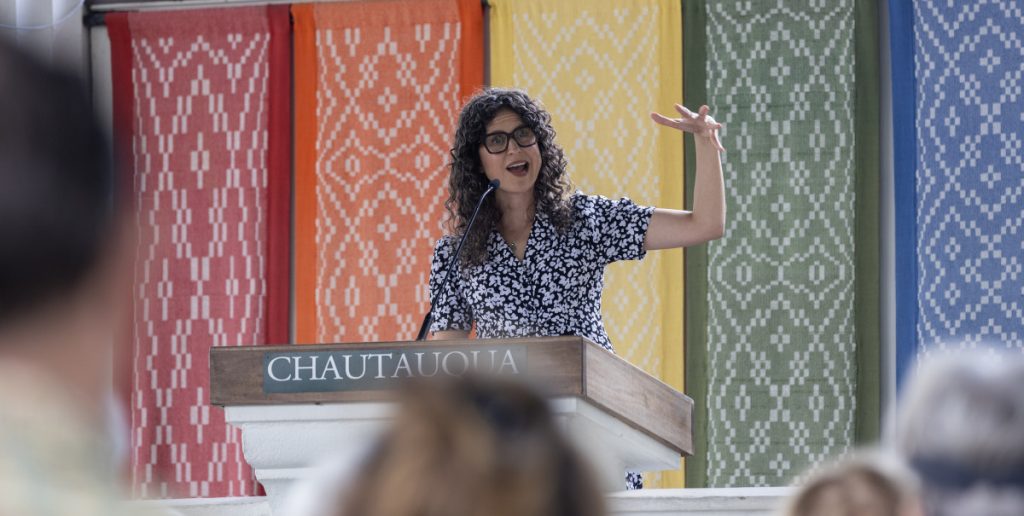
At 2 p.m. Wednesday in the Hall of Philosophy, Wigg-Stevenson delivered “Stop, Do Nothing, Receive: Attending to Art of the Common Good” as part of the Interfaith Lecture Series.
“The context in which we give an artwork our attention, the way we let an artwork work on, in and through us — this matters just as much for the common good as the artists who make the art and the artworks themselves,” she said.
Amid Week Five’s celebration of artists, Wigg-Stevenson said she wanted to invite participation from “those of us who have allowed someone else’s art to create us.” She said her renamed theme would be more like: “Art, Artists and — most of all — Art-Lovers Against the Odds.”
Wigg-Stevenson began with a call for the audience to visualize a work of art that has moved them, without analyzing its meaning or justifying its importance.
“Let go of whatever you’re carrying in here so that you can connect with some deeper part inside yourself — your own spirit, or divine spirit — and from that place of letting go, the invitation is to allow the artwork you wrote down to … emerge from wherever it lives deep inside you and present itself fully to your imagination.”
She told the audience to filter the rest of her lecture through the lens of what makes their selected artwork matter to them.
She said she is not an artist herself, so her lecture is born out of the struggles she recognizes in other art viewers and the opportunities they have to “be better art-viewers for the common good.”
Wigg-Stevenson argued that telling the story of artwork through the lens of “What does it mean?” often eclipses questions such as “Why do I love it?” and “What happened to me, what happened to all of us, that day in its presence?”
Wigg-Stevenson explained this using the example of Rebecca Horn’s “Concert for Anarchy,” a moving sculpture suspended from the ceiling of the Tate Modern in London.
The sculpture is a piano programmed to open suddenly, thrash around and erupt in cacophonous sounds. The collective experience the artwork evokes, according to Wigg-Stevenson, is not one captured by a description of the piece on a wall.
Wigg-Stevenson described art’s potential to alter pre-established perspectives by allowing people to “see what they couldn’t see before.”
She used the example of Dorothea Lange’s 1936 photograph, “Migrant Mother,” saying its iconographic portrayal of a woman named Florence Owens Thompson fostered empathy from middle-class people toward migrant workers — not through pity, but through the “dignity of their humanity.”
“‘Migrant Mother’ provoked a transformation in a whole class of people,” she said.
Art’s power to achieve a common good, such as bridging misconceptions between classes, Wigg-Stevenson said, depends on the “careful attentiveness of art viewers” as much as the power of the artwork.
She called on the audience to think back on their selected artwork and note any “dissonance” it evoked, as she said this clash is the catalyst of art’s transformative ability.
While calling for people to apply this approach to their own art viewership, she acknowledged cultural tendencies to view art as a novelty, high-expense, Instagram-worthy experience.
Wigg-Stevenson referenced the philosophies of Simone Weil on art’s impact on human attention and spirituality.
“It holds us steady, even ‘traps’ us for a moment, … to jump-start our willingness to wait, our desire to empty ourselves, to be reoriented anew, so that we can receive what it has to offer us — that is, its transformation of us and society around us,” she said.
Wigg-Stevenson presented three practical tips to help audiences become “better art viewers.”
Step one is “receive the art.” In practice, she said this means to pause for at least one minute the next time one encounters an artwork that stops them in their tracks.
Step two is “receive irresolution.” In this state of doing nothing, she said, it is important not to form an opinion, analyze or judge. She said sitting in the unresolved is an important part of welcoming art’s transformative effect.
Step three is to “receive reorientation — again, and again and again.” She said this is the moment when one can ask: “What can I now see that I couldn’t see before? … In what way can I now love God and neighbor that I couldn’t love before? And why? And how?”
As a response to art’s continued emotional impact, she said “Concert for Anarchy” continues to unfold in her after 20 years, she re-articulated the artwork’s description, characterized this time by her three tips. Her description included the impact of the artwork on herself and others she shared the room with, using emotive words such as curiosity, guilt and wonder.
Guiding the audience in mindfulness around art, she said, leaves even those who ultimately may remember nothing of her specific references with a transformed moment in their spiritual practice.
She said not “neatly” tying up the lecture is intentional, to leave the audience in a moment where art caused an individual and collective halt.
In alignment with what she called for audiences to practice, Wigg-Stevenson’s reimagined art description of “Concert for Anarchy” focused on feeling, not interpretation. She ended by identifying a common thread between those who lingered in the room with the artwork: “We’re all lingering now together.”