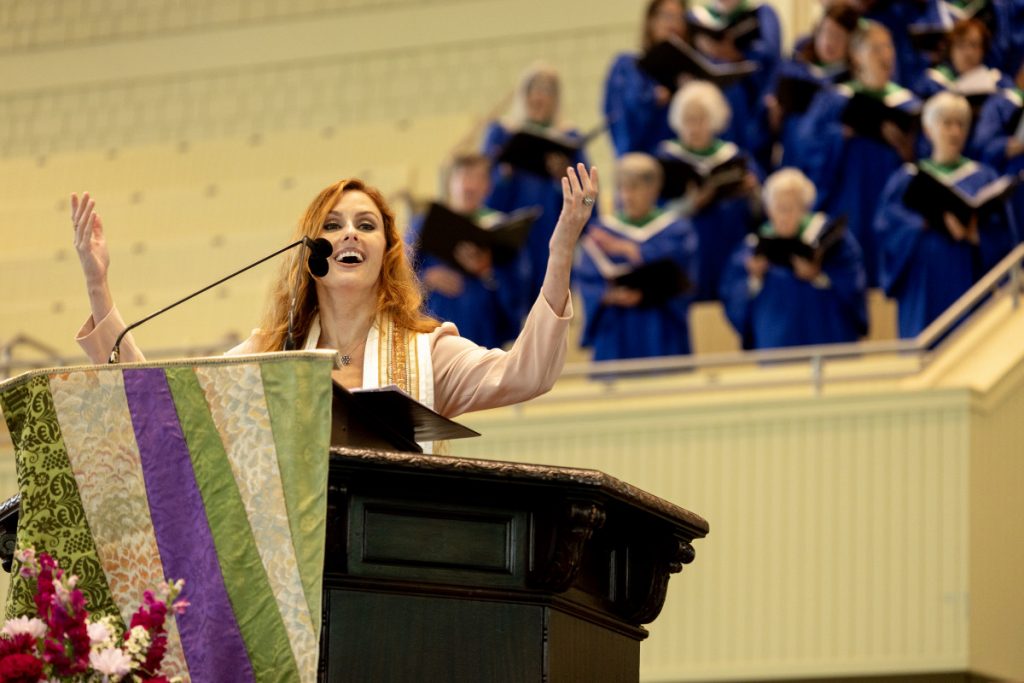
Cantor Olivia Brodsky sings “Hallelujah/Hinei Ma Tov” before delivering her sermon “Music as a Gateway for Spirituality” Sunday in the Amphitheater.
MARY LEE TALBOT
Staff Writer
When someone asks you if you are religious, it can be a very complex question. Cantor Olivia Brodsky asked the congregation at the 10:45 a.m. Sunday morning worship service in the Amphitheater to close their eyes for a moment. “Think of a time when you felt connected to something greater than yourself. Try to evoke that feeling within you.” She suggested watching the ocean, a sunset or singing happy birthday to a stranger in a restaurant.
Brodsky continued, “In those moments, something shifts. Parts of ourselves that may have been dormant are suddenly awakened. Our senses are heightened, and we are entirely consumed by the moment. Some people describe this experience as awe or wonder and others as spiritual or religious. Religion helps us to encounter those feelings of awe and wonder more frequently and with greater intentionality.”
“Music as a Gateway for Spirituality” was the title of her sermon. The Scripture reading was 1 Samuel 16:10–23. Before she began her sermon, Brodsky sang “Modim” by Jonathan Comisar, accompanied by Sonya Subbayya Sutton, interim director of Sacred Music, on the Steinway piano.
“I sang ‘Modim,’ a song of thanksgiving, because music enables me to embody joy in real time. Judaism and perhaps other traditions more broadly teach us not only what to believe, but also how to cultivate our capacity for noticing the blessings that are already before us,” Brodsky said.
Brodsky said her introduction to Jewish worship as a child left her unengaged and playing cards in the coat lobby with her friends. When she encountered a cantor, Mayor Finklestein, who became her mentor, her understanding of worship changed. “Sometimes action is what inspires belief. What changed was how I encountered the prayers. Music taught me what prayer feels like; it became my gateway to Jewish ritual life.”
Music facilitates sacred experiences to allow people to encounter holiness. “Before we have resolved our theology, music allows us to encounter holiness. That, I believe, is one of Judaism’s greatest insights,” she said. “Religion is not merely a collection of ideas about the sacred, it is a set of practices that helps us to perceive the wonders that are already before us. Music was never regarded as mere decoration for worship; it functioned as a medium in which human beings encountered one another and the divine.”
As a vehicle for revelation, music opens the heart and mind to the sacred. We praise God with music, like Psalm 150, when our ordinary language reaches its limits, Brodsky told the congregation.
Music carries an intrinsic power to heal, as in the Scripture for the day, 1 Samuel 16: 10–23. Music therapy is an established part of patient care, she noted. Those with dementia often remember songs from their childhood. Music reaches places where memory can’t.
In Jewish worship, the Torah is proclaimed by cantillation, the chanting of the text. “Torah is proclaimed through cantor, the mark that transforms written text into sacred song,” Brodsky said. “This is not accidental. It reflects a profound theological conviction. Torah study was never intended to exist solely up around the printed page. It was meant to be heard. One who reads scripture without melody and studies emotionally without song has failed to engage Torah as it is meant to be experienced.”
She continued, “We elevate our worship through music. We do this because beauty itself can become a vehicle for holiness. The purpose of beauty is not merely aesthetic pleasure, it is attention. Beauty awakens us. It interrupts routine and prevents ritual from becoming mechanical, reminding us that something extraordinary can be encountered within the ordinary.”
Music draws our full selves into the act of prayer. It asks not only for our intellect, but also our spirit, imagination, emotions and memories. “Only years later did I come to recognize that my own experience reflected something Judaism had understood for millennia: Music taught me what prayer feels like. Long before it taught me anything about theology, it revealed something fundamental about how human beings come to know the sacred. Some realities cannot be grasped through explanation alone; they must first be encountered,” she said.
Religion does not create spirituality. It harnesses it, enabling us to access that which is sacred more easily, she told the congregation. The primary purpose of Jewish ritual is not to prove God’s existence; it is about cultivating the capacity to encounter the sacred in ordinary life.
“Perhaps we have misunderstood the relationship between belief and experience. We often assume that belief produces religious practice. But, Judaism has long suggested that experience can also deepen our beliefs,” she said. “That is perhaps why it is sometimes regarded as a religion of deed over creed. May we continually pursue that which evokes the spirituality within us and continue to open our hearts and minds to the holiness that exists all around us.”
The Rt. Rev. Eugene Taylor Sutton, senior pastor for Chautauqua, presided. Rabbi Samuel Stahl, associate in the Department of Religion, read the scripture. Richard Spivak, a member of the Hebrew Congregation of Chautauqua, read the prayers. Owen Reyda, organ scholar, played “Prelude for the Opening of the New Synagogue in Berlin,” by Hugo Schwantzer, for the prelude on the Massey Memorial Organ. Sonya Subbayya Sutton, interim director of Sacred Music, accompanied and directed the Chautauqua Choir for the anthem, “Hallelujah/Psalm 150,” music by Leonard Cohen and words from Psalm 150. Cantor Olivia Brodsky, chaplain at Chautauqua for Week Four, sang the words to the psalm and led the congregation in singing the chorus. Sutton directed and Reyda accompanied the Chautauqua Choir in the offertory anthem. “Bless the Lord, O my soul,” music by John Dove and text from Psalm 104. For the postlude, Sutton performed “Miriam’s Dance,” by Joel Martinson, on the Massey Memorial Organ. Support for this week’s chaplaincy and preaching is provided by the J. Everett Hall Memorial Chaplaincy and the Randell-Hall Memorial Chaplaincy.