
LILY RESLINK
Staff writer
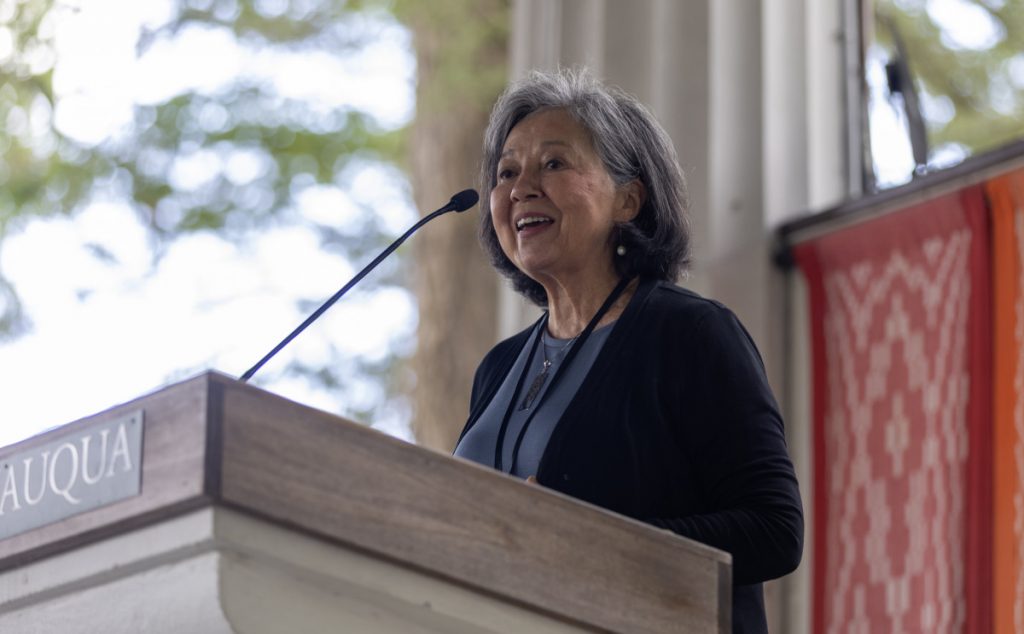
Rita Nakashima Brock explained that humans have existed for 300,000 years and were largely hunter-gatherers until the Ice Age ended only 10,000 years ago. Then, about 5,000 years ago, Brock said, empires began. The scholar, editor and writer spoke at 2 p.m. Wednesday in the Hall of Philosophy about “empire and paradise.”
Brock looked beyond the origins of empire to reflect on what it means for humans to only see “paradise” — in accordance with widespread Abrahamic religions — as something impossible to pursue until the afterlife.
She said empire and its inherently unequal distribution of resources contrasts ancient religious texts and foundational theological beliefs.
Brock explained that humanity’s pursuit of paradise on Earth is contingent on the mindset of not extracting more resources than is necessary to sustain life. The power structures that uphold empire, she explained, take advantage of religious understandings of the afterlife to make people perceive paradise as something they cannot pursue while they’re alive.
This shift in core beliefs, she argued, damaged humanity’s innate understanding of how to live in unity with nature and finite resources. She said the desire for more power and resources stemmed from empire, in which a select few grow in power when people are obedient at their own expense.
In contrast to pre-empire norms of redistribution, wherein no one person or group sought to accumulate exorbitant wealth, she said empires rely on “massive resource extraction” that is accumulated “in pockets of a few people.”
Brock shared her experiences visiting the Arctic, which she described as transplanting her into a way of life she said represented the 300,000-year-old human lifestyle of only taking necessities from the Earth.
“For most of our existence as a species, humans lived as arctic peoples in tribal units with seasonal migrations that followed food sources,” Brock said. In hunter-gatherer societies, she explained, “excess surplus is a liability because it takes more calories to carry it than redistribute it.”
She said that before the development of empires, societies were naturally reliant on redistribution as a survival strategy. “Sharing is a central value. If you have too much, give it away.”
Traditional Indigenous feasts called “potlatches,” marked by times of celebration like weddings, reflected this norm. In these feasts, leaders signified their status by giving away possessions and valuables. Brock said the U.S. and Canada banned these “because they don’t fit the good capitalist values.”
Referencing the work of scholar and author Luke Kemp, Brock named the “dark triad of traits” that characterize empire: sociopathy, narcissism and Machiavellianism. Brock continued, saying Kemp said the collapse of empires is inevitable.
Brock also named several of the reasons that Kemp listed for empire’s collapse: decisions from the lower class to return to hunting-gathering, pandemic, internal revolt, invasion from other empires, climate change, massive inequality from bloat at the top and “feckless, incompetent rulers.”
“Of course, we can see some common current applications of this,” Brock said.
Empires, according to the patterns analyzed by Kemp, collapse after 400 years. She said Kemp warned that if the cycle through various forms of empire continues, humans will face extinction in the next 500 years. According to Brock, Kemp sees democracy as the alternative to empire; it is “fragile” but “perhaps, our best hope.”
Brock used history and modernity to explore the question of whether religion can help save society from the resource drainage and inequality she argued are the result of imperial mindsets.
“What if a core problem is the very idea of power and authority itself that is carried forward in imperial religions and orients people to obedience to an invisible ruler?” Brock asked.
She pointed to the role of religious texts in reinforcing empire.
“We tend to separate out these ideological elements of religion and human rulers as political, but gods parallel the hierarchical imperial systems they endorse …” Brock said.
She said constructs within empires have enabled monotheism to support unquestioned obedience in ways that perpetuate the maintenance of power at the top of an empire. Pointing to examples from Judaism, Brock said it is positive for faith practices to encourage questioning and interrogation. In her perspective, the mindset of unquestioning loyalty is contrasted by faith practices — also in ancient texts — that are rooted in stability and cooperation with the natural world rather than at its expense.
In association of Abrahamic religions with “ethical monotheism,” she spoke about how ancient religious texts applied moral laws equally to all people.
Feeding the hungry, healing the sick and questioning theology, according to Brock, are teachings that support sustainable human practices in conjunction with the pursuit of paradise on earth.
“It was only in college that Christianity began to make sense to me in an Old Testament class, which taught me to see Jesus in the long prophetic trajectory of resistance to oppressive power and a commitment to justice and human flourishing,” Brock said.
These biblical teachings, she said, are a guide to fighting empire.
“I confess, I was a rebellious child,” she said. “I didn’t like to be ordered to do things, and I questioned authority — which prepared me to be a feminist but not a faithful person in an empire.”
She said ancient texts describe the mission of the church as being “paradise in this world so that human life could flourish.” According to Brock, literature about paradise is concentrated on ancient texts, which holds implications about the dilution of this mission when it does not benefit empire. She named several descriptions of and terms for paradise from different traditions.
“We can see these stories and descriptions of paradise as nostalgia for a lost world, perhaps. But we might also hold them as a vision for creating communities of resistance against survival as we struggle through the many years ahead.”
Brock concluded with an excerpt from her book with Rebecca Ann Parker, Saving Paradise: How Christianity Traded Love of This World for Crucifixion and Empire that called for people to be “more responsive to and responsible for life in this world.”
“All is not lost,” Brock said. “There is still beauty and life here. Let us save it.”