ARIANNA NEVAREZ
Staff Writer
At 10:15 a.m. Tuesday, Rachael Zoe Miller, an ocean conservationist, author and National Geographic Explorer, was told she was going to be on the Amphitheater stage at 10:45 a.m. the following day. She said this was the biggest “put me in, coach” moment, but it was also a “it takes a village” moment to help “upgrade her informal wardrobe to reach the magnitude of this stage.”
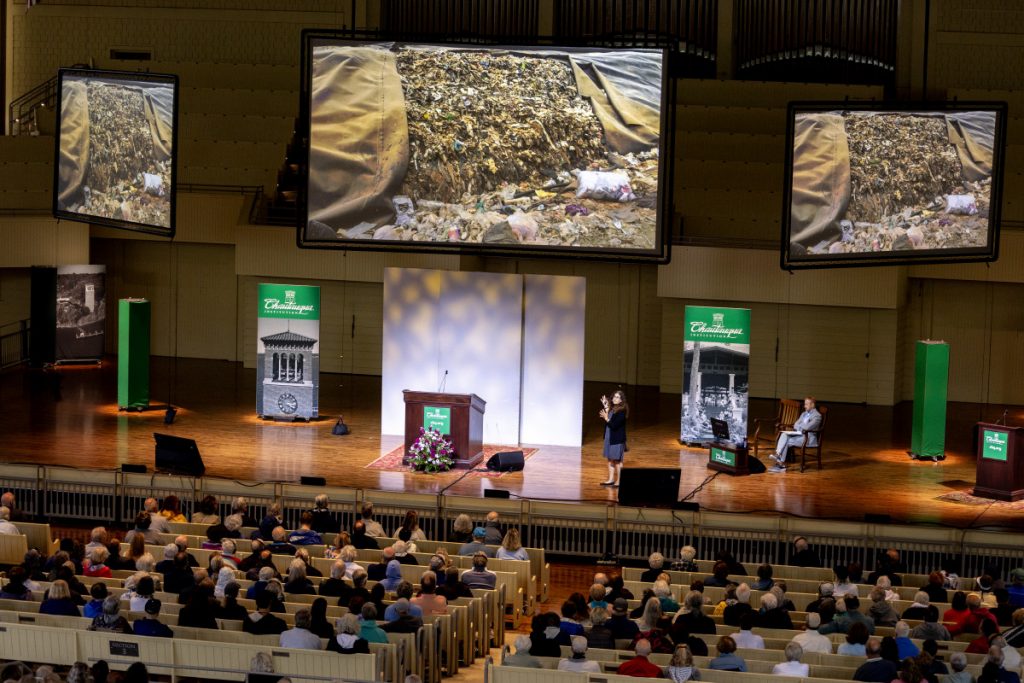
At 10:45 a.m. Wednesday in the Amp, Miller took the stage with a discussion focused on her marine debris expeditions and microplastics in the ocean.
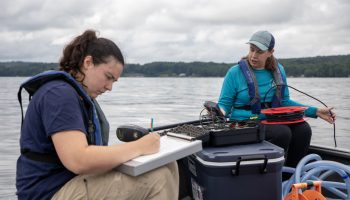
Miller is a co-founder of the Rozalia Project for a Clean Ocean, which is “dedicated to protecting the ocean, lakes and rivers” and “conserving a healthy, thriving marine ecosystem.” She said the team works on a marine debris model and uses “data cleanups” to understand specific microdebris in different areas.
“We are optimistic in the face of an overwhelming problem at beaches …,” Miller said. “We remain optimistic because we recognize that the collective ‘we’ got us into this literal and figurative mess, and we believe that the collective ‘we’ can ultimately get us out of it.”
To contextualize the projects she works on, Miller highlighted her work on the Gulf of Maine. In a collaborative program, the Rozalia Project collected 100,000 pounds of waste. They also took note of the pieces of fishing gear they collected to understand how it got there and thus prevent it from re-entering the ocean.
Miller cited “the generation of plastic waste” as a starting point to locate her work in sustainability and oceanic conservation. She said marine debris or trash is often transported to the sea from rivers, whose routes are determined by winds and currents. She said locations of waste accumulations like the Great Pacific Garbage Patch were portrayed in a hyperbolic manner. More realistically, Miller said, there is a “microplastic soup” at the center of ocean gyres.
“You can sail across the ocean and see some big fishing gear, but mostly, what you’ll see is a big, beautiful ocean,” Miller said. “But if you dip a net with fine mesh in there, you will come up with handfuls of microplastics. Then, moving to understanding the exact location of all of this microplastic, what we find is that the science is still a little wide. It’s still a little new.”
As more microplastics show up in the ocean, they affect marine life, according to Miller. She said about 1,300 species have microplastics in their body. Not only does this affect the creatures underwater, but the issue also transfers to humans. She said, “Microplastics and hydrofiber have been found in foods — alarmingly, in foods that are just grown with relatively limited handling.”
Besides food, Miller said microplastics are found in tap water, and even higher numbers of these plastic fibers are found in water bottles. At a microplastic summit a few years back, she said she sat next to a researcher who studied bottled water and microplastics; she brought up the high number of microplastics in such a small amount of water to him, and he replied by saying, “After doing the study, I don’t let anyone I love drink from a plastic water bottle.”
“Can’t get more powerful than that,” Miller said.
Miller went on a National Geographic-Lindblad Expedition Cruise to sample air and water, during which she sought out and investigated microplastics and microfibers. She specifically looked for hotspots of microplastic or microfiber in the Arctic and Antarctic regions.
Because the Arctic city of Svalbard, Norway, had one of the lowest populations in the region, it was an “unexpected” hotspot. With further research, the team found that the high microplastic concentration was due to currents. In the Antarctic region, Marguerite Bay had currents that brought microparticles from North America — specifically, microfibers from textiles.
“[Antarctica is] such a precious place that we want to make sure that our data are as specific as possible, so that we can communicate with ships and their passengers and how they organize field staff …,” Miller said. “We need to know who to talk to, and so part of our data collection is to identify the source of these microparticles.”
Miller visited landfills in Jakarta, Indonesia, on another marine debris expedition. There were mountains of consumer debris “not really breaking down, but just hanging out,” including clothing, home textiles and plastic bags.
While Miller was visiting, she said trucks kept bringing more and more trash. As this was happening, she observed people with baskets going through the landfills in hopes of finding something of value. She said there were “so many people involved in this exchange that there’s a guy selling snacks up there halfway up the mountain.”
“This, to me, is a system that isn’t working,” Miller said. “It is a study in inefficiency.”
However, there is good news about people trying to find balance, Miller said. At the bottom of the mountains, multiple initiatives are trying to reduce the waste, from machines picking out the plastic bags people send with compost to Waste4Change, an ethical trash-sorting company.
“David Wallace-Wells used the term ‘small numbers in the big world.’ The way I say it is, ‘lots of littles make a big,’ and this is a great example,” Miller said. “It is overwhelming to look at those trash mountains, but then think, ‘What if there was one of these (initiatives) in pretty much every neighborhood hiring people that needed to work and diverting all of that trash?’”
Miller discussed sustainability solutions targeting waste around the world. Alternative materials in the textile industry can create more sustainable fashion, she said. Some examples she used included a green tea-based leather alternative and a company in Finland that creates regenerated cotton.
Miller said one way to advocate and support conservation efforts is to support policies requiring microfiber filters in washing machines. Countries have begun creating laws toward change on this issue. She said education can happen in many ways, like through art and books. Miller said “interdisciplinarity is a solution,” and “bringing together different people from different areas makes for better action.”
“What we’re here to do this week, and what we’re talking about — whether it’s with clothes or microplastics or air pollution, or whatever it is — ultimately, is to preserve the opportunity, the option to be able to see ice as far as the eye can see for your kids, your grandkids and your great grandkids,” Miller said. “If anyone can make a big ripple effect, I know that it’s here.”