Column by Mary Lee Talbot
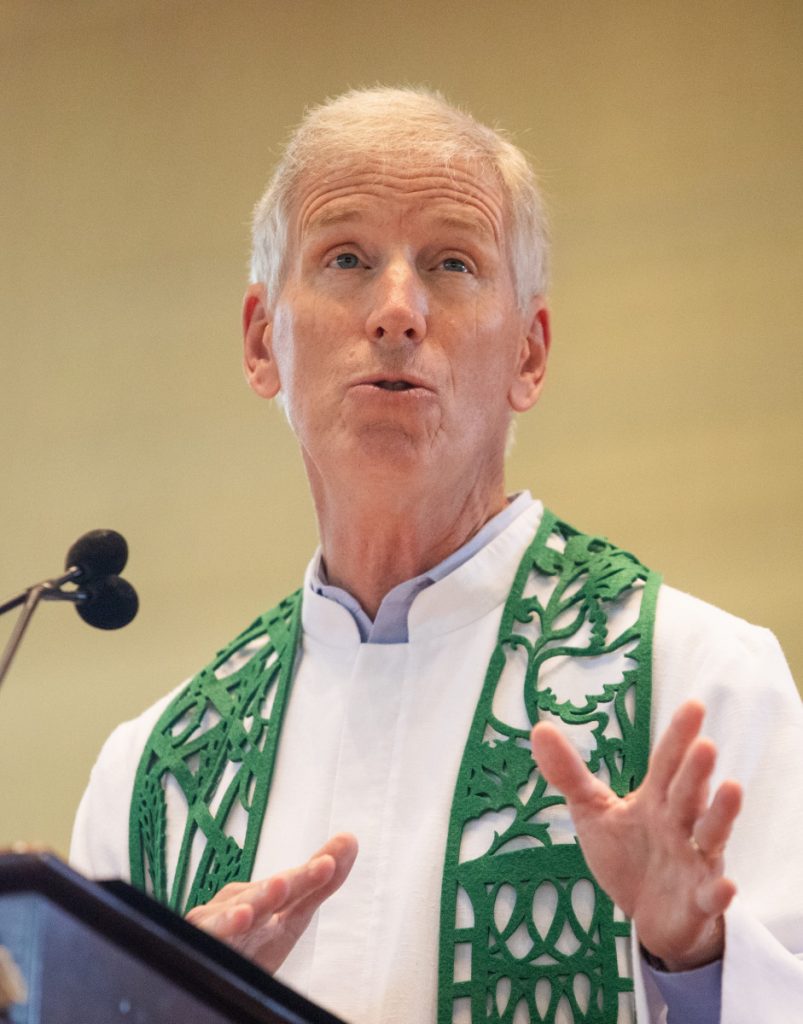
Recalling the days in early July 1776 in Philadelphia, the Rev. Robert Henderson, chaplain for Week Two at Chautauqua Institution, began his sermon with a story. Henderson’s sermon title was “A Spacious Moral Vision,” and the scripture reading was Matthew 15: 1–14.
It was July 1, 1776, and John Adams had risen to speak, stating clearly that “looking into the future, he saw a new nation, a new time.” After Adams had been speaking for nearly an hour, the two delegates from New Jersey, Francis Hopkins and the Rev. John Witherspoon, arrived. Witherspoon, a Presbyterian minister and the only clergyperson among the delegates, asked if Adams would mind repeating his address. Adams objected, but the other delegates urged him to speak and so he gave his hour-long speech over again.
Debate on the proposal for independence lasted for nine hours, and in a preliminary vote, nine colonies voted in favor. They adjourned for the night and, on July 2, another vote was taken. No one opposed the motion and the colonies voted for independence.
According to historian David McCullough, Adams thought July 2 would be the most memorable day in the history of America. “It ought to be solemnized with pomp and parade, with shows, games, sports, guns, bells, bonfires and illumination from one end of this continent to the other from this time forward forever more.”
It took the Continental Congress two more days to finalize the wording of the document. Thomas Jefferson’s words still echo: “We hold these truths to be self-evident, that all men are created equal, that they are endowed by their Creator with certain inalienable rights, that among these are life, liberty, and the pursuit of happiness.”
Henderson said, “I love that story. I love the references to the Creator, to the will of God and the idea of freedom in the heart of the whole enterprise … I am also humbled and haunted by the truth that not all people experience this country as a place of freedom, nor have all men, not to mention women, been treated as equals.”
As an example, Henderson offered an analogy by columnist Leonard Pitts of how the grand initial vision has devolved. Pitts said the last 50 years in America were like getting invited on a bus from Tampa to Seattle. But the bus stopped in Kansas City, a nice enough place, but people boarded the bus to go to Seattle. Pitts said, “Let’s not get too comfortable and set up house halfway to the destination, because ritual observances can ring hollow if the initial vision remains unfulfilled.”
In Matthew’s Gospel, Jesus suggested that the religious leaders of his time had lost their original vision, and that in time, the rites and rituals of their religion defined their faith more than the original vision. That made Jesus angry and the anger spilled out on the Pharisees when they asked why his disciples did not wash their hands before eating.
Henderson said, “It helps to remember that the Pharisees lived in a hostile culture. Roman occupiers regularly reminded Jews of their lower social, political and religious status. The Pharisees were doing what tradition required: keeping tradition, maintaining structure and establishing boundaries to maintain their identity.”
In Jesus’ day, handwashing was not a normal practice; if a Jewish person washed their hands before eating, they were signaling something distinctively Jewish, a declaration of who they are and to whom they ultimately belonged. Jesus’ disciples threatened Jewish identity by not following Jewish tradition, and the Pharisees let Jesus know that.
“Everytime I read this story, I wonder if Jesus is simply worn out by the dissonance of his faith and theirs. He was healing the sick people and casting out demons, and the only thing the denominational officials want to talk about is dirty hands,” Henderson said.
Henderson continued with a story of presiding at a funeral for a child. The whole congregation pitched in to show extravagant love for the child’s family. After the service, one person accosted him and said, “Dr. Henderson, did you see the flowers in the hallway? They were wilted! This is unacceptable; who do I talk to about this?”
Jesus got angry at the religious leaders because they forgot the ‘why’ of faith, which is to love God with all our heart, soul, mind and strength and our neighbor as ourself. Jesus warned them to beware when their traditions got in the way of being faithful.
“Beware, you religious people, when faithfulness becomes more about maintaining tradition than loving God. Beware when your faith serves to preserve the status quo more than loving your neighbor,” said Henderson.
He warned that these stories and images of the Pharisees have contributed to antisemitism. “Let me be clear, the Pharisees are not as sinister or unique as some have suggested. Similar accusations have been made against clergy who sell out to self interest or never take a stand.”
Henderson continued, “In my experience, the real reason is not sinister. Clergy and community share life over years, and that makes conflict more difficult. When you share the joy of living in community with so many faithful people, it can seem petty to denounce the status quo.”
He told the congregation that now is not the time to “revert to ritual in hopes of maintaining a shallow peace. It is the time when God asks each of us to use whatever power and influence we have to stir up good trouble, trouble that tilts the world toward God and neighbor.”
Reynolds Price, former professor of English at Duke University, wrote in A Serious Way of Wondering: The Ethics of Jesus Imagined, “Anyone who today wishes to consider what Jesus might have done at any crossroads of moral choice could hardly do better than reflect upon a single command — you shall love your neighbor as yourself. It is a spacious moral vision.”
Christian faith embodies a spacious moral vision centered on the love of God and neighbor, Henderson said. “That’s the heart of the matter, the heart of the church, of my church, your church, the heart of the temple, the heart of the mosque.”
He told the congregation that it is hard to know where to begin, but it could be the person one walked to church with, the neighbor who lets her dog run off the leash or forgets to take in his trash cans, neighbors in the temple or the mosque, neighbors who live in the big house on the hill or public housing across the tracks.
“If we want to be more like Jesus, we will focus on the vulnerable, the immigrant, the housing insecure, the gender threatened, the racial minority. That’s the ‘why’ of our faith: to be an embodiment of that God/neighbor love right here on Earth.”
Poet Wendell Berry wrote in his poem, “Our Real Work,” “It may be that when we no longer know what to do / we have come to our real work, / and that when we no longer know which way to go / we have come to our real journey.”
Henderson said, “I think he’s right.”
The Rt. Rev. Eugene Taylor Sutton, senior pastor of Chautauqua, presided. The Rev. Mary Lee Talbot, Ph.D., read the scripture. Organ scholar Owen Reyda performed “Festival Prelude” by Horatio Parker for the prelude. The Chautauqua Choir sang “Hymn for America,” by Stephen Paulus under the direction of Sonya Subbayya Sutton, interim director of Sacred Music, and accompanied by Reyda. The offertory anthem, sung by the Chautauqua Choir, was “The Promise of Living,” by Aaron Copland. The choir was directed by Sutton and accompanied on piano by Arlene Hanjinlian and Reyda. “America the Beautiful,” music by Samuel A. Ward, setting by Cecil Effinger and text by Katherine Lee Bates, served as the doxology. The postlude was “Toccata for America,” by Brenda Portman, played by Sutton on the Massey Memorial Organ. Support for this week’s chaplaincy and preaching is provided by the Geralsine M. and Frank E. McElree, Jr. Chaplaincy Fund.