ROCCO PRIOLETTI
Staff Writer
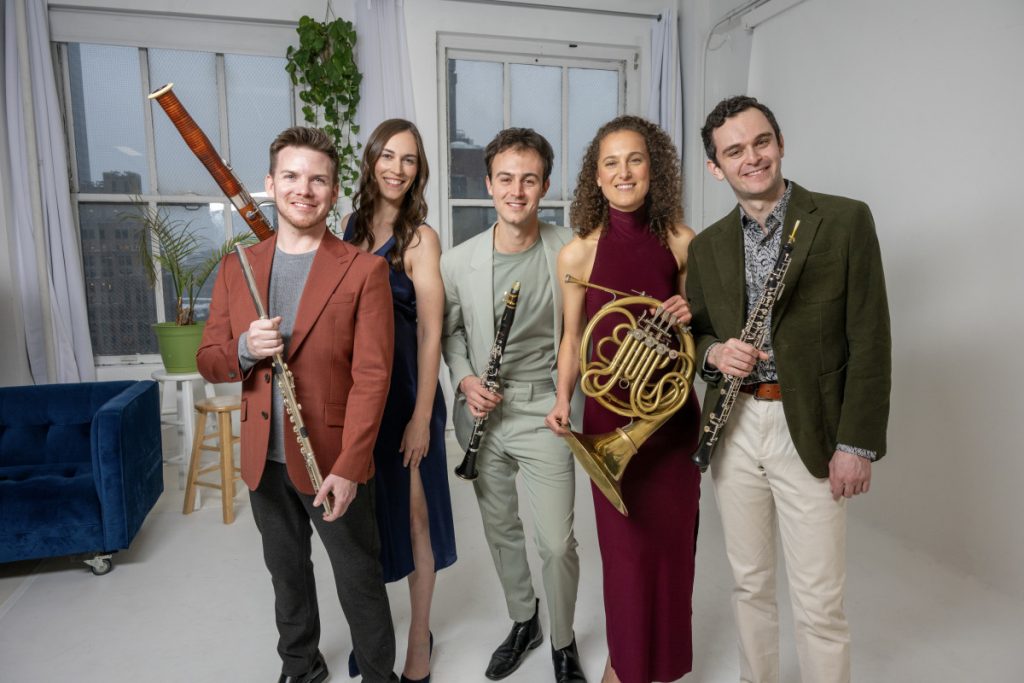
This afternoon, WindSync returns American classical traditions to the air with their diverse repertoire. The wind quintet will perform three pieces by Nadia Boulanger from their latest record, Nadia, released earlier this April.
“The album honors Nadia Boulanger, who is probably the most influential teacher of music of American musicians in the 20th century, in addition to being a conductor, composer, lecturer [and] an incredible guide of modern music as it emerged across the world,” said Kara LaMoure, WindSync’s bassoonist and artistic director.
The program is rounded out with a rendition of Phillip Glass’ Piano Etude No. 17 and Elliott Carter’s Woodwind Quintet, which was dedicated to Boulanger.
“These are two quintessential New York composers who … really exemplify some of what makes American classical music American,” LaMoure said.
She contrasted the two opposed avenues that the composers led music down. To her, Glass embodies the “bustling,” train-like, “mechanical sound of minimalism,” while Carter personifies the ultra-modernist school of complex, jazz-like rhythms.
“And if that doesn’t kind of span two of the main threads of American classical music, then I don’t know what does,” LaMoure said.
Though Glass and Carter’s musical expression vary vastly in sound, what ties the two together is their shared relationship as composition students under Boulanger. While the French composer’s style was akin to the impressionism of Debussy or Ravel, LaMoure views the way Glass and Carter vastly reinterpreted Boulanger’s influence to be “a testament to her teaching.”
“… It liberated the individual voice of each composer. … American music … is characterized, basically, by diversity, which is so exciting,” LaMoure said. “And so, any American ensemble performing today, and coming from that legacy, is going to play in a diversity of styles. And I hope that that is shown by our program.”
WindSync’s program asks where the legacies in American music originated, highlighting the individual voices that sculpted them.
At 4 p.m. today in Elizabeth S. Lenna Hall, WindSync will deliver their performance, culminating in Mozart’s Serenade in C Minor, K388. The closing statement visits the origins of chamber music itself.
LaMoure described Mozart as a composer who “brought the winds indoors,” distinguishing them from solely being the voice of nightlife music.
“But, Mozart felt that there was something more he could say with these instruments. And his wind serenades, while they weren’t initially kind of commissioned in this environment of winds-as-outdoor-instruments, he actually created something dramatic, almost operatic-sounding,” LaMoure said.
An aspect that distinguishes WindSync from other chamber ensembles is their penchant for playing from memory onstage. What started from memorizing Prokofiev’s “Peter and the Wolf” for school performances to “break that fourth wall” between an audience of children, ultimately formed unique connections with even the “most seasoned concertgoers.”
“I think that performing from memory now, for us, reveals just our trust in each other and our deep knowledge of the piece,” LaMoure said. “And, [it] frees us up to have spontaneous and playful moments once we’re on stage through that nonverbal physical, visual communication.”
This aspect allows for slight variations in performances; these may manifest in changing accent placements or by echoing each other’s different pronunciation of phrases.
“And that’s really the essence of chamber music, is the spontaneity and flexibility of a small ensemble,” LaMoure said.
LaMoure notes the frequent ornamentation, or musical flourishes, of clarinetist Graeme Steele Johnson and fellow CSO oboist Noah Kay during Mozart’s Serenade.
“I never know what ornaments they’re going to slip in on any given night, and you can feel how them playing off of each other then drives the way that we all perform the piece,” LaMoure said.