
SOPHIA ROOKSBERRY
Staff writer
After gestating for three years and completing a run of previews over the weekend, the official opening of Best for Baby will take place at 6 p.m. tonight in Bratton Theater.
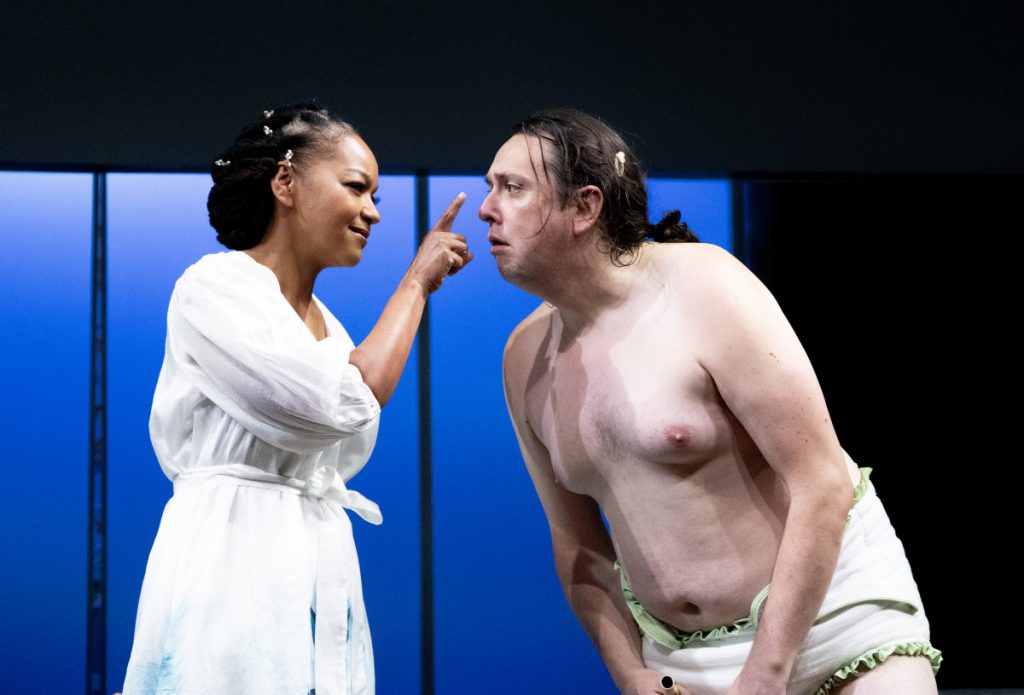
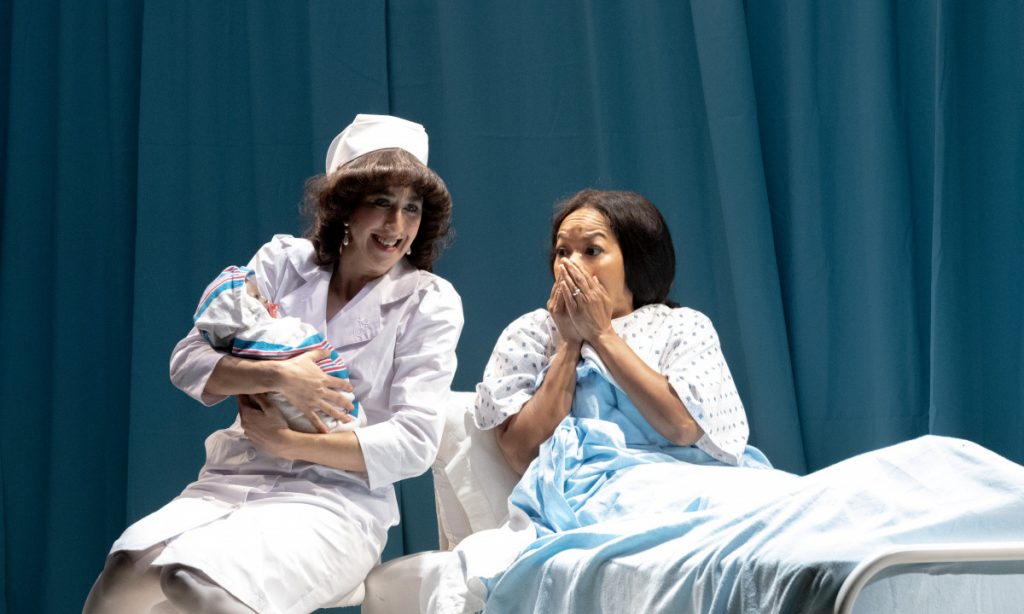
Best for Baby takes audience members through decades of Johnson & Johnson’s scandalous history, from the discovery of asbestos in its baby powder in the 1970s to its filing for bankruptcy in 2024. The multi-billion-dollar company serves as the play’s central character, but in the form of a personified manchild named Johnson, played by Brian Owen.
Juxtaposing the diaper-clad, tantrum-prone narrator with her calm and empathetic demeanor is Joyce, portrayed by guest actor Crystal Dickinson.
“We see a big span of [Joyce’s] life, which is really cool,” Dickinson said. “She works for the company and you get to really see the arc of how that has impacted her life, and I think that it’s important for audiences to see that the decisions that are made by people with power have real impact on everyone and everything, and that it is important for us to hold people accountable. I think Joyce helps us to see that in a really human way.”
After spending two summers as a teacher for the Acting Conservatory, Dickinson joined Best for Baby when it was presented as a New Play Workshop last year.
“I read the play, and it was just spectacular, and immediately after those readings were presented, they announced that they were going to do the show,” Dickinson said. “That’s how great it was. The reception was just so positive from the show, and when they asked me to do it here, it was a reason to come back.”
Dickinson has undeniably influenced the play during her time on the grounds, both through her personal insights and her working relationship with playwright Sharyn Rothstein.
“Much of the harm that was done because of this baby powder was done to African American and Latino populations,” Dickinson said. “To be able to represent that and to be able to tell that story in a human way, and for Sharyn to trust me to explain to her what my life is like and to explain to her the perspective she may not have, and for her to be so open and willing to utilize that in the play and in her writing has been so affirming in a way that I didn’t expect.”
Unlike Dickinson, guest actor Olivia Oguma joined the cast of Best for Baby this summer. Despite the brief rehearsal time, she said she felt the effects of the nuanced story almost immediately and found rewarding acting challenges within the script.
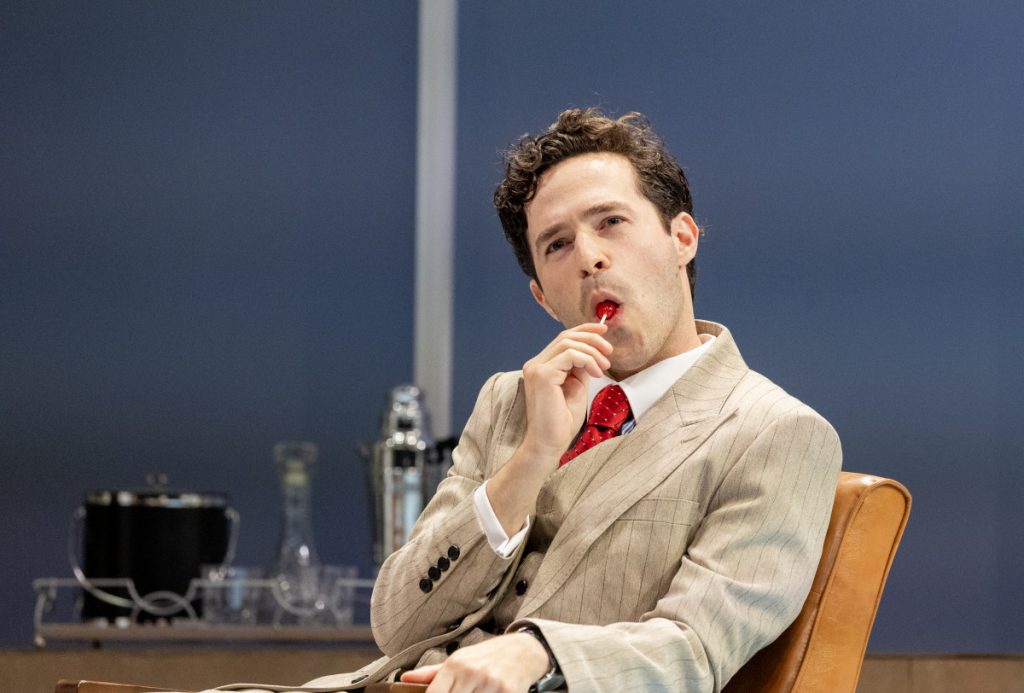
“We’re rooted in this reality of these terrible things that happened because of corporate greed and America and the way that things work, but we’re able to draw the audience in with this comedic element,” Oguma said. “… What I’m doing is very serious, and then sometimes I just have to try and not laugh because Brian, who plays Johnson, is so hilarious.”
Oguma’s primary role in Best for Baby is Christine Yang Slackman, a marketing employee at Johnson & Johnson. As concerns about the baby powder scandal continue to grow throughout the company, Oguma’s character is enlisted to keep the product on the shelves. Despite the ill intentions motivating her character, Oguma believes Christine maintains a strong moral compass.
“I love this role because I think she’s really interesting, and she’s also not a stereotype,” Oguma said. “… If I could have my pick … I would want to do roles that are not one-dimensional, not stereotypes and get to play in the present day.”
In addition to multifaceted characters, the varying dimensions of Best for Baby pose a challenge for the designers. Amith Chandrashaker designed the lighting for the play and found himself constantly toeing the line between comedic and dramatic design.
“The bending of the government by lobbyists or other interest groups to shape law to allow for the cosmetics industry to do what they want is very scary … but it’s told through such a funny way,” Chandrashaker said. “… I wanted the lighting to make sure that we’re always in the comedic world and then we drop into that reality of like, ‘Oh my God, what they’re talking about is very serious,’ [and] for that to really resonate and hit.”
Emotionally turbulent plays often come with significant messaging for the audience to take home with them, and Best for Baby is no different. In this case, those lessons are a plea for audience members to continue speaking out against corporate greed and corruption. Audiences will have a chance to experience this call to action until the last run of the surreal tragicomedy on Aug. 2.
“I hope that [audiences] see themselves, even if they don’t identify with us demographically, as people who are going through something,” Oguma said. “It’s a difficult situation, because in this play we are directly targeting a certain group of people to try and keep a product on the shelves to make money … I hope that people are able to see the bigger picture: ‘Even if it didn’t affect me personally, it affected other people, and I want to … fight for what’s right.’”