
LILY RESLINK
Staff Writer
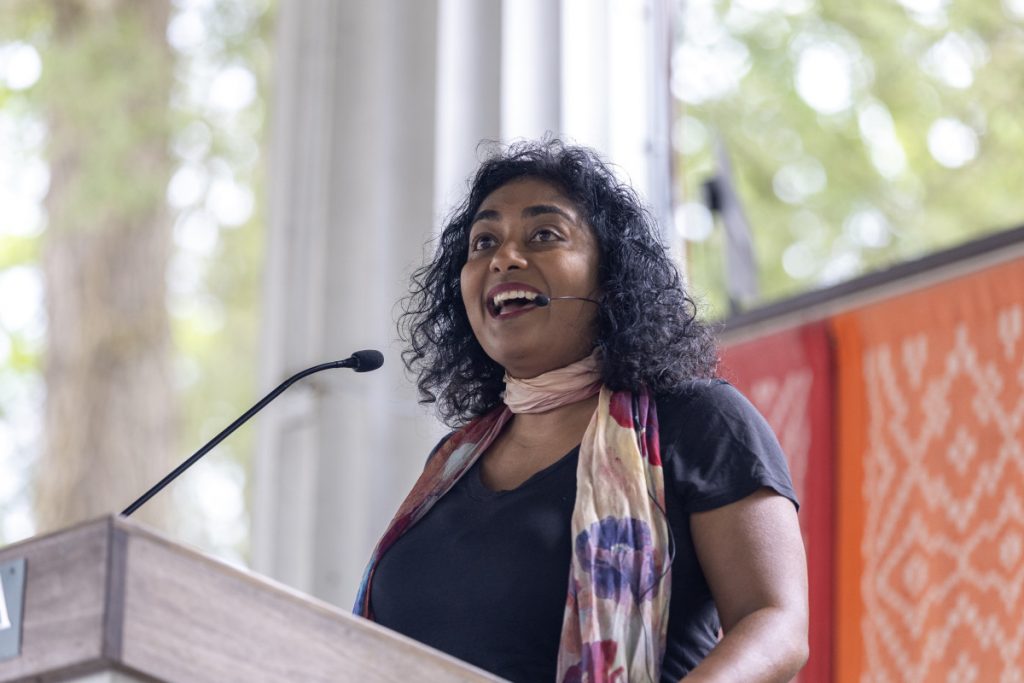
At its core, Sonya S. Cronin’s Interfaith Lecture was a testament to the power of story as a source of hope.
Her 2 p.m. Interfaith Lecture took place Tuesday in the Hall of Philosophy, where Cronin suggested that what society does with trash is a commentary on culture, and what society treats as trash includes humans.
“We do to people what we do to trash — send them away out of sight, and hopefully out of mind,” Cronin said.
Cronin critiqued this behavior and said she is “here to declare that all people matter, even if we in America treat 1.9 million of our co-citizens as disposable trash.”
Cronin is the founder of The Carrier Pigeon Post, a nonprofit newspaper that brings poetry, essays and stories to incarcerated people throughout the U.S. She spoke about the power of stories to act as vehicles for hope, especially for those who lack their own hopeful narratives to draw from.
“CPP may not raise the dead or even turn water into wine, but it does feed 26,000 people (with knowledge) every month who are desperate for hope,” Cronin said.
“The grammar of prison, the psychology of shame, the sociology of isolation, the architecture of surveillance, the docile body — the machine efficiently manufactures despair upon despair, but we already know that hope combats despair,” Cronin said.
She said while people may generally consider certain conditions as cruel to both people and animals, such as being confined to a small space with no air conditioning, these conditions are still permitted in prisons. This treatment, she said, proves that society includes groups of humans within the “throwaway culture” usually associated with material trash.
Cronin explained how the places that society sends its trash inherently become places of despair. For the people that Cronin said are treated comparably to trash, she said despair is a pervasive reality. She emphasized this point with a story from biblical times about a “very sinister” trash heap called “Gehenna.” As a place “where all the bad people were banished to burn forever more,” she said it became equated with hell on earth.
She paralleled this to what she explained to be a cycle of despair for many people in prisons; without the ability to envision a way out, it can become difficult for people to find hope or imagine an alternative.
“We may have abolished torture, but we have become very good at punishment,” Cronin said. In her perspective, she said, the constant reinforcement of dehumanizing treatment — such as being a number rather than a name — is particularly destructive for those who already come from struggle.
“Those who live at the extremities of society know despair is relentless in ways that comfort cannot imagine,” Cronin said. She added that despair enacts its cruelest work in secret.
“The self, already struggling, is now erased,” she said.
Whether “homegrown” from one’s own narratives or “borrowed” from another, she said hope cannot be without a source.
“Hope, once borrowed, carries a person past a wall that the past had built, and hope always finds a way. The only question that remains is who will carry that hope.”
She emphasized hope as a “public good” that transcends any religion. She said the role of public theology is “to concede despair.”
Cronin said, “Public theology faces the worst squarely in the eyes. Public theology gives hope to the hopeless.” Stories, she said, also “create a world and invite readers to come in” with no requests in return.
“Story, and thus hope, plots new roads with new possibility.”
Cronin said, regardless of disparity in one’s misfortune throughout life, it’s never too late to introduce hope.
“We can change how culture has decided to throw away trash, or we can turn a blind eye,” Cronin said. “May the crumbs that fall from the table of this humanity’s heaven feed those who our country has thrown away.”