NORA SMITH
Staff writer
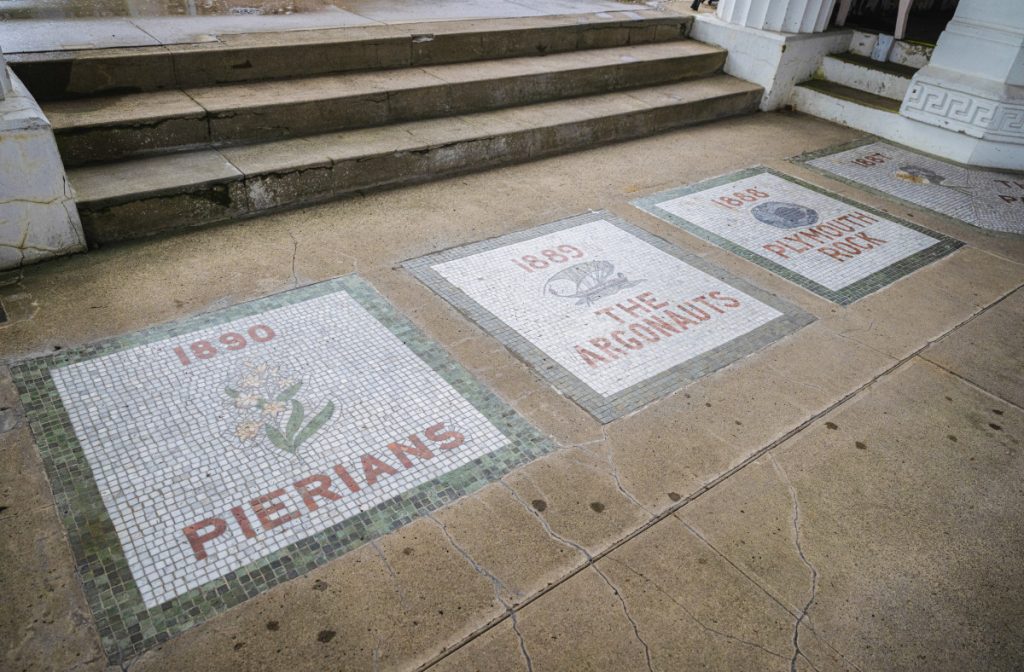
If you’ve ever looked down at your feet in the Hall of Philosophy and noticed the color hiding below, you may have wondered what could be right beneath your feet. The tiles adorning the Hall of Philosophy are the history of Chautauqua, artistically documented through mosaics.
In the past three years, the Chautauqua Literary and Scientific Circle Class of 2000 Mosaic Project has restored 26 of the 51 mosaics wrapping around the perimeter of the Hall of Philosophy.
The original president of the CLSC class of 2000, Thomas Rowe, established the endowment to preserve the mosaics in 2000 and managed the project until 2015. Now, the Tile Mosaic Committee includes Karen Paul, John Dilley and Margaret Minor, all of whom have been elected to serve as presidents of the Class of 2000 alongside Class of 2000 Secretary Ellen Chamberlin; the group intends to work for another two years until the project is completed in 2028.
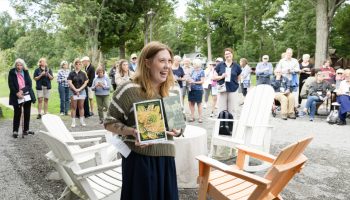
“We’re going to stay together as long as we can,” Paul said.
Paul said the committee has raised $79,000 toward its $100,000 goal and plans to continue maintaining and sealing the mosaics every two years. She said the Alumni Association of the CLSC helps to collect and record all donations, and according to the AACLSC’s website, the committee most recently completed restorations for 1886, 1889, 1898, 1899 and 1900 in the spring.
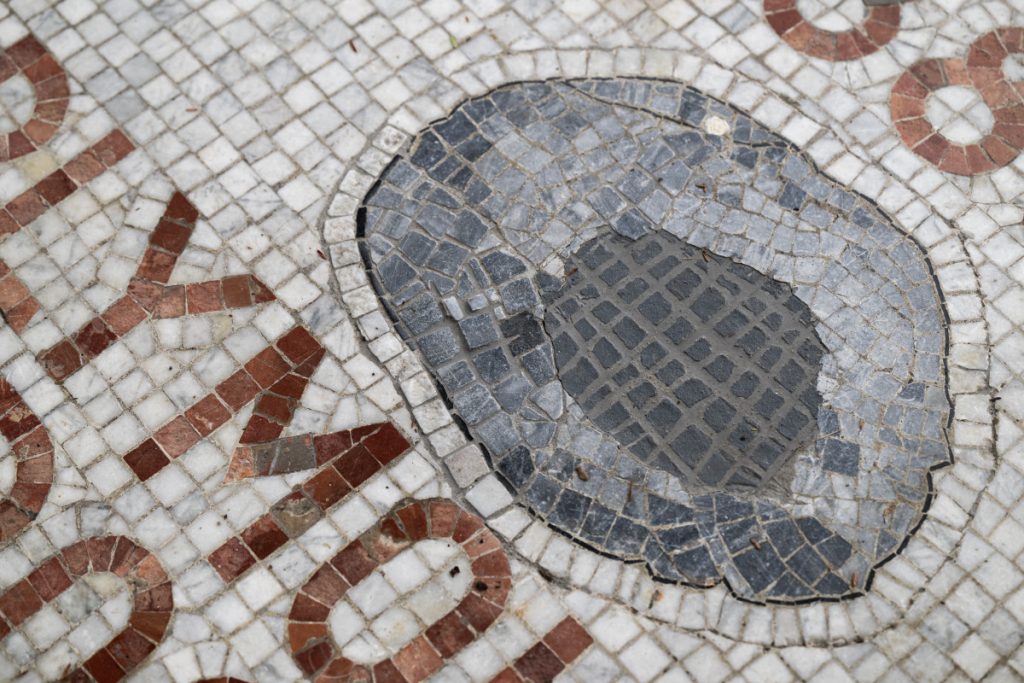
Paul said donations for the project can be made through the AACLSC’s website, and the committee’s goal is to reconstruct at least eight more in 2027.
“This is really an encyclopedia of Chautauqua,” Paul said. She explained that the first structure at the site of the Hall of Philosophy was built in 1879, and after the 25th anniversary of the CLSC, construction began for what is currently known as the Hall of Philosophy and the first mosaic was installed for the CLSC class of 1882.
“Every [CLSC] class was allowed to pick a design, their name, and they actually picked their own person to do the mosaics,” Paul said. She added that the committee has been doing research and discovering new facts about the mosaics.
Paul specifically pointed out the 1978 mosaic, which her friend recently discovered, honors the centennial anniversary of the CLSC; according to a July 19, 1978, article in The Chautauquan Daily, every member of the CLSC at the time contributed money for individual tiles and would then sign the Golden Book.
“[The Golden Book] is supposed to be in Pioneer Hall, but nobody knows where the book is,” Paul said. “So, I’m trying to find it. Nobody’s even heard of it before, but to find these stories about every single mosaic, it’s just phenomenal.”
The July 19, 1978, article in The Chautauquan Daily reads, “a CLSC Centennial Project is valued at $1,950 and contains approximately 975 one-inch tiles,” and explains the intentions behind the mosaic’s design and its significance.
“Every single mosaic stands for something different,” Paul said. She even keeps a book-like collection of notecards strung together for each mosaic, including a photo of each mosaic alongside information on each CLSC class.
Denise William Stebbins, owner of Living Glass Gallery in Westfield, New York, works with her husband, Daryl Stebbins, to restore the mosaics. Paul said while Denise William Stebbins is the artist, Daryl Stebbins cuts each individual tile himself.
Because the Hall of Philosophy is below ground level, Paul said a major threat to the mosaics is rainwater, in addition to foot traffic; the restoration requires preventative measures such as sealing the cracks in the concrete.
Paul credited Administrator of Architectural and Land Use Regulations and Capital Projects Manager Ryan Boughton as being instrumental in making the project a success by dealing with the details to keep the project safe and secure.
Paul pointed out a recently restored mosaic, “The Progressives 1886,” which she said took Denise William Stebbins 60 hours of work, laying the 1,300 tiles Daryl Stebbins cut comprising the design one at a time on her hands and knees.
“[The mosaics] are pieces of Chautauqua, and they need to forever be here, and the community support we’ve gotten has been amazing,” Paul said.