
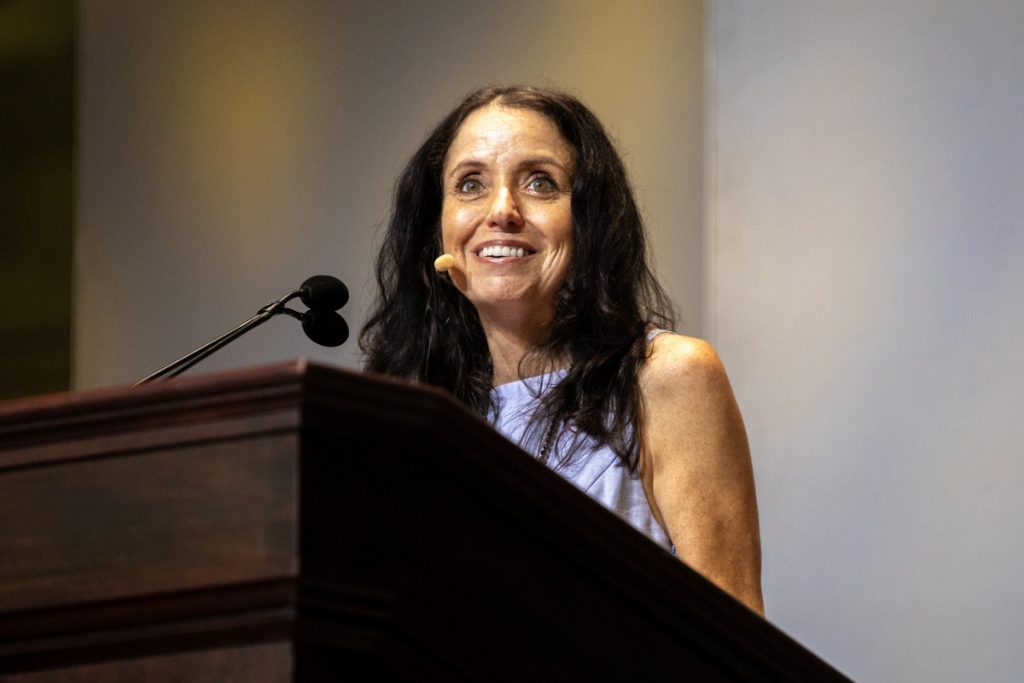
Danielle Nierenberg, president and co-founder of Food Tank, speaks on the future of agriculture, food and their intersection with technology Monday in the Amphitheater.
ARIANNA NEVAREZ
Staff Writer
Working as what she called a “professional listener,” Danielle Nierenberg has traveled around the world for 20 years to talk to farmers, scientists, policymakers and food workers. Through these conversations, she saw signs of transformation in the agricultural world.
“One of the best ways to understand the future is to listen to the people who are already building it,” Nierenberg said. “That’s become my work. That’s become my passion over those last two decades.”
Nierenberg, co-founder and president of Food Tank, shared what she found from traveling, what resources are needed for agriculture to thrive and how uncontrollable factors can affect the farming world at 10:45 a.m. Monday in the Amphitheater. In 2013, Nierenberg co-founded Food Tank, a nonprofit working to educate on and reimagine food and agriculture systems.
Several years ago, Nierenberg visited Zasaka, a social enterprise based in Chipata, Zambia, where she said the enterprise was not doing anything “flashy.” Instead, they were expanding farmers’ access to small tools that increased productivity and helped young people see farming as an opportunity. She said the most important aspect of technology is its ability to improve lives and the future of agriculture.
Female farmers at a cooperative outside of Ahmedabad, India, were experimenting, innovating and simply needed someone to listen and share their experiences, according to Nierenberg. She said they didn’t need someone to come in and invent something for them.
“Every growing season is an experiment. Every drought requires adaptation. Every new pest requires creativity,” Nierenberg said. “Farmers have always been innovators, and that lesson has been reinforced everywhere I travel.”
When she was in high school, Nierenberg said climate change was discussed as something that would take hold in the far future, but she said farmers are living with the consequences of this change now. Another issue she said affects agriculture is the shrinking budget of the U.S. Agency for International Development, which she called an “unsystematic upheaval” done by the Department of Government Efficiency.
Nierenberg said these cuts have been projected to cause “14 million additional deaths by 2030, including 4.5 million children under the age of 5.” Programs that existed before these cuts prevented an estimated 91 million deaths, according to Nierenberg. By terminating these funds, she said decades of trust and relationships were “discarded” overnight.
“Foreign assistance was never about charity or unreciprocated gifts to the world,” Nierenberg said. “These funds were essential for supporting democracy and the development of governments and societies that were compatible with American values around democracy and its founding beliefs about the inalienable rights of all people all over the world.”
Following these budget cuts, the future cannot be predicted, Nierenberg said. She said the consequences will unfold in the next few decades, and the long-term effects will hurt generations to come.
“It’s really important to understand that development is not something delivered to communities; it’s something built alongside them,” Nierenberg said. “What strikes me isn’t only the scale of the challenge facing farmers in the Global South right now; it is their strength, it is their determination, their ingenuity — not because they necessarily wanted to adapt, but because they have no choice. That resilience is something I encounter over and over again all over the world.”
Nierenberg said people ask her if she is optimistic about the future; she said she feels hope because of the people responding to challenges with creativity and courage. The challenges aren’t small, but the people facing them “are extraordinary,” according to Nierenberg.
In the technology world, Nierenberg said people have been asking the wrong questions. She said the most effective technologies don’t tell communities what they need; instead, they ask people on the ground what they want. An effective technology must solve a real problem, be accessible and be created with help from those affected by the problem, she explained.
“The future belongs to thoughtful agriculture — agriculture that combines innovation with expertise, scientific discovery with practical wisdom and new ideas with generations of accumulated knowledge,” Nierenberg said. “The most important technologies are often the ones we stop talking about. They become part of our everyday lives.”
In talking about the future, Nierenberg said the spirit of resilience lives in communities around the world that are trying to solve these agricultural issues. She cited Indigenous leaders who make up less than 5% of the global population, yet they “protect a quarter of the world’s land surface and the most biodiverse ecosystems that we have left on Earth” while also adapting to climate change.
“They have achieved this because their cultures treat nature as a partner, not just as a resource,” Nierenberg said.
Women account for about 43% of the global agricultural workforce, according to Nierenberg, but barriers such as limited access to resources and a lack of decision-making power lessen their productivity.
According to the Food and Agriculture Organization of the United Nations, if women had the same access to resources as their male counterparts, they could raise yields by 20 to 30%, and the number of hungry people in the world would be reduced by as many as 150 million people.
When Nierenberg visited Guatemala, she met female coffee farmers who created a model that included them at every step of the process — from planting to selling. When Nierenberg asked them for advice, they told her, “When we invest in women, we don’t just invest in individuals; we invest in entire communities.”
Though Nierenberg said “the future of agriculture is young people,” agriculture has an image problem because it is portrayed as hard work with little gain and limited career advancement. She said agriculture is more than simply growing food, and it is connected to everything, which Nierenberg said means “agriculture has become one of the most intellectually interesting and important fields anyone can work in.”
Nierenberg said the future of food will not be built without farmers and rural communities, who have been wrongly blamed for “the failures of our food and agriculture systems.” She said that these communities have been left behind and need investment.
Furthermore, the agricultural revolution will not be defined by a single new technology, Nierenberg said. Rather, it will thrive by combining the power of technology and the knowledge of those who have been paving the way, like farmers, Indigenous communities and women.
Food intersects with nearly every challenge the world faces, which means it can also address the biggest challenges, according to Nierenberg. She said solutions will emerge through “mass incremental change,” relying on relationship building and a willingness to listen to one another.
“We tend to think of ourselves as descendants of the past, and we are, but we are also the ancestors of the future. We need to start behaving and thinking like the stewards we’d like to be remembered as. The next agricultural revolution won’t be judged by how sophisticated our technologies have become. It will be judged by whether future generations inherit healthier soils, healthier communities, healthier ecosystems and healthier food systems because of the choices we make today,” Nierenberg said. “… Our responsibility is to make sure the people building it have the resources, opportunities and respect they deserve.”