
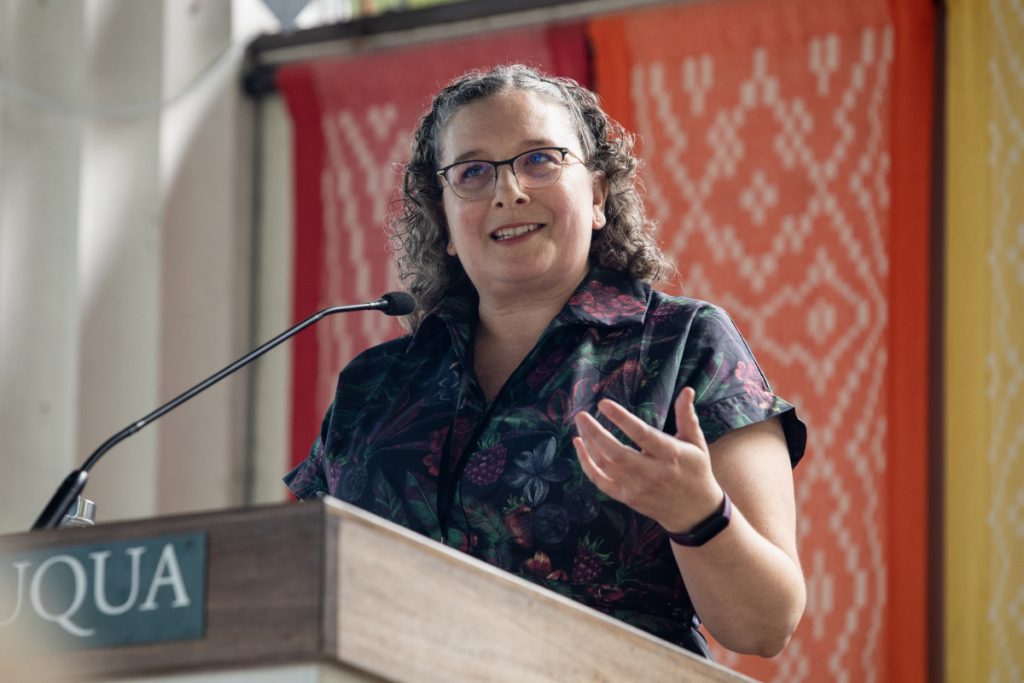
Adrienne Krone, associate professor of environmental science, sustainability and religious studies at Allegheny College, speaks on religious alternative food movements that have spread across the nation Monday in the Hall of Philosophy.
LILY RESLINK
Staff Writer
Adrienne Krone delivered a lecture on groups in the U.S. who have turned to religious texts and traditions to answer “What we should eat?” at 2 p.m. Monday in the Hall of Philosophy; she said this question is getting harder to answer.
Krone is an ethnographic researcher and associate professor of environmental science, sustainability and religious studies at Allegheny College, who discussed religious alternative movements she lived among and learned from during her year spent at four field sites.
She spoke about this ethnographic work documented in her book, Free-Range Religion: Alternative Food Movements and Religious Life in the United States, which references how these groups engage with the food system through nontraditional religious institutions.
While she said religion is often excluded from scholarship on food justice and alternative food movements often exclude religion, she said her book presents an argument that religious people are “working to revolutionize the food system from the ground up.”
Krone outlined the four movements she studied in her ethnographic research, noting the incorporation of scientific and secular methods.
The Hallelujah Diet Health Retreat, she said, centered around the belief that humans are meant to adopt raw vegan diets in accordance with the food available in the Garden of Eden.
A three-month farm retreat called the Adamah Farm Fellowship, she said, offered a place for young adults to sustain a farm and practice Judaism together.
Baldwin Beef Farms is a family-owned cattle farm run by Christian farmers who use a Muslim Halal slaughterhouse to produce pasture-raised beef for a secular market, Krone explained.
Finally, Pearlstone Center, she said, is a Jewish farm retreat that observed a biblical agricultural sabbatical year during her time of residence.
Her lecture examined these sites’ population, food systems and integration of religion.
Explaining the origin of the Hallelujah Diet Retreat, she said George Malkmus was a Baptist pastor who researched alternative food options after being diagnosed with colon cancer.
“His story is that he… went raw vegan and cured (his) cancer.” Malkmus published a book about his experience, which Krone said is the basis of this retreat and the Hallelujah diet.
She said the retreat is based on Genesis 1:29 from the King James Version, and Hallelujah dieters understand this Scripture as “what you can pull off a tree is what you can eat.”
With adjustments, she said the retreat practiced a diet of roughly 80% raw produce and 20% cooked grains. With Jewish hosts and participants who were all Protestant Christians except herself, Krone said the retreat’s incorporation of religion was theologically interesting.
At Adamah Farm Fellowship, she said she lived among 10 of the farm fellows, who primarily spent their time planting, weeding, harvesting and washing produce to sell at a farmer’s market. She said posters on their kitchen wall listed values such as “We harvest all of our own produce” and “We make as much as we can from scratch.”
In this “pluralistic Jewish community,” she explained that discourse ensued over how to practice Shabbat and participants consistently navigated uncomfortable conversations.
At Baldwin Family Farms, she said she spent most of her time with the patriarch of the family, founder V. Mac Baldwin. Emphasizing the contrast between the farm’s secular marketplace and Baldwin’s personal faith, Krone said he was characterized by his frequent ministering to all he encountered.
“He was often quoting Scripture and giving quizzes that I often failed,” she said.
She noted the distinction between the living conditions of cows and chickens at the farm, which she said “is a really interesting interpretation of how we should be raising animals based on his rather strict reading of the Bible.”
She explained that Baldwin offered a biblical explanation of why, unlike the cows, chickens lived in cages indoors. “The Scripture talks about cows grazing in green pastures, but it does not talk about chickens doing the same,” she said.
In the “complicated interfaith relationship” between Baldwin Farms and Chaudhry Halal Meats, she said Baldwin’s inclination toward ministering included the slaughterhouse’s owner, Abdul Chaudhry.
At the Pearlstone Center, Krone said she experienced a “shmita year” where they paused to “let the land rest after six years of work.”
She said religious complications arose from the retreat’s non-Jewish director, as well as disagreements about observing shmita outside of Israel.
She concluded with a positive note on religious groups “willing to deal with some of the discomfort of working across religious lines” to address problems posed by the industrial food system.
“This religious participation in alternative food movements and food justice is only increasing as climate change and other issues become more present. So, it is worth keeping an eye on what the religious folks are doing right now,” Krone said.