
Column by Mary Lee Talbot
One of the most famous opening sentences for a novel is in Charles Dickens’ A Tale of Two Cities. “It was the best of times, it was the worst of times, it was the age of wisdom, it was the age of foolishness, it was the epoch of belief, it was the epoch of incredulity, it was the season of light, it was the season of darkness, it was the spring of hope, it was the winter of despair.”
Dickens wrote this novel almost 100 years after the events of the French Revolution. In the moment (of the Revolution), no one knew it was the best of times, the worst of times. “The novel is historical fiction,” the Rev. Anna Carter Florence, Ph.D. said, “in that it has truth, but it is not factual. This might have been our story. There are so many stories and so many ways to tell them.”
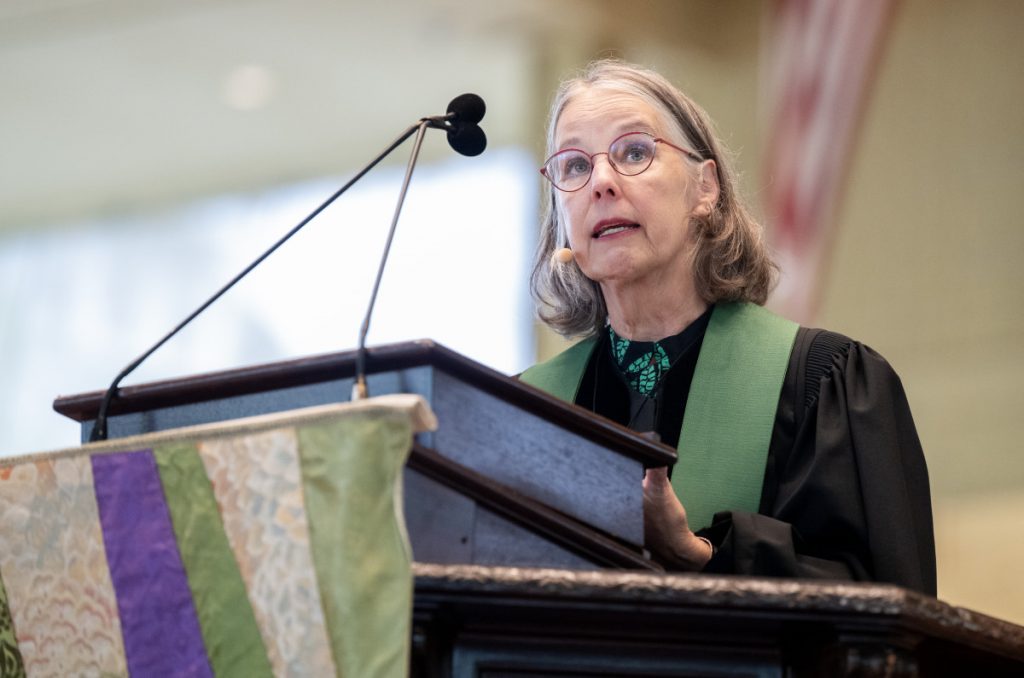
Florence preached at the 10:45 a.m. Sunday morning worship service in the Amphitheater. Her sermon title was “Bread at the Gate,” and the scripture reading was 1 Kings 17:8–16.
Good writers and good prophets, she said, know how to tell people, “Right now, y’all are not the best, you are not the worst, but you could be better.” Elijah was one such prophet. Jews still set a place for him at the Passover Seder, complete with an empty chair and a full glass of wine in case he decides to speak to our time.
He was a prophet of justice and miracles, Florence told the congregation. “He made good trouble and he was taken up to heaven in a chariot in a whirlwind. He had a showdown with 400 prophets of Baal and only had a sword. He was like the Bible meets the Avengers.”
In the scripture reading, when Elijah meets the widow of Zarephath, he had just started down the path God set for him. Elijah had announced a famine. He told the people of Israel that there would be no rain except by his word. “There was a new prophet in town,” Florence said, and the corrupt king, Ahab, knew he would be a pain and ruin his good time.
God told Elijah to hide, to flee the country. This was the first test for Elijah to trust God to care for him on the run. “This was not an easy plan,” Florence said. “Why didn’t God just pull out an old miracle — like manna in the wilderness? Or why not let Elijah use his own powers to call down fire, make a pot of chili as men do or strike a stone to make bread?”
She continued, “God’s plan was more personal. First, he had ravens bring Elijah food, and then provided flour that replenished itself. God was breaking down barriers, old patterns. Elijah had to rethink his biases and prejudices, because he had some, before he could live into his destiny. He had to unlearn things about foreigners and women, about what was clean and unclean.”
Florence posed some questions for the congregation. “First, does a prophet’s strength really come from a fire and brimstone and superhero acts of power or does it come from the quiet withholding of power so that someone else who needs it can flourish? Second, is flying solo really the only way for a prophet to get the work done or does the word of God require mutual discernment?”
She continued, “Third, if God decides that someone needs to get over their squeamishness about birds being given the job of food delivery to ravens, not kosher creatures in Elijah’s day, will the prophet complain about his wilderness grub hub options, or can a man of God bite his tongue and deal with a little dirt on his pancakes knowing that God loves ravens, too? As Peter will say centuries later in the book of Acts in the New Testament, what God has made clean, we must not call profane.”
Elijah needed to understand all these things in order to speak to the people. The poor and vulnerable were paying the price for what was going on in the throne rooms. There was a need in the land to call out for justice.
“Today, people in poor countries are calling out to us, in rich countries, about climate change, asking us to take action,” she said. “God’s survival plan for Elijah is designed to sensitize him to the needs of real people. Otherwise, Elijah runs the risk of turning into a religious fundamentalist, obsessed with purity laws.”
There must be change in order for the most vulnerable to live, and the vulnerable were widows and orphans. When Elijah and the widow run into each other at the city gate, she is a foreign enemy who did not worship the God of Israel. Florence said, “God has told Elijah that after he has learned his lesson about ravens, a widow in the foreign city of Zarephath is his next source of food and shelter while his own king in Israel is trying to hunt him down and kill him, which is irony straight-up.”
Elijah asks her for water and bread “as if there was not a drought, as if she had all the flour she needed, as if she was not about to die,” said Florence. “The widow said to him, ‘I know your God sent you. Look at me: how could your God think that I could be a safe haven?”
Elijah decided they should muddle through until God sent rain. He might have said, “You will be a safe haven for me, and I will be one for you.”
Florence said, “Chautauqua, I am wondering what is happening in your life. Do you have days of the best and the worst, of wisdom and foolishness, of light and shadow, hope and despair? Have you met the widow or her son, have you been fed by ravens or maybe you met Elijah? Has some prophet who showed up out of the blue to fill up an empty place at your table and said, ‘Here is my piece of the Revelation. What piece do you have?’”
She continued, “If we listen hard to each other, to Ken Burns, to two tales of our 250th anniversary, we will hear a tale of two worlds where the realm of God is breaking its way into this one with stories of safe haven and how we may be that for one another. No matter which side of the city or the river or the gate we live, this may be the time, and it may be the place. And may the God of ravens and widows and Elijah the prophet bless us this week, as we go. Amen.”
The Rt. Rev. Eugene Taylor Sutton, senior pastor for Chautauqua, presided. Pat McDonald, president of the Alumni Association of the Chautauqua Literary and Scientific Circle, read the scripture. Owen Reyda, organ scholar, played “Tuba Time,” by Norman Cocker, on the Massey Memorial Organ for the prelude. The Chautauqua Choir, under the direction of Sonya Subbayya Sutton, interim director of Sacred Music, sang “Let Us Break Bread Together,” a spiritual arrangement by Gwyneth Walker after the death of Breonna Taylor. Reyda provided accompaniment on the Massey Organ. The offertory anthem, sung by the Chautauqua Choir under the direction of Sutton and accompanied by Reyda on the organ, was “I Hear America Singing,” music by Neil Ginsberg and text by Walt Whitman. Sutton led the choir and congregation, and Reyda accompanied the group on the organ in “America the Beautiful,” words by Katherine Lee Bates and music by Samuel A. Ward, with the setting by Cecil Effinger. Sutton played “Toccata on ‘Great Day,’” by Adolphus Hailstork on the Massey Organ for the postlude. Support for this week’s preaching and chaplaincy is provided by the Mr. and Mrs. William Uhler Follansbee Memorial Chaplaincy and the Alison and Craig Mathinsen Endowment for the Department of Religion.