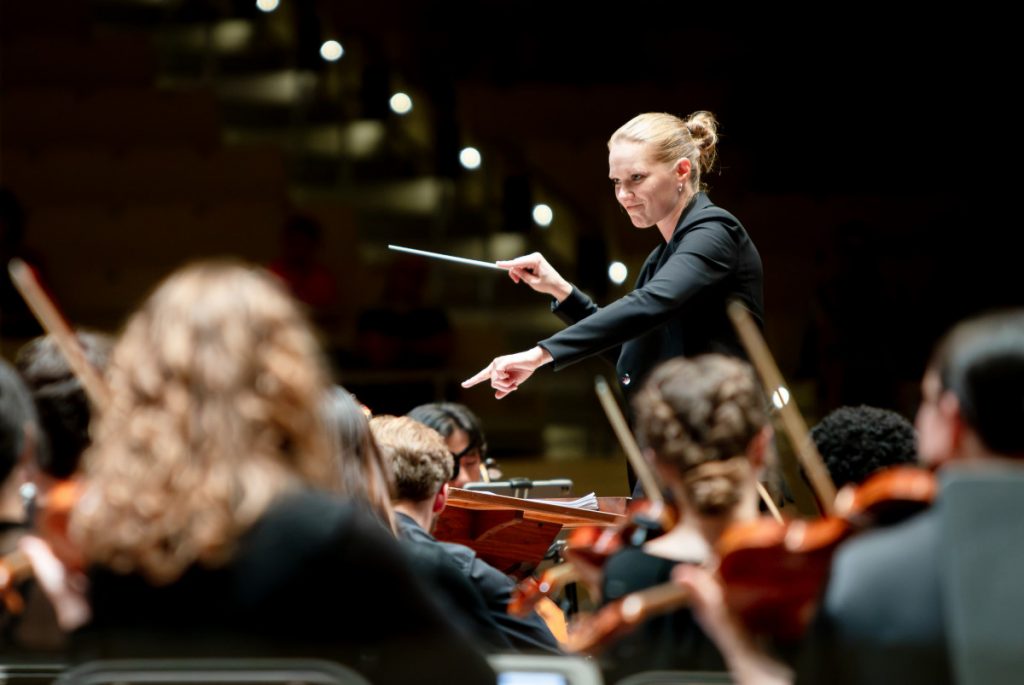
David Effron Conducting Fellow Hannah Schendel leads the final Music School Festival Orchestra concert performance of the 2025 Season Aug. 11, 2025 in the Amphitheater.
ROCCO PRIOLETTI
Staff Writer
At 8 p.m. today, guest conductor Hannah Schendel will deal the Chautauqua Symphony Orchestra their musical fate in the Amphitheater through pieces by Richard Wagner and Pyotr Ilyich Tchaikovsky.
“The program’s centered around this theme of fate and redemption,” Schendel said. This overarching narrative will first take audiences seabound with Wagner’s “Flying Dutchman Overture,” opening the evening with an operatic journey toward redemption.
Wagner’s overture is centered around a sea captain who is stranded in a ghost ship and is “cursed for eternity to sail to sea unless he can find a woman who will profess her love to him until death,” Schendel said.
The piece begins in a gloomy manner, as if it were musically shipwrecked in the same thunderstorm the story inhabits. By the third act, the overture ends triumphantly with moments of beauty peaking through the orchestral thunderclouds.
Tonight marks Schendel’s first time conducting Wagner’s “Flying Dutchman Overture.” Having heard it previously, she laughed at the pirate-centric story, which compelled her toward the piece.
Tchaikovsky’s Symphony No. 5 is a piece that the conductor is familiar with.
“It’s one of those pieces that master classes often program. And so, I’ve gotten to do various movements of it and … have thought about it for a number of years,” Schendel said. “And so, I’m really excited to do the whole thing with [the] CSO.”
Tchaikovsky’s piece follows a similar narrative to Wagner’s — but in a grander and more indirect manner.
“Tchaikovsky doesn’t explicitly say that there’s a narrative. But, he gives these sort of pictures of what the music might be,” Schendel said “… This piece starts out with a full resignation before fate and the weight of what that might feel like. And so, this also starts out very dark and kind of lost.”
Schendel noted the second movement’s love duet has “probably the most famous and beautiful horn solos in the entire repertoire.” The following movement transforms into a “wistful,” nostalgia-tinted waltz. The final movement draws comparison to the triumphant determinism of the ending to Wagner’s “Flying Dutchman Overture.”
“Both of [the pieces] are really heartfelt, and there’s kind of an emotional rawness … that’s really compelling. You know, other composers often are really concerned with musical form. … [Both pieces] have form to them, but they’re a little bit looser, which then lends itself more to a narrative and the more kind of emotional scope, which is kind of interesting,”
Schendel said.
Schendel began conducting during her undergraduate years in college, when she studied both violin performance and biology.
“Conducting was a required course for the violin major, and I ended up just loving it,” Schendel said. She noted how conducting shared interests between her two majors, being “very analytical, scientific [and] psychological.”
In 2025, Schendel was Chautauqua Institution’s David Effron Conducting Fellow. During her time, she conducted CSO performances and assisted Rossen Milanov, Timothy Muffitt and Steven Osgood.
“[I’m] really excited to be back and it’s such a great community. [There’s] wonderful people, wonderful opportunities there,” Schendel said.