ROCCO PRIOLETTI
Staff Writer
Imagine splitting a piano key down the middle. Instead of enraging the nearest pianist, in the world of microtonality and just intonation, this action figuratively reveals the hidden notes in between a note. These new piano keys, frequencies in-between what is typically considered to be in-tune to Western standards, comprise a wide variety of new pitches which would usually be deemed flat or sharp. However, music did not always adhere to these rules that now dictate this as being out of tune.
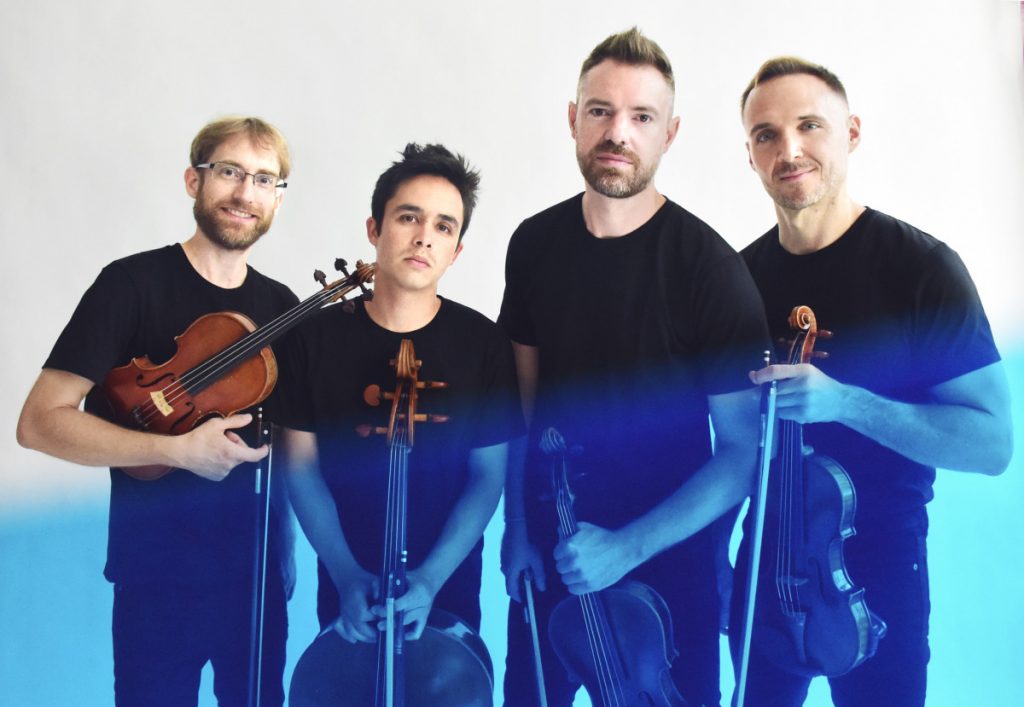
At 4 p.m. today, JACK Quartet will guide Elizabeth S. Lenna Hall to hear the notes hidden in between the piano keys in their program, “Modern/Medieval.”
For the quartet’s cellist Jay Campbell, the pieces are all unified by the sounds of very early music; some are reminiscent of Medieval music, some Baroque and others Renaissance. Members of JACK Quartet were collectively inspired by a “strong resonance” they felt connected contemporary experimental music to the music from many centuries ago.
“If you go back to the 14th century, you get some of the most rhythmically complex music that exists up until, maybe, the 1950s,” Campbell said. “You get people who are experimenting with all kinds of really interesting microtonality and rethinking
tuning systems.”
This connection forms the narrative motivation behind the program.
“I think it’s really kind of to showcase that some of these ideas that feel really new and novel within contemporary music are actually very, very old. Like, these ideas have roots, and these ideas come from somewhere,” Campbell said.
Their opening piece, titled “Angelorum Psalat,” is the only remaining work from a 14th-century composer named Rodericus; though, even this name is unverifiable as to whether it was real or a pseudonym. The composition is part of a larger manuscript of medieval music called the Chantilly Codex.
“It’s this totally crazy piece that has like 40 different noteheads (which indicate a note’s pitch, duration or value) in the original notation, and it implies all these different ratios and relationships between the two voices in the original song,” Campbell said.
JACK Quartet’s violinist, Christopher Otto, transcribed the piece into modern notation and wrote two additional lines, which “punctuate” Rodericus’ original two. Campbell noted that Otto’s interpretation makes it sound like there are multiple tempos occurring simultaneously.
During the COVID-19 pandemic, Campbell became interested in the work and studies of Nicola Vicentino, an obscure 16th-century composer and instrument-maker who created a 19-note-per-octave keyboard. Today, the quartet will perform his piece “Musica prisca caput // Madonna, il poco dolce.”
“There’s a lot of chromaticism, but what he does is he goes smaller than the half-step. So, he’s like forming different ways of thinking about whole-tone tuning and different ways of tuning a keyboard,” Campbell said.
During his lifetime, Vicentino engaged in musical arguments questioning how far music can be pushed before it became too dissonant and incomprehensible to human perception. Vicentino’s view — in favor of microtonality — directly opposed that of music theorist and composer Gioseffo Zarlino, who opposed non-diatonic music. Though Zarlino’s viewpoint prevailed among popular music consensus, Campbell viewed the present as being a “rich period” for microtonal explorations.
“There’s more and more instrumentalists that are putting the time in to develop the skills, [to] develop the kind of ear training and ear-specificity that so much [of] what we call microtonal music requires,” Campbell said. “And it’s quite beautiful and it’s really complex and ear-tickling in a lot of ways. It’s taken a long time for this to get started.”
Juri Seo’s “Three Imaginary Chansons” was composed specifically for JACK Quartet’s “Modern/Medieval” program. The piece was inspired by the rhythmic complexities of the Chantilly Codex. Campbell noted that it sounds like both medieval and contemporary music at once.
“Modern/Medieval” comprises the material for JACK Quartet’s upcoming CD via ECM Records.
Should any concertgoers be unfamiliar with microtonal music, Campbell assured that audiences can enjoy the program without needing to understand
the technicalities.
“These are all things that our ears naturally parse and pick apart and put that together for us,” Campbell said. “… This music plays on what is already latent and natural within our physical bodies and within
our brains.”