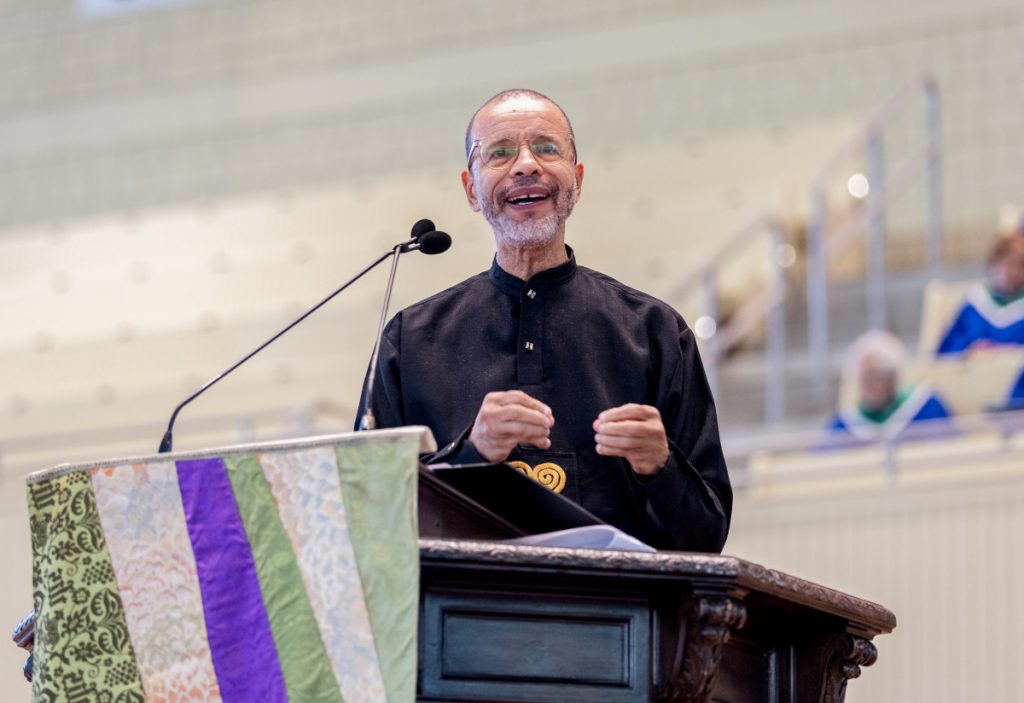
The Rev. Frank A. Thomas delivers his sermon “Weeping over Jerusalem” Sunday in the Amphitheater.
MARY LEE TALBOT
Staff Writer
“I don’t know much about global power or the changing international order, but I do know right from wrong,” the Rev. Frank A. Thomas, Ph.D., said. “We can either expand the health and wealth of the privileged, or we can expand the freedom, health and legitimacy of the poor across the globe.”
Thomas preached at the 10:45 a.m. Sunday morning worship service in the Amphitheater. His sermon title was “Weeping over Jerusalem,” and the Scripture was Luke 19:41–46.
What about the “least of these,” as Jesus talked about in Matthew 25? Jesus said to help the sick, the needy, the naked, the hungry and those in prison, when it was done “to the least of these, it was done to me.”
Thomas said, “I want to ask the global powers, ‘Who does Jesus mean by ‘the least of these?’ This is a critical question: Can the spiritual and moral benefits be for all creation? It is a question of peace. Can anyone thrive, or can there be a lasting international order if it is not founded on peace?”
He asked the congregation what are the things that make for peace. He said that the sermons for the week will be a riff on Luke 19:41–46. “It is a difficult text … that contains hope and despair, outrage and mercy, comfortable and uncomfortable, haunting and demanding. But I hope at the end we can say, ‘The Lord was among us, and it was good to be here.’”
When Jesus was going into Jerusalem in Luke 19, he saw the city and wept. If only you had known the things that make for peace, Jesus said, a reflection of Lamentations 3:22–23, for the Lord never fails.
The multitude had been following him since Galilee, and momentum and expectations were building. Jesus was put on a colt and the people saw the prophecy of Zechariah come to life: a king who was righteous, humble and lowly, riding on a donkey and bringing salvation. Matthew and Mark in their gospels said Jesus had a hereditary right to be king because he was descended from David. Luke and John said Jesus was a king in his own right. His kingdom was spiritual but still a threat to Rome.
“Jesus said nothing, no waving, no thumbs up, no celebration from Jesus,” Thomas said. The Pharisees did have something to say: They stopped the parade and told Jesus to rebuke his disciples for all the blasphemous talk. Jesus told them that if the people did not cry out, then even the rocks would cry out, and the parade continued.
When Jesus could see Jerusalem from the Mount of Olives, he wept. “The Greek here means that Jesus sobbed convulsively, lamented bitterly, howled with tears,” Thomas said. “Jesus said, ‘You should have known the things that make for peace.’ Do any of us know the things that make for peace?”
He continued, “Some of us think that we can bomb our way to peace, but after Hiroshima and Nagasaki, we found we are not safe unless we have nuclear bombs. We can argue, threaten or bully and lie in our marriages, with our children, trying to get our way. But that does not make for peace.”
Thomas told the congregation, we try to be right and get loud and ugly and hostile. “Have you seen the hurt after getting your own way? Have you ever loved anybody enough that being right makes you wrong? This doesn’t lead to peace. You have to love people deeply to make peace.”
Maybe Jesus did not say anything in the procession because his heart was filled with despair. He knew Jerusalem was doomed because it didn’t know the things that make for peace. “We should be grateful he weeps rather than inflicting punishment and judgment. His response is based in divine love, hesed, also known as loving kindness and steadfast love,” Thomas said.
He continued, “Hesed is used 240 times in the Bible, especially in Psalms. This is covenant love, where the weaker party can seek protection even if they do not deserve it because they are in a relationship that is beyond the law and it is offered to all who need redemption. God does hesed, God does kindness, mercy and faithfulness. God is hesed.”
Jesus weeping over Jerusalem came from a place of grace, because there is a chance of redemption. “We have a duty to practice loving kindness; it is one of the things that makes for peace. Maybe we will stave off doom; if you have a better idea, let me know,” Thomas said.
Thomas then shared “The Loving Kindness Prayer,” a Buddhist-inspired meditation in the words of Jon Kabat-Zinn. It can be said for anyone, over any situation, in any time or place.
“May ____ be safe and protected and free from inner and outer harm.
May _____be happy and contented.
May_____ be healthy and whole to whatever extent possible.
May _____ live with the ease of well-being.”
He continued, “Positive vibes are the things that make for peace. The Word of God for the people of God. Let those who have ears hear what the Spirit is saying to the churches. And let the people say, Amen.”
The Rt. Rev. Eugene Taylor Sutton, senior pastor of Chautauqua, presided. Veronica Biggins, a member of the Chautauqua Board of Trustees, read the Scripture and canticle. Organ scholar Owen Reyda played “O Mensch, bewein dein Sünde groß BWV 622,” by Johann Sebastian Bach on the Massey Memorial Organ. The Chautauqua Choir, under the direction of Sonya Subbayya Sutton, interim director of Sacred Music, sang “Dona Nobis Pacem,” from Mass in B Minor by Bach. Reyda accompanied the choir on the Massey Organ. The offertory anthem, sung by the Chautauqua Choir, was “Antiphon,” from “Five Mystical Songs,” music by Ralph Vaughn Williams and text from George Herbert. The choir was under the direction of Sutton and accompanied by Reyda on the Massey Organ. Sutton played “Toccata,” Symphony No. 5, by Charles-Marie Widor, for the postlude on the Massey Memorial Organ. Support for this week’s chaplaincy and preaching is provided by The Rev. Leonard J. Ebel Chaplaincy.