
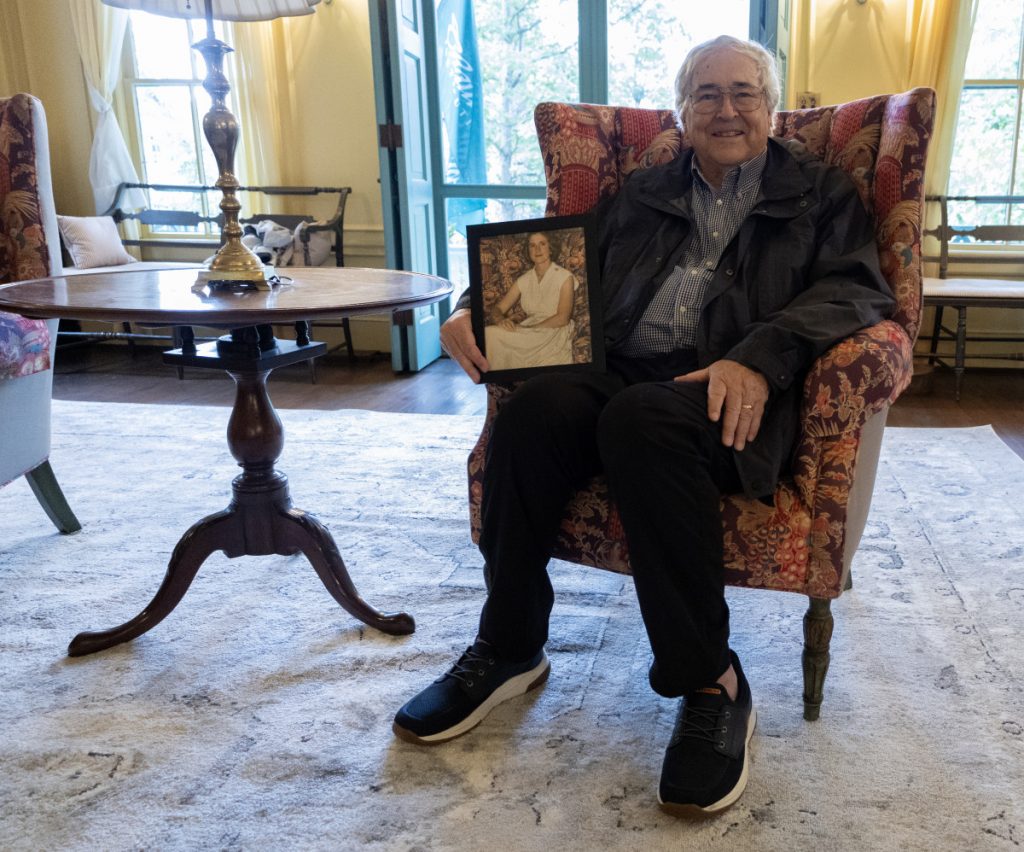
Ted Arnn sits in a recently restored historic chair with a portrait of his late mother, Nancy Miller Arnn, who passed the chair down to him, June 25 in the Lewis Miller Cottage.
LILY RESLINK
Staff Writer
Through the work of archivists, an upholsterer, a graphic designer, a member of the Miller family and Chautauqua Institution’s Department of Religion, the sofa and set of wing chairs that accommodated the residents and assorted guests of the Lewis Miller Cottage since 1922 are once again serving the same purpose, in the same place.
Ted Arnn, great-nephew of Thomas Edison and Mina Miller Edison, came to visit upon the return of the restored furniture to Lewis Miller Cottage at the beginning of the 2026 Summer Season.
“It feels like coming home. It looks great,” Arnn said.
Arnn said the cottage is one of the few places that historical figures stayed — such as Thomas Edison and Chautauqua’s co-founder Lewis Miller — that are still composed of mostly
original material.
Arnn noted the Fort Myers house and the Llewellyn Park house as the only other residences on the grounds where that holds true.
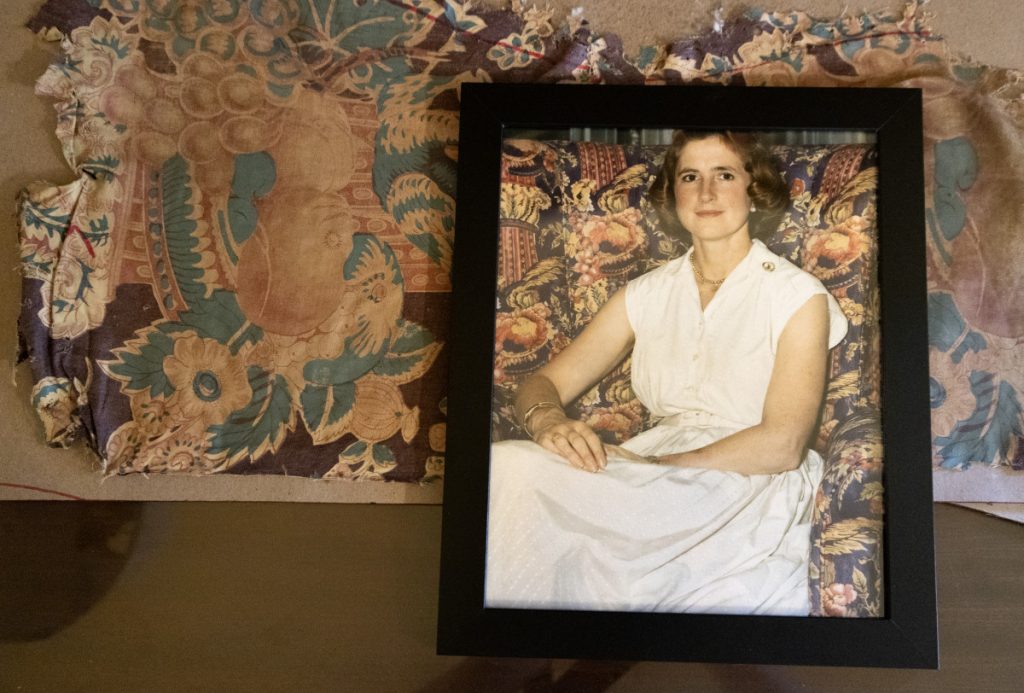
A photo of the late Nancy Miller Arnn sitting in the chair taken during her lifetime.
The cottage has hosted the Miller family and its descendants for around 100 years. It also hosted close family friends, such as Henry Ford, and high-profile guests, such as President Ulysses S. Grant.
Arnn entrusted the Chautauqua Foundation with the cottage in 2016 to historically preserve it while also maintaining the space’s functionality for active residence and hosting.
For the summer season, Director of Religion Robert-Wilson Black lives in the cottage with his family.
Wilson-Black said that spanning 1874 to the present, it is impossible to retain all of Chautauqua’s history, but the work of preservation acts as a way to celebrate and steward it.
“The things we try to preserve are the things that we want to retrieve again. It’s good to retrieve pieces of faith, [the] importance of family, love of country,” Wilson-Black said.
While the furniture’s history began when Mina Miller Edison redid the house in 1922, it was the history of the people who sat on that furniture in 1922 that motivated modern-day restoration efforts.
By the 20th century, the family’s well-loved furniture still existed — but not in usable shape.
Arnn said the decision to preserve furniture often comes down to whether it is worth the financial resources. He said he had been supporting the maintenance of the home’s artifacts and he finds it important to have the space look as it did originally.
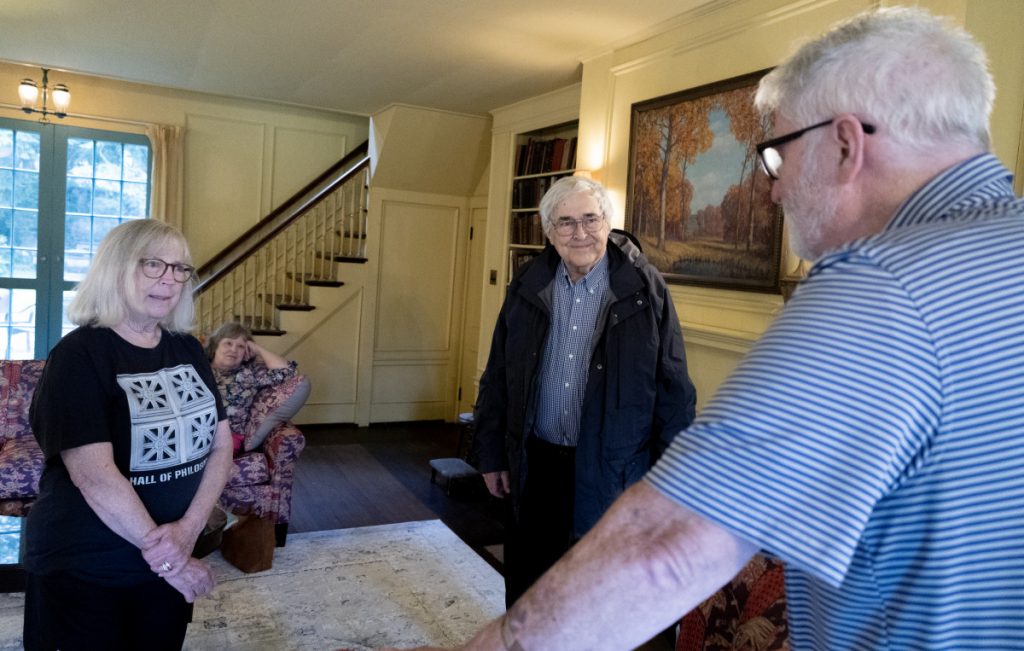
Abbey Custom Textiles General Manager Steve Terry, right, tells Ted Arnn and his wife Mary Boyle how he and his wife, Dianne Terry, restored the chairs.
Steve and Dianne Terry, partners in business and life, entered the upholstery project when Arnn discovered them online amid his challenge in finding a match to the chairs’ fabric.
Steve, who is the general manager of Abbey Custom Textiles and has been upholstering for three decades, said the couple wanted “to be that conduit to connect the past with the here and now.”
Upholstery, Wilson-Black said, contrasts humanity’s “off-the-shelf society” with its “bespoke-tailored past.”
“We’re showing the rest of the world that there are options that aren’t just available off the shelf,” Steve said.
He said Arnn faced a challenging task in finding a resource to reproduce the chairs’ fabric, and he was grateful that he “reached out to a little obscure North Carolina company.”
Steve said this was a dream job. “It’s nine hours from North Carolina to this house, but this does not happen every day.”
He explained that the process of upholstering these pieces began with a “chair autopsy.”
Dianne, Abbey Custom Textiles CEO and graphic designer, said, “through graphics and Photoshop, and a piece of the (original) material, we were able to recreate the original fabric,” adding that she used hex codes to match the colors precisely.
Steve said he identified that the chairs had been reupholstered in 1966 and again around 1989. “Underneath about four layers of cotton on this chair was the original seat fabric,” Steve said.
Dianne said that while the original material, cotton chintz, was not possible to print on, they selected a comparable alternative. She said it is increasingly more important to be making efforts to preserve and restore furniture, especially when it is connected to key historical figures.
“In reupholstery, part of what you’re supposed to do is remove all of the old fabric,” Steve said. “The way that this chair was made, it had these channels in there, and whoever did it in 1966 … he had some shortcuts.”
Steve added that he identifies both as an upholsterer and a recycler. In two generations of the upholstery trade, Terry said he and his father saved hundreds of trees through their work.
Dianne spoke to the environmentally sustainable values of their business. She said their mission includes “keeping old fabric and old wood out of the landfills.” According to Steve, the typical digital printing process would produce 30% to 40% textile waste of the print fabric, but their technique prevents waste by printing each part individually.
According to the team responsible for its restoration, the chairs had some unique features.
“There’s a lady’s chair, and then there’s the gentleman’s chair,” Steve said, which are distinguishable by the depth of the seat and the shape of the legs.
In preserving the historical character of the chairs, Steve and Dianne were careful to maintain the chairs’ padding, which contains hog hair. Steve explained, “As long as hog hair doesn’t … get wet or it doesn’t get introduced to insects, it doesn’t wear out.”
Hidden under the center cushion of the sofa, information about the furniture’s history is printed directly on the fabric, as well as a QR code that directs to an article from The Chautauquan Daily on the Lewis Miller Cottage’s history.
According to Arnn and Wilson-Black, the house contains 85% of the original furniture from the time of Mina Miller Edison’s death. Arnn said it seems that “a very appropriate place for the house to go would be to the Institution.”