
Column by Mary Lee Talbot
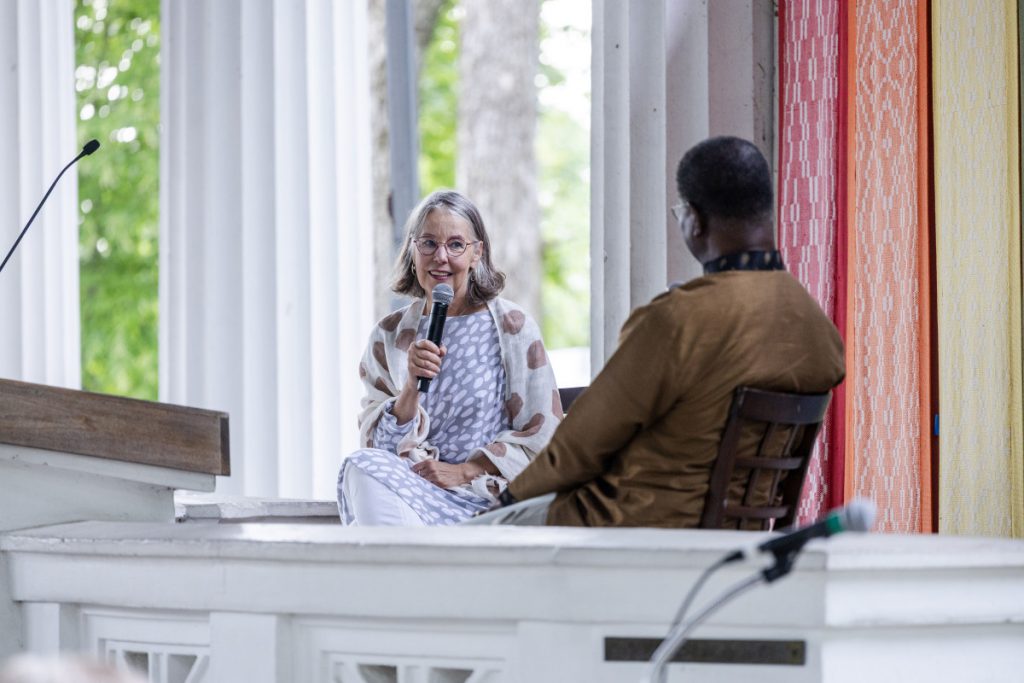
The Rev. Anna Carter Florence, chaplain for Week Six, engaged in a conversation with the Rt. Rev. Eugene Taylor Sutton at the 9:15 a.m. Thursday morning worship service in the Hall of Philosophy.
“I was taught that there is a lot of room to understand God and many beautiful ways to God,” Florence said. Her father was a Presbyterian from Missouri who went east to “stand in the light.” Her mother was from an Episcopalian and Unitarian family from Massachusetts. Her mother was a poet and her father a professor of dermatology. She grew up in Rochester, New York, Philadelphia and Guilford, Connecticut.
When Sutton asked if her family was religious, Florence replied, “We were the first in the church and the last out.” She remembered doing a lot of singing in vacation Bible school. She did confirmation, as was expected, but when she expressed some doubts about it, her father told her to figure out what was bothering her about it, but “this is what you are doing.” She and her family took this rite of passage very seriously.
Her form of teenage rebellion was to be part of a rock band with friends from church, and they gave their concerts in the church. The band played a lot of Earth, Wind & Fire, and the bass player in the group went on to work with Ray Charles and Earth, Wind & Fire.
Florence went to college at Yale University, and she decided to check out the campus Christian group. “I lived a very sheltered life, because this group was still debating whether women could be leaders. So I did theater instead. Theater is like church in that there is a place for you and they have got to take you in. In the theater, you also pay close attention to the texts,” she said.
She took some courses at Yale Divinity School while in college, and after she graduated, she had a “moment of clarity. I had no idea what I wanted to do after college, but the next moment I knew I was going to seminary. I felt settled and grounded, and I knew it was God [speaking],” she added.
Sutton asked her if God calls everybody. She said yes, but in many different ways. “The universe offers beauty and pain, and we can take them and it will feel like a call. A call can come many times. I am still discerning; it is a constant act of paying attention, as Mary Oliver said.”
Sutton asked if her faith had ever been rocked. She said, “If you told someone that their faith would be rocked, it would be unbearable to hear. There are things that break our hearts and how we mend them together is the way to a new call. If we don’t see logic, as we are getting older, we can see connections.”
Asked why she selected the Scripture for the day, she said Genesis is the first book of the Bible, and John’s opening verses are a sermon on Genesis 1. “There is beautiful poetry in these Scriptures and Scripture keeps interpreting itself. The Bible hands me the texts and tells me to say something from my time. These texts are alive, and they talk with and through each other.”
Sutton put forward the question, “If God is in control, why is the world the way it is?” Florence answered that was a question worthy of Chautauqua. “We have to focus on where we are now in our responsibility to the world. The creature does not just go; we are here to live among and with all creation,” she said.
Her hope, she said in answer to Sutton’s final question, is “for life and life abundant, for our families and for those whose families are threatened. I hope I have the strength to act, to work for the well-being of others, including the trees and the water. We have to dig deep to find the resources.”
The Rt. Rev. Eugene Taylor Sutton, senior pastor of Chautauqua, presided. The Rev. David Carter Florence, pastor of the Black Mountain Presbyterian Church in Black Mountain, North Carolina, led the morning prayers. The Rev. Robert Franklin, former senior pastor of Chautauqua and director of the Department of Religion, read the Scripture. The Scripture readings were Genesis 1:1–8, 31 and John 1:1–3, 14. Saxophonist and flutist George Wolfe, accompanied by guitarist Rami Vamos, played Sonata in A minor, Movement 1 by Jean Baptiste Loeillet, arranged for guitar and soprano saxophone by Wolfe. The musical meditation mid-service was an improvisation by Wolfe on the Native American flute. The postlude was “Gymnopédie No. 1,” by Erik Satie, arranged for guitar and soprano saxophone by Paul Reilly and George Wolfe. Sonya Subbayya Sutton, interim director of Sacred Music, provided incidental music for the service. Support for this week’s services is provided by The Mr. and Mrs. William Uhler Follansbee Memorial Chaplaincy and The Alison and Craig Marthinsen Endowment for the Department of Religion.