MARY LEE TALBOT
Staff Writer
Chautauquans of a certain age might remember the long line at the Chautauqua Bookstore on Sunday morning, waiting to get The New York Times. The bookstore did not open until after the Sunday morning worship service was finished. A newspaper needs a delivery system, especially when subscribers like to have paper in their hands to peruse the day’s events.
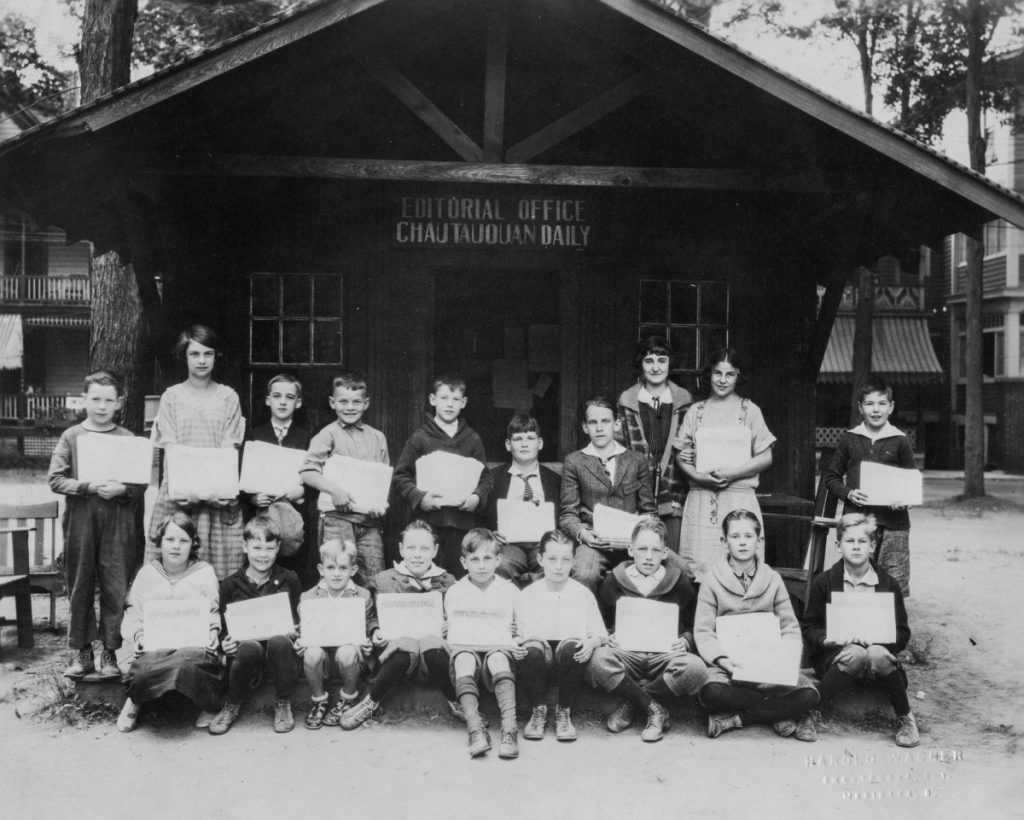
Now imagine that line of customers every day at The Chautauquan Daily Business Office waiting to get their copy of the day’s newspaper. Thankfully, Chautauquans have had generations of Daily carriers who have been willing to get up early, deliver the Daily to subscribers, sell the Daily before the morning lecture and the evening concert and stand in Bestor Plaza trying to outshine each other with their sales pitches.
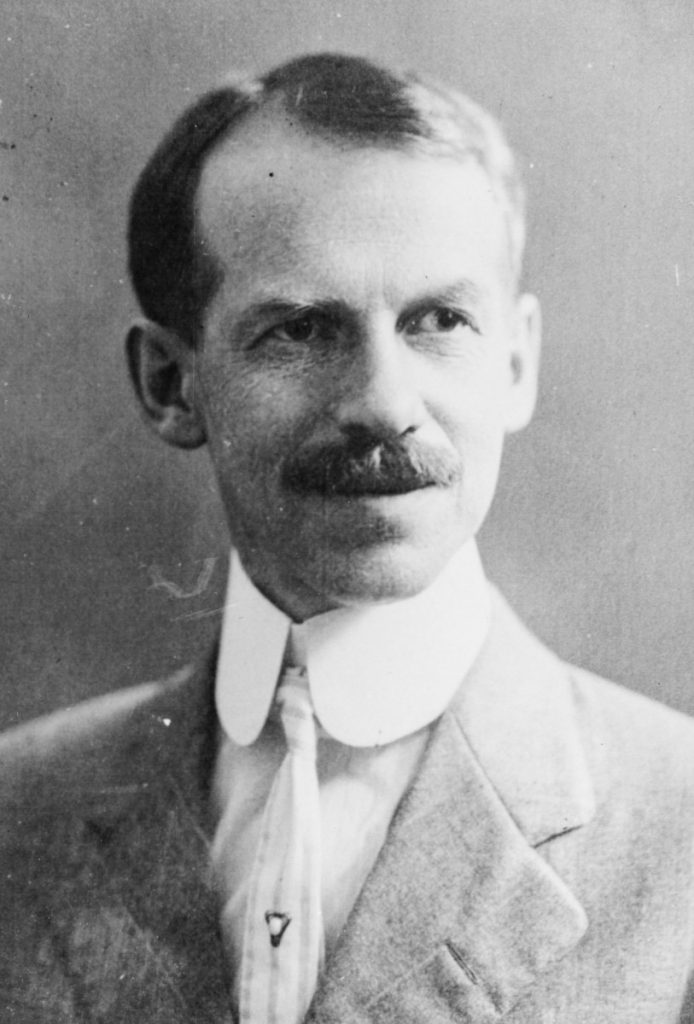
In 1922, John Vance Smith of Johnstown, Pennsylvania, sold nearly 6,000 papers. He was 14 years old and had just completed his third year of selling Dailies. In the early 1920s, there were weekly sales prizes and a seasonal prize. Smith won many weekly prizes in 1921 and 1922 and the season prize for both years. His reward for 1922 was 10 dollars’ worth of books. He told the Daily that he was going to look for a “regular” job next summer.
Another prize-winning seller was Allen Tate, who sold Dailies from the mid-50s to early 60s. One year, he was the top Daily seller and received a bonus: a silver dollar. He delivered papers to the south end of the grounds and sold papers on Bestor Plaza and in the Amphitheater in the morning and evening. In the Amphitheater, the sellers would walk up and down the aisles to sell papers. Tate’s chant for selling the paper was “Two fat nickels or one thin dime keeps you reading all the time. Chautauquan Dailleeey!” One of his greatest competitors was David Morrow, now deceased. Tate later worked in the Business Office of the Daily, assigning routes, taking subscriptions at the front desk and other tasks to get the Daily out to customers.
John Keating holds the record for most sales in one night (714 for Al Hirt) and more than 1,000 for two performances by the Mormon Tabernacle Choir. From 1966 to 1975 (ages 13–22), he delivered and sold papers, wrote sports coverage and handled the advertising under business manager Claire Limberg and editor Alfreda Locke Irwin. Some of the sellers he worked with included Ed Evans, Dean Eelman, Rick Talbot, Dan Templeton, Davie Thor, Bruce Horner, Doug Horner and Wesley Horner.
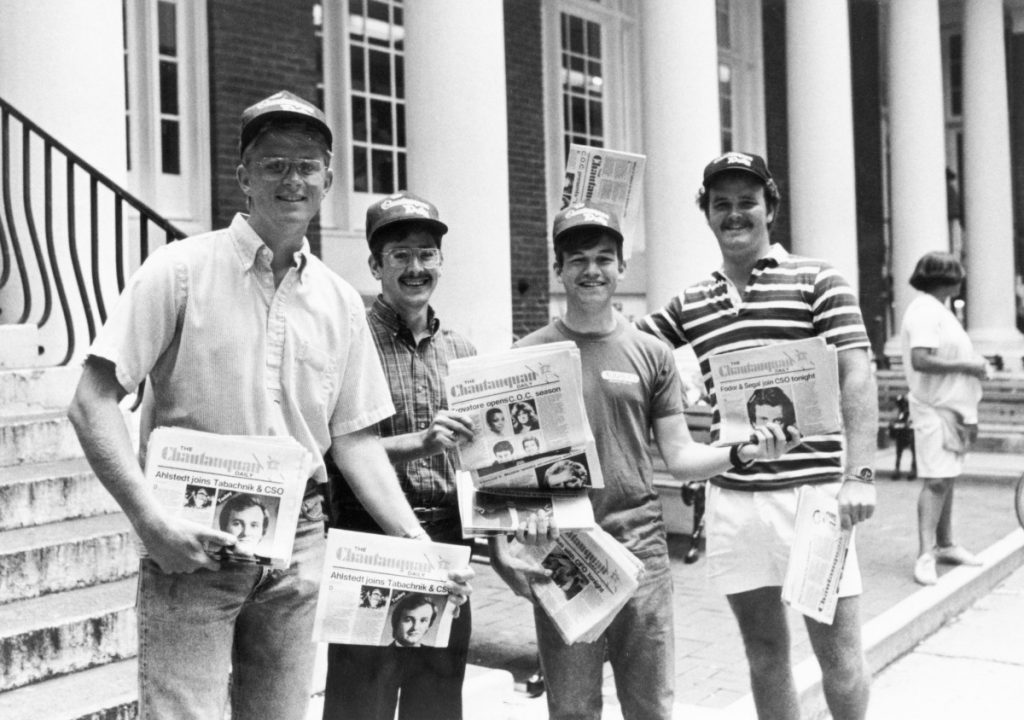
Trustee for Life at Chautauqua, George Snyder, worked at the Daily. Snyder started when he was 12 and worked through the summer after his first year of law school. He delivered and sold Dailies from 1975 to 1978, was the circulation manager from 1979 to 1981 and, finally, was the ad sales inside the grounds and advertising manager from 1982 to 1986. Other people he worked with or supervised included Jim Jamison, Barry Rothschild, Clay Smith, Tim King, Greg King, Chris King, Phil Lahey and Kevin Lahey, Phil Walker, John Faust, Alan Gardner (and his sister), Heidi Vanderveer, Randy Branch, Mark Jacobs, Tom McElree, Mac McElree and Tom Crissman.
Taylor Egri-Thomas sold the Daily during Weeks Seven–Nine from 2007 to 2009. At that time, the Daily was 50 cents. His favorite selling spots were the corner by the Coffee Gazebo and the Bestor Plaza fountain, and at Bellinger Hall during the 55+ week. Before the big Friday night concerts, the paper carriers sold Dailies inside the Amphitheater. It was not uncommon to receive $20 for a 50-cent paper and be told to keep the change. He tracked all his earnings (mostly in quarters) by teaching himself Microsoft Excel. On Fridays, he went to the finance department in the Colonnade to change the quarters into bills. Selling the Daily helped him develop a strong work ethic and learn “high” finance, but he also got to chat with the friendly (and very generous) Chautauquans who loved the jingles.
Does anyone have a new jingle they want to share?