Arianna Nevarez
Staff Writer
For Vital Voices Global Partnership, a new leadership model set the foundation — a model composed of five key components: a driving force, deep roots in the community, connection across lines that divide, “bold ideas, bold action” and a resolve to pay it forward.
“The world is gearing for a different model of leadership,” CEO and President of Vital Voices Alyse Nelson said. “A model of leadership that is about compassion and inclusion and collaboration, not about chainsaw rip-it-all-down leadership — about empowerment.”
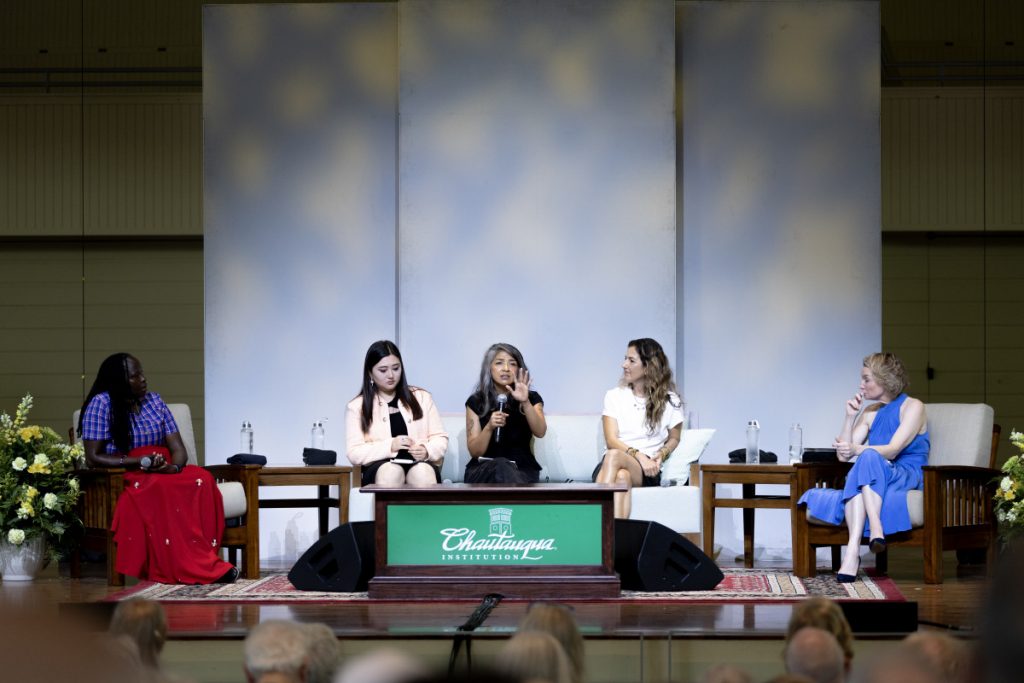
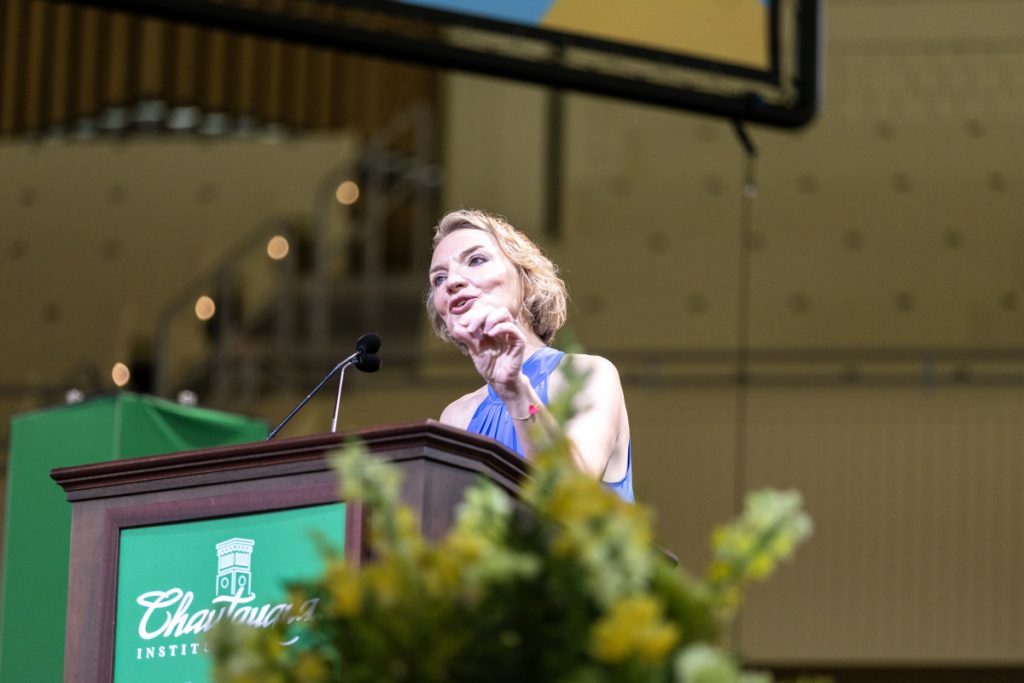
At 10:45 a.m. Tuesday in the Amphitheater, Nelson and four Vital Voices Fellows spoke on how leadership needs have shifted and how women have risen to help their communities during Week One of “Icons and Instigators: Women Who Change the World.”
Each of the women on the panel shared their stories, or “driving forces,” that led them to join Vital Voices. The lecture began with Nelson and her story about wanting to visit Beijing for a fourth world conference. She was told “no” so many times, yet she ensured she made it to the conference to speak out. There, she realized her “why” after hearing Hillary Clinton use her platform to uplift other people’s voices.
“I realized in that moment: I don’t have Hillary Clinton’s power or voice, but I have a voice, and I can use it,” Nelson said. “I can go back, and I can create space, spaces for one of those voices to be heard, and that became my driving force.”
Kakenya Ntaiya, CEO and founder of Kakenya’s Dream, then talked about growing up in an indigenous Maasai village in Kenya and how the girls in her village were forced into child marriage and female genital mutilation (FGM). She said her only known roles were to be a wife or mother, but she negotiated with her father to let her go back to school. She pushed to defy all odds, eventually earned a PhD and returned to her home country to change the story for the next generation of girls.
Breeze Liu, founder and CEO of Alecto AI, spoke about how, in April 2020, her life was changed forever when an AI-generated pornographic video of her circulated. Liu said she felt her world collapse. Then, she remembered her grandmother, who endured foot binding, survived smallpox and lived through wars in China, and she decided to persevere and fight for change.
Ariela Suster, the founder of SEQUENCE, grew up in El Salvador during the Salvadoran Civil War and saw a cycle of violence that she wanted to help break. After going to school in the United States, Suster set up a SEQUENCE workshop, which created employment opportunities for at-risk youth in the community through crafting artisanal products.
Leah Lizarondo, founder of Food Rescue Hero and vice president of global network and issue advocacy at Vital Voices, brought up her 16-year-old self dreaming of moving to New York from Venezuela. She moved to the city 10 years later, but she realized something was cropped out of the photo; there was a stark difference between people in suits versus lines stretching outside doors at soup kitchens. She knew she wanted to create a solution, knowing there was an abundance of food that was being thrown out.
“The other thing that comes into my head with all of these women … is that when you get the idea, when you see what I would call “the light,” you can’t close your eyes and unsee it,” Lizarondo said.
Ntaiya discussed her deep roots in her community that led to her feeling comfortable driving for change in her home. After graduating, she returned to Kenya and held conversations with fathers and people with power in her village to help them understand the need for young girls to receive education. She has since founded two schools and educated more than 1,000 girls.
“We just started changing the story for girls, and … some of them have graduated,” Ntaiya said. “They’re teachers in the cities that we’re in. Some of them are nurses. Some of them are doctors down in the village, and the girls are seeing role models who are fleeing from FGM, who are fleeing from child marriage, and the story is now very different.”
Liu emphasized the need to connect across lines that divide. She worked with people who disagreed in politics and technology, but she found that all of these people she talked to agree on a simple truth: “Human dignity is not partisan.” Liu created the TAKE IT DOWN Act, which criminalizes the nonconsensual distribution of intimate visual imagery, and watched it pass through the Senate, Congress and eventually be signed into law by President Donald Trump.
“Watching the law that I helped create become the law of the land, it was an extraordinary moment,” Liu said. “But the greatest victory actually wasn’t the legislation itself — it was proving that people who disagree can still come together to solve problems that matter, and that is what gives us hope. Because if we can do it in Congress, we can do it anywhere.”
Lizarondo was told her idea was unattainable when she first began her journey, but she didn’t let others’ opinions on her bold idea stop her from taking action. Though it started with just a group of friends going out and taking extra food to shelters and churches, it grew to the release of the Food Rescue Hero app that has had more than 60,000 people help transport over 350 million pounds of food.
“So when we talk about a bold idea, we all have bold ideas. … The bold action is just taking that first step, and I think what we invite you all today is for you to do that,” Lizarondo said.
Suster closed the conversation in the Amp with her desire to pay it forward. While she lived in El Salvador, her brother was kidnapped, but the community came together, held prayer events and demanded that her brother be returned. What stuck with her was that people who didn’t even know her showed up to help, and she made it her purpose to return that favor.
“As I look around this room, I see so much wisdom, I see so much experience. Sometimes paying it forward isn’t just about money or resources, it’s about showing up for somebody or speaking about somebody’s work, whether or not [they are] in the room,” Suster said. “The biggest movements began because one person showed up for the other. My brother was released because people showed up; my business started and exists because people showed up. You showed up today. Now, the question isn’t if you have the power to change somebody else’s trajectory. The question is: ‘Whose trajectory would you change?’”