Arianna Nevarez
Staff Writer
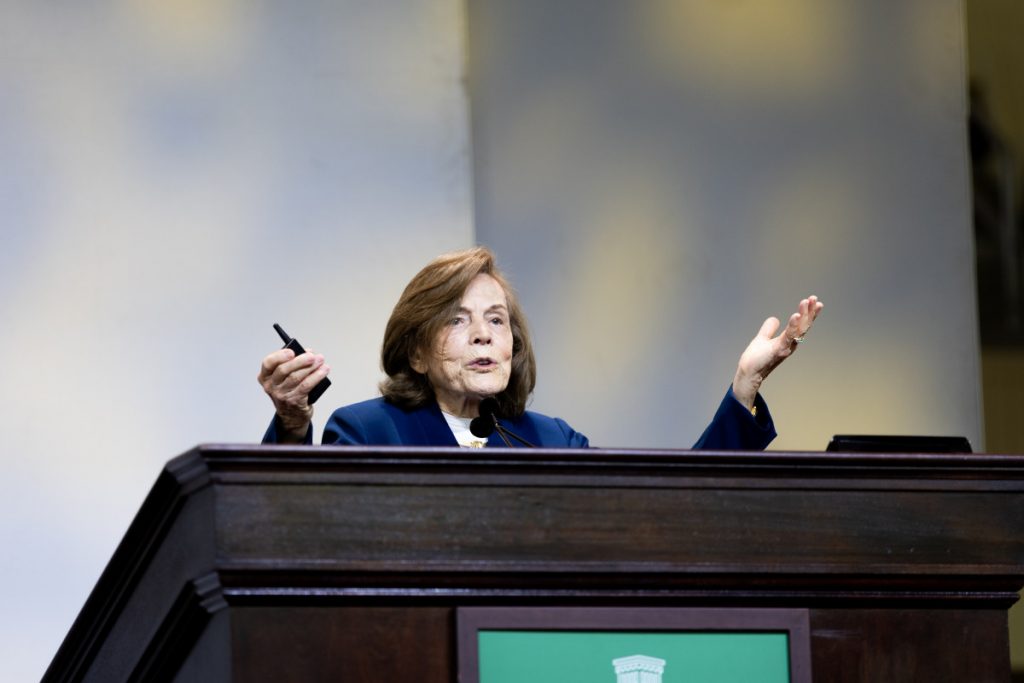
In 1970, Sylvia Earle led an all-female team to the bottom of the ocean to study marine life. She fell in love with the reefs and the life around them. Now, she points out how humans have negatively impacted this ecosystem over time, but she said humans still have a choice to change for the future of the ocean.
“What the planet used to be no longer exists,” Earle said. “The planet that I came from, deep in the 20th century, no longer exists.”
At 10:45 a.m. Friday in the Amphitheater, Earle closed out Week One of the Chautauqua Lecture Series.
She began her lecture describing how Jane Goodall approached chimpanzees with respect and how that set an example for the way Earle approached marine life. Earle said we have rewarded people in the past for killing animals, such as in hunting or fishing, but Goodall treated animals as citizens of the planet, just as humans are.
Mission Blue — the nonprofit Earle is the founder and CEO of — supports Hope Spots, oceanic locations key to the ocean’s health. She said Mission Blue approaches these spots with care.
Earle said when one is “looking at fish, looking at squid and octopus and all the creatures who make the ocean a living ocean, to treat them with respect. … It’s the ocean that makes Earth a habitable planet that we tend to take for granted.”
Earle criticized the normalization of capturing marine wildlife and the erroneous belief that the ocean is a bottomless resource. In reality, she said the maximum known depth of the ocean is seven miles, and the average depth is only two and a half miles. Earle pointed out how, at the beginning of the century, the population was one billion. Now, there are eight billion people, but the expectation of the ocean to provide in the same way it did remains.
“One species: It’s us with the power to alter the nature of nature,” Earle said.
Earle then dove into how humans initially explored Antarctica to find animals for “commercial extraction.” Seals were the initial victims, then they turned to penguins for oil. Whales were then the target but eventually became a protected species. Now, polar bear hunting is still allowed in a few countries.
Earle said most organisms live in the polar region or the ocean, so she argued that Antarctica is one of the places that can lead to the most scientific findings due to its climate.
“If we lose Antarctica, from the frozen continent to the surrounding sea, we really lose a key aspect of what makes Earth habitable,” she said.
When Earle first started exploring the ocean in the 1950s, biologists and geologists called it the “Anthropocene” era because humans’ effect had become “important,” according to Earle. She said she sees this in human activity in reefs, which can affect the overall ecosystem. She compared human interference with reefs to taking out doctors or lawyers from New York City; it’s taking away necessary pieces of a prosperous community.
“Some places that I knew and loved when I began exploring in the 1950s were beautiful coral reefs,” Earle said. “It’s painful knowing globally about half of them are gone, gone because of warming, but also because of a habit of extracting wildlife, of fishing, of taking the lobsters, taking the fish, … or other creatures that we take to market. It’s actually taking apart the system.”
Earle said she has seen people come together in Hope Spots. But, she said, humans need to think about what is put into the ocean, specifically plastic.
Plastic is not only from bottles, straws and plastic bags; Earle said the main perpetrator is fishing nets and lines. Earle said these materials have been scaled up to extract and capture this marine wildlife to meet the “market” needs. She said plastic doesn’t disappear overnight. Instead, it can take centuries for plastics to dissolve into microplastics.
“It’s just amazing to think that just in decades, we have developed technologies that make it possible for us to be the greatest predator — not great white sharks, not grizzly bears, but us,” Earle said. “Our appetite for what comes from the sea goes on our menus, and therefore, we think it must be okay. It isn’t okay.”
On her 80th birthday, Earle dove into the Arctic, and she said she was reminded of all the things humans have done to affect the ecosystem that existed long before humanity. She shared the value of having these creatures alive to help us. Specifically, Earle said economists have valued whales at $1 trillion due to the carbon they sequester.
In understanding the value of whales, Earle said other species should also be valued, such as sharks. Movies and the news have portrayed them as something to be feared, but she said that in the course of a year, millions of sharks are killed by humans.
“It is an eat and be eaten world,” Earle said. “It’s not just mosquitoes and humans. It’s life. It’s how the world functions, how the chemistry of the planet is maintained.”
Earle said as much as humans need sea creatures, marine life needs humans to help take care of them. She also asked the audience to think about whether or not humans need to eat sea life. The choices society makes can impact other food chains that can lead to extinction, and Earle argues that humans need to do anything possible to keep nature alive.
“If you do nothing, that’s a choice. If you do something, whatever it is, nobody can do the same thing because we all are different. That’s our power,” Earle said. “The diversity of choices can lead to a positive outcome. That’s why I’m here talking with you to inspire you to dive in, get acquainted with who you are, what you can do.”