
ARIANNA NEVAREZ
Staff Writer
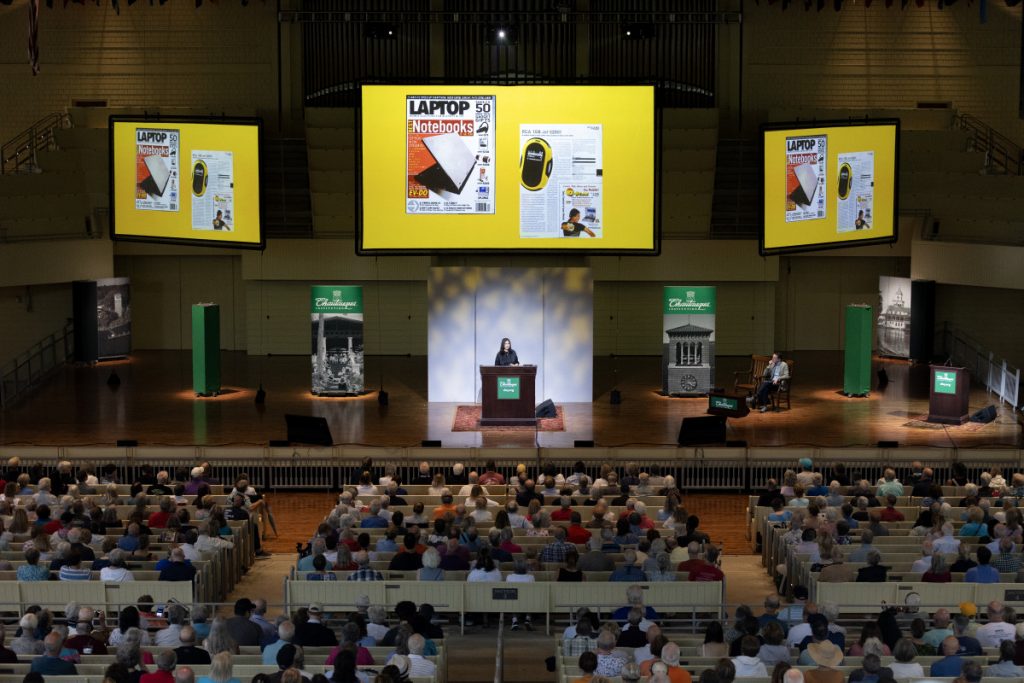
From Laptop Mag, where one of her first articles was about an MP3 player with 1 GB of storage, to the invention of the iPhone, Joanna Stern wrote her way through technology journalism. She would later dominate this field through legacy outlets like The Wall Street Journal and even create her own media outlet, New Things.
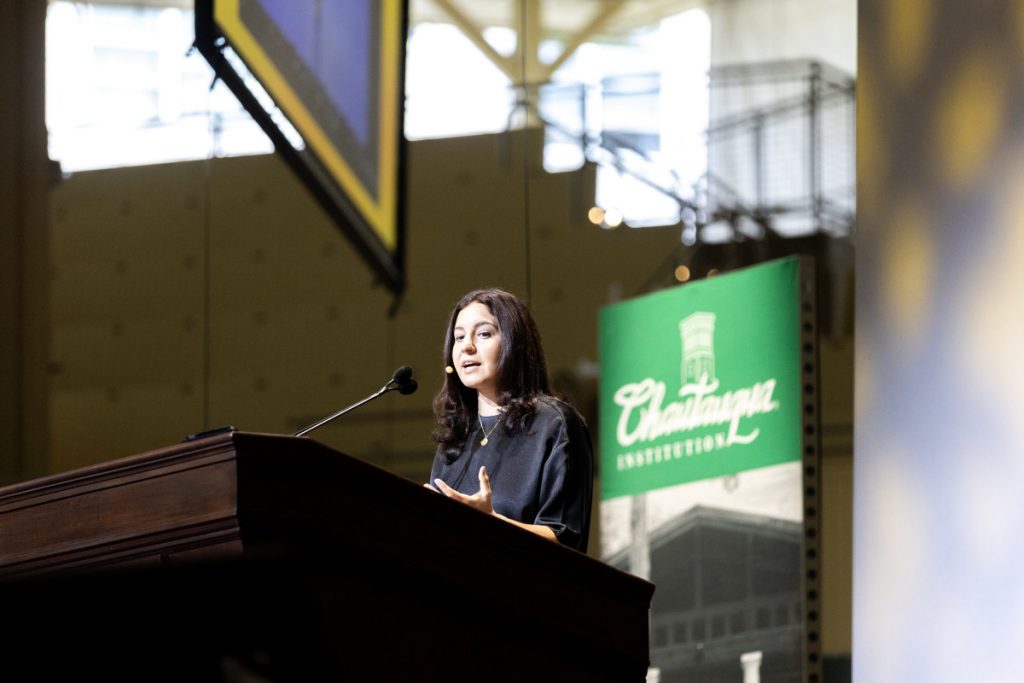
Stern lectured at 10:45 a.m. Monday in the Amphitheater, opening Week Two’s “Breaking the News: Charting a New Media Landscape,” by walking the audience through navigating the technological journalism world.
The year after Stern started working at Laptop Mag, Apple released the iPhone. She said the iPhone race changed her career because she was suddenly covering the “most exciting technological shift” in decades. Stern wanted to create an environment for people to learn in a personal and friendly way.
This led Stern to move her career to Engadget, where she would blog about these advances. Yet, she knew all the people around her were quick writers, and she noticed a need to step up in a different way.
“I realized that I needed to do something else to set myself apart, and that was to have some voice in writing about technology, a little humor, a little attitude and being able to help people along the way,” she said.
Then, Stern moved to The Verge, where she realized video was becoming more influential due to its incorporation into cell phones; so, she started learning how to appeal to this new medium. At the same time, social media platforms started to form a new kind of presence in the journalism world.
A mix of media companies began putting their work onto social media, while the journalists started spending more time on these apps and creating a new kind of platform for themselves, she explained.
“I was spending a lot of time on Twitter and Facebook, sharing my articles, sharing my videos, and I was starting to create a brand of my own,” Stern said. “I grew a lot of followers, and I connected directly with the audiences there versus the audiences at these publications I was working at, and every time I switched from one publication to another, people followed me; they could follow me through social media.”
In 2013, Stern received an offer from WSJ to serve as its technology columnist. She created video content for them while covering the rise of smartphones. While she was working for WSJ, she also started putting her content in other places, such as YouTube and a newsletter. This is when she realized anyone could now reach an audience and grow a publication; a new business model had emerged for journalists where they no longer needed to be in the “traditional” media world.
Newsrooms were shrinking. Advertisements were falling off. There were trust problems. Stern said she noticed that mainstream news was no longer the thriving place it once was.
“I started to look around and said, ‘Maybe the safest place in this news landscape isn’t inside of the brand; it’s being the brand,’” Stern said.
She was conflicted on whether or not it was wise to leave the WSJ and create her own brand. So, she listed out the pros and cons but she still couldn’t decide. However, she was in her year of using artificial intelligence in research for her book, I Am Not a Robot: My Year Using AI to Do (Almost) Everything, so she asked ChatGPT. It answered that Stern should quit. But ChatGPT “doesn’t have a mortgage and kids to worry about,” so Stern ended up making the real decision to leave on her own.
Stern created a technology-focused media outlet called New Things, where she has an editorial partnership with NBC News. Through this, she has independence in what she publishes while having access to resources of a “trusted institution,” calling this the “best of both worlds.”
Then, she shifted the lecture’s focus toward how AI and news have been working together. While building the foundation of her news outlet, Stern said AI has become a “co-founder” because it helped her research, edit and speed up the busy work.
Stern also brought up agentic AI, which can make decisions and go through multi-step processes with a single prompt. She said this can be a powerful tool, but she has a few rules for traversing the world of AI.
Stern first said humans must work with AI, not for it. She admitted she used it for research for a story about Meta AI Glasses and how people were paying for the removal of the recording-indicator light from the glasses. She had Claude Code go through Facebook, find data from people providing the service and put it into a spreadsheet. Later, her production assistant reviewed this to ensure it was correct, but Stern said using AI allowed more time for her assistant to work on other tasks.
She talked about the balance between using it as a tool and having human input.
“The moment you start to outsource all the hard work and the thinking to AI, AI isn’t working for you; you are working for it,” Stern said. “You can use it to move faster, you can use it to spark ideas, you can use it to do some of that tedious work … but the ideas to do that have to come from you.”
Questioning the output of AI is “extremely important,” according to Stern. She said this is critical to journalism because AI can hallucinate quotes and facts.
Lastly, she said people should train their data. Stern said she can’t lean on AI to find new stories as a reporter because everything AI knows is from data that comes before it. So, the only way she said people build their “training data” is by firsthand experiences.
“I now would ask you to put your phones away, because by putting the phone down and talking to each other and paying attention to the real world, that’s how we form our training data, that’s how we as reporters tell new stories, tell the stories about the truth in the world around us,” Stern said.