Arianna Nevarez
Staff Writer
As an opinion columnist, Jason Riley, who has worked on the editorial team for The Wall Street Journal, does research and makes sure to keep himself informed, but he said he is not “expected to give an answer.” Instead, that is the role of news journalists, but they’re not providing an objective explanation, he said.
“It’s true that news organizations have never been entirely objective in their political coverage. But in a previous era, they were considered more trustworthy by the public,” Riley said.
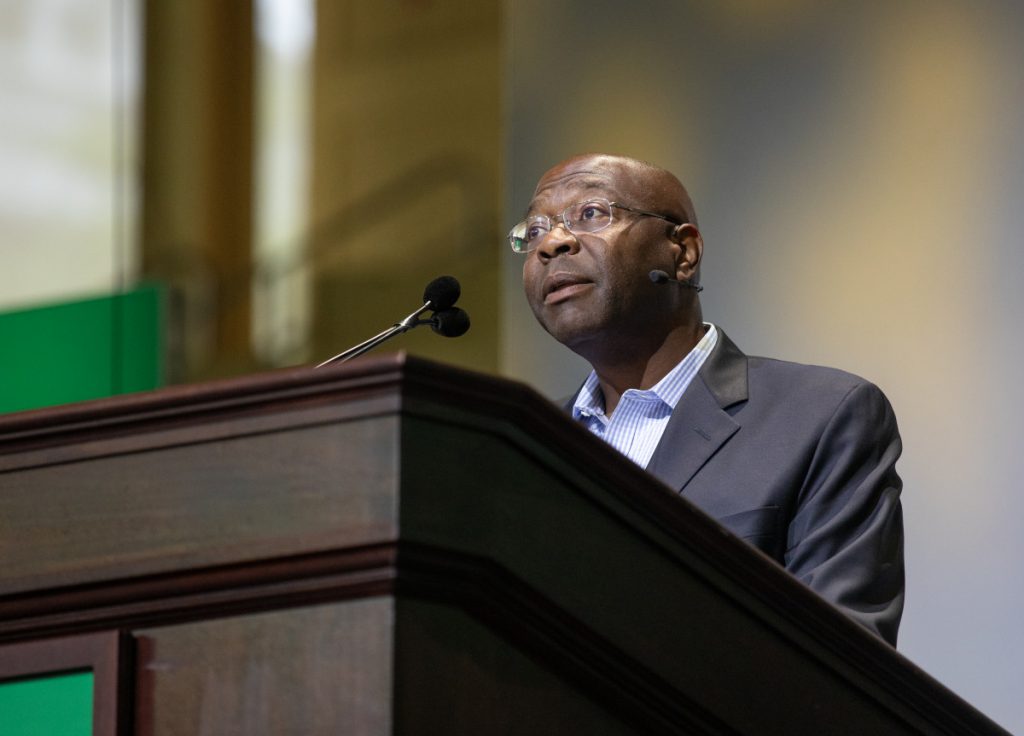
At 10:45 a.m. Wednesday in the Amphitheater, Riley lectured on the public’s distrust of media, the “narrative control” journalists build and changes in the news business model that feed into what he said readers want.
According to Riley, Gallup did a poll on the trust in media in the United States, which has hit an all-time low; he pointed out the fall of trust in 2016 due to the coverage of President Donald Trump. He said that Republicans and conservatives complaining about bias in the media are not “imagining this.” According to a Syracuse University study, only 3.4% of journalists identified as Republicans.
“My point is that today we have a political press war in which almost every journalist is at political odds with nearly half of the voting public,” he said. “Let me reiterate this: Roughly half the country supported Trump’s presidential bids, but that was true for less than 5% of the political press. This was already a problem a quarter century ago, when most of the public trusted the media. Now, most people don’t trust the media, and it poses a much, much bigger problem.”
In 2016, Riley said, the nation’s leading news organizations that “already tended to lean left” became more openly oppositional in their White House reporting, not just in their editorial page.
Riley said the move to suspend professional standards was “enthusiastically endorsed” by those who named themselves guardians of journalism ethics. He cited The New York Times’ coverage of Trump while “discarding any pretense of objectivity.” He referred to the 2016 edition of the Columbia Journalism Review, which he said was applauding journalists who were abandoning steadfast attachment and pushing against the Trump White House.
Once Trump won, Riley said the news media’s reaction was the problem. They failed at predicting the election’s winner, so they resisted, according to Riley. He said the reporters insisted that a surge of white bigotry put Trump in the Oval Office and Trump’s victory over Hillary Clinton proved that racism and sexism were ascendant.
But, Riley said, statistics showed a rise in support for Trump from Black, Asian and Hispanic voters. He said none of these were given attention because they “did not fit the media’s preferred narrative of Trump.”
“They’ve abandoned journalism and become political activists,” Riley said. “That’s wrong, and it has helped undermine police credibility in the eyes of the public. Even with regard to topics not directly related to electoral politics, the media has proven itself to be untrustworthy.”
Riley then turned to give an example of how the media has proved itself to be “untrustworthy.” He brought up the coverage of the police and the Black Lives Matter movement. He said the United States had looting, riots and billions of property damage that he believes the media bears a “huge responsibility for.”
“The entire Black Lives Matter movement was premised on a lie, which is that police officers were targeting unarmed Black people and that Black men in particular were being shot by cops at alarming rates,” Riley said. “In the media, on college campuses, among Civil Rights activists and in the world of sports, a dishonest narrative took hold. The press is very eager to break down police shootings by race, but hesitant to break down criminal behavior by race, which gives the public a very distorted picture of what’s happening.”
Riley said in the United States, Black people are only 13% of the population, yet they account for more than half of all homicides. But he said 90% of these murders are done by “their peers.”
Riley said the narrative of the police being at the forefront of this issue connects to stories based on viral social media clips and journalists “controlling the narrative” when there is no empirical data to support their stories.
He also said the news “bends over backwards” to provide multiple perspectives regarding the commitment of violent crime by illegal immigrants, yet they do not when there are incidents involving young Black men and police officers because “one narrative serves their agenda and the other does not.”
“Bad cops should be called out and punished, and I think the activists and the media are performing a public service when they call attention to police misconduct,” Riley said. “The problem is the overemphasis on police behavior. If you believe that these lives really matter, if you want to reduce that Black body count, just as a practical matter, should your main focus be on the 2% of Black shooting deaths that involve cops? Or the 98% that don’t?”
Riley then moved to the other issue at hand for journalism: restoring trust. He discussed how newsrooms made money primarily through advertisements. Riley said that in this past era, editors had advertisers in mind and had more reason to offer objective and balanced coverage.
Then, advertisers flew to online platforms, leaving newspapers to make the majority of their revenue through subscriptions. Riley said the prioritization of keeping the number of subscribers up leads editors to now focus on the issues and coverage that readers want.
“The dilemma the news business faces is that to regain trust, it would help to become less partisan,” Riley said. “But the subscriber-based business model rewards partisanship and divisive news coverage.”
Riley used The New York Times as an example of this phenomenon. He said the publication wrote more than 3,000 articles in two years on the Russian election interference story. Riley said the stories implied that Trump was culpable and that the scandal would take down his presidency: something that Riley said — after a lengthy investigation by Robert Mueller — ended up being a ”nothingburger.”
Riley said this was a failure on the NYT, but its subscriptions doubled during the first year of the Trump presidency.
“What was a journalistic failure translated into a subscription bonanza, a business model of success,” he said.
Riley said his goal was to describe the problem. He does not know the answers to how legacy media will dig themselves out of this or if they ever will, but he said he has faith in the “free market capital system in America.”
“If there is a market for objective and trustworthy journalism — and I think there still is — news organizations will pop up or adapt to fill them,” Riley said. “Heaven knows, they will have their work cut out.”