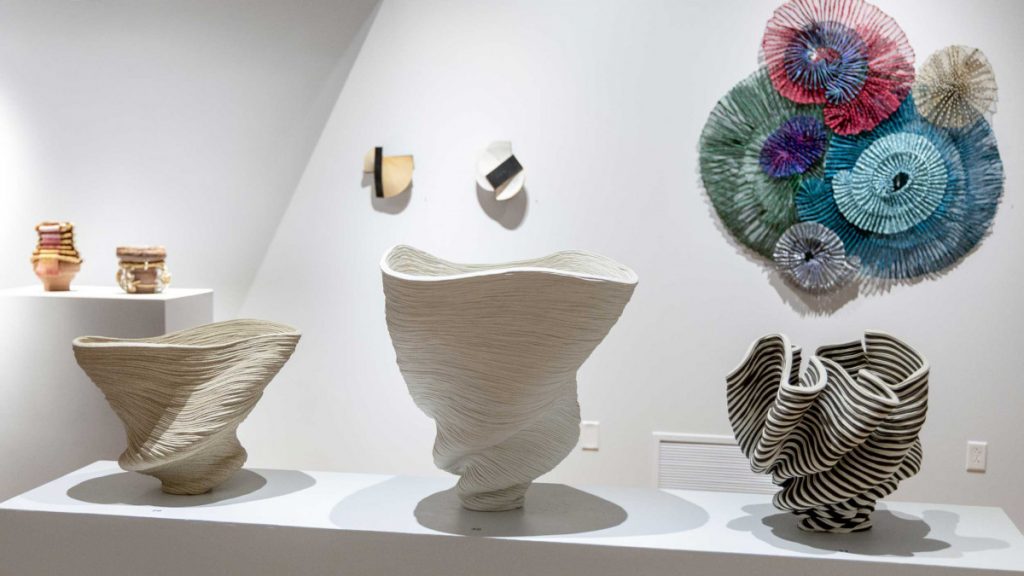
Pieces by Philip Soucy are displayed in the exhibition “Twisted” June 22 in Strohl Art Center.
JENELL TAYLOR
Staff Writer
Atticus Adams can’t remember a time when he wasn’t creating. Having grown in Appalachia, his family is made of quilters, woodworkers and other artists who modeled for Adams the joys of making. Adams himself works with various forms of metal, mesh and acrylic, drawing from fond childhood memories of mountain streams and overgrown grass.
“I come from a family of creatives,” he said. “Because my family had no money, creativity was looked at as a hobby — never a career. The path to being a full-time artist was a long process.”
Adams creates sculptures displayed in various formats — wall-mounted, hanging and installation. Much of his work takes on an abstract, cloud-like form, suspended between fluidity and solid structure. Particularly, his work with aluminum and copper mesh wire is inspired by childhood summers spent with his grandmother, rushing in and out of her screen door.
“Touching the material brings me back to a time of happiness,” he said. “The pleating and shapes from Victorian clothes found in an old trunk and the vibrant colors from a visit to pigment shops in Venice represent layers of personal happy memories.”
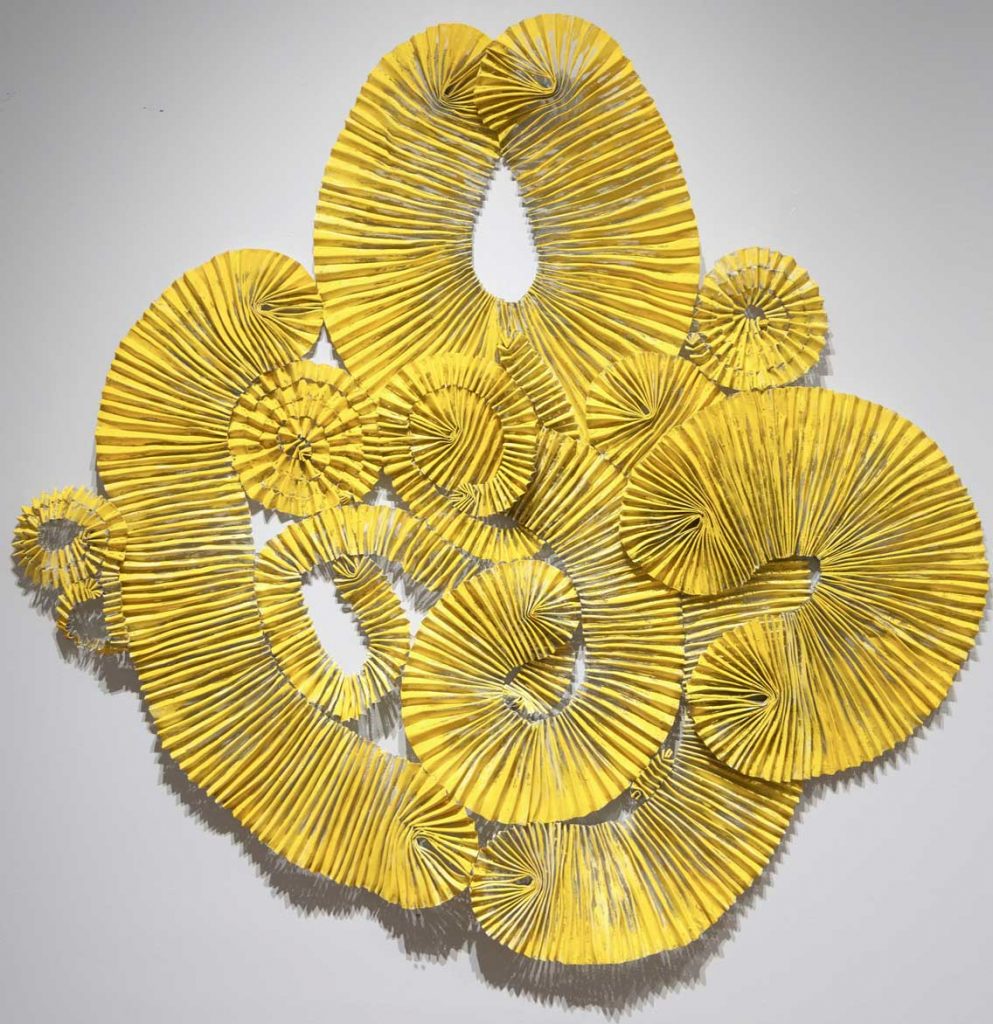
“Uxmal Summer” by Atticus Adams.
Adams’ work is being displayed in “Twisted,” a sculpture-centered exhibition also featuring works by Vivian Chiu, Kyle Cottier, Andrew Hayes, Terumi Saito and Philip Soucy.
The exhibition is curated by Judy Barie, Susan and John Turben director of the Chautauqua Visual Arts Galleries, and is open through Aug. 24 in the Gallo Family Gallery of Strohl Art Center.
Drawing from the foundation of her own familial history and traditions, Japanese artist Saito uses her work to explore cultural memory and humanity’s shared heritage.
“Working across different cultures made me reflect on my own heritage and on the universal role of making by hand,” she said. “Clay and textiles became a way to explore how cultural knowledge, memory and identity are carried through materials and passed from one generation to the next.”
Saito’s works are sculptural forms that reflect her ideas of continuity, body and landscape. Her practice is rooted in the traditional practice of backstrap weaving, a technique she learned in Peru and fine-tuned during research in Guatemala and Japan.
“I am drawn to weaving because it is both a physical process and a way of thinking, which connects body, material and time,” she said. “I reinterpret woven structures through sculpture, combining natural dyes and fibers with hand-built ceramics to explore tension, fragility and resilience.”
Saito described her pieces in “Twisted” as conversations between softness and solidity, movement and stillness. As the fiber twists and winds around the clay body, it creates a two-way mirror where one can look at history and it can look back.
“[The pieces] reflect on how traditions evolve over time while carrying traces of memory, labor and the hands that shape them,” Saito said. “I see continuity as something that is constantly evolving rather than fixed. Traditions survive because they adapt, and I approach my work in the same way.”
Saito urged viewers to surrender to slowness. Rather than searching for a single meaning, she encouraged viewers to reflect on the culture and tradition that is present in their individual lives.
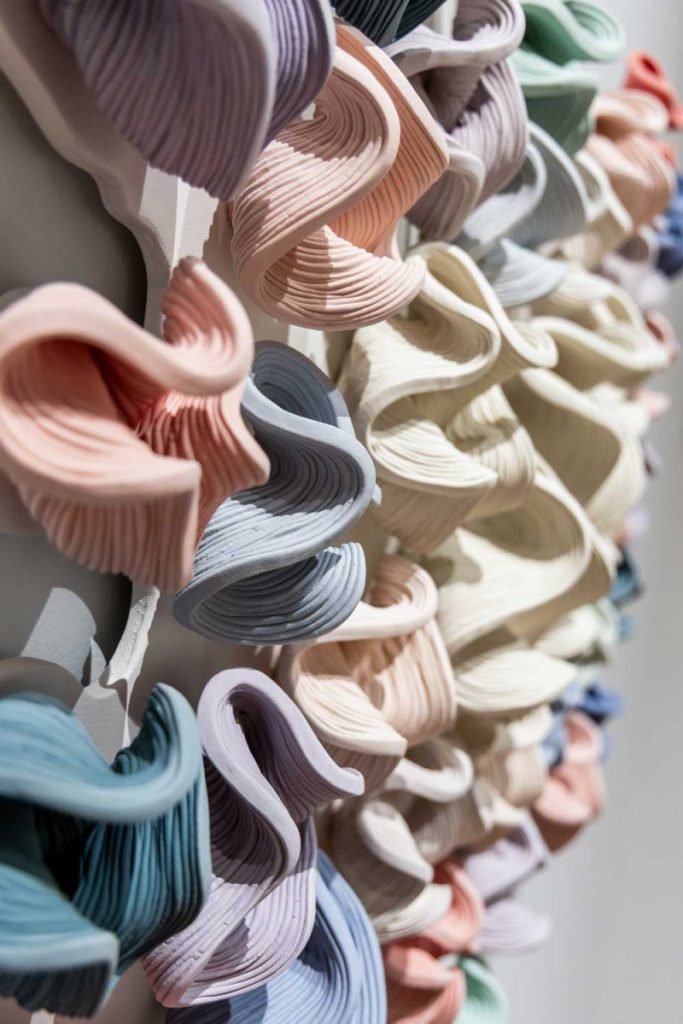
“Wall Piece” by Philip Soucy.
“I hope viewers take time to notice the details, the woven structures, the textures and the dialogue between fiber and clay,” she said. “I invite them to reflect on their own connections to memory, place and the traditions that have shaped their lives.”
In contrast to Saito’s fiberworks, Chiu uses wood to create her sculptures. Her pieces explore the depth of visibility and the malleability of perception.
Making use of her natural inclination for problem-solving, Chiu “utilizes continuous deconstruction and reconstruction to create optical sculptures,” according to her artist statement. Her works are reminiscent of the human form, household objects and complex architectural bodies.
Similarly, interdisciplinary artist Cottier makes use of wood to bring his vision to life. With a heavy, detail-oriented focus on transformation, repair and survival, his works combine sculpture, installation and photography to explore the constructed and digital worlds.
Cottier’s works are made rather slowly, starting with the collection of thousands of small, modular units. These pieces are then used to form larger structures. “My process is rooted in repetition, weaving and mending, guided by a logic of interdependence and preservation,” he said in his artist statement. “I approach memory as physical and provisional, a space continually unmade and rebuilt over time.”
Multimedia ceramicist Soucy focuses on clay because of its ability to endure. Its emergence from the natural world and journey to once again return to and reflect it is an intimate portrayal of history, time, materiality and form. With a childhood spent in Europe, he was surrounded by the century-old works of various guilds: masonry, blacksmith, stained glass and sculpture, setting the stage for his curiosity about art and beauty.
“[Clay] cheats death for the sculptor; some of our oldest artifacts of humanity are clay,” he said. “As soon as I put my hands in clay and began building, I knew I had found my weapon of choice. I can use the material conceptually, but I can also form and preserve a series of moments one layer at a time.”
Coil-building is Soucy’s foundational technique, performed by rolling out clay coils anywhere from a few inches to up to seven feet long, and then placing each layer around the waves of the sculpture. This process is repetitive and often meditative, speaking to his close relationship with the material.
“There are of course 3D printers and extruders and all sorts of machines that could speed the process in different ways, but hand rolling and hand forming the coils slows down the process deliberately to tune into the flow and connect to the material itself,” he said.
“Clay holds the imprint of both its place of origin and of the time spent making,” he continued. “The more time my hands are on the clay, the more of myself is imprinted, too.”
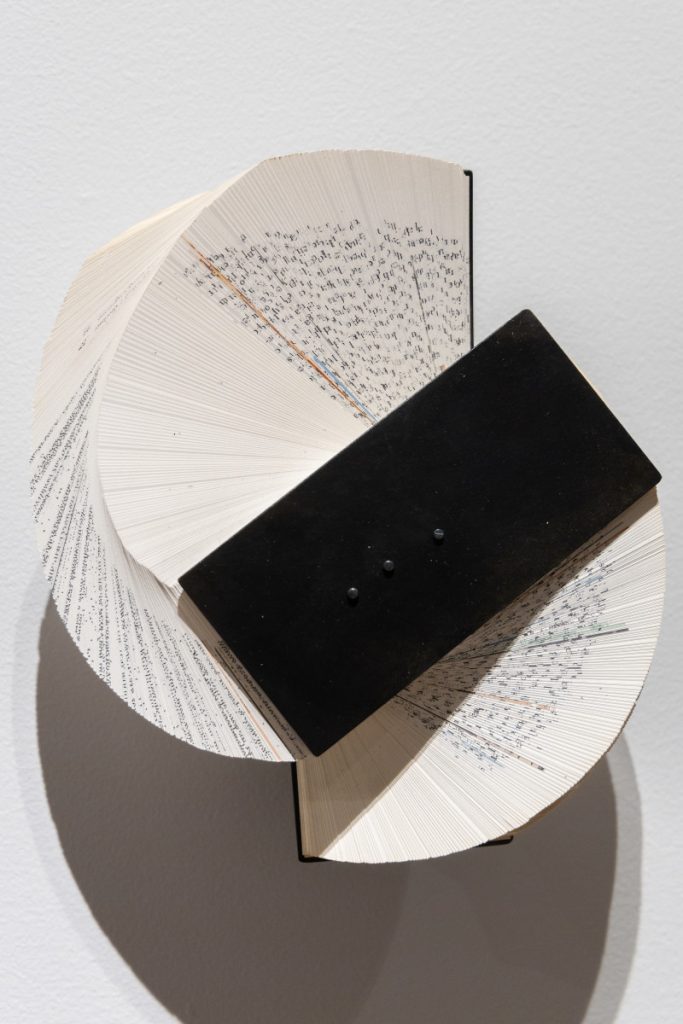
“Contorted Volume 29” by Andrew Hayes.
Made over the span of the last year, Soucy’s works in “Twisted” showcase his experiments in size, shape and movement, testing just how far he can push a body of clay. These experiments can be unpredictable in practice due to the capricious interactions of the kilns and gravity. Each piece represents the weeks of tinkering he does in order to find the proper stability, color, flexibility and overall intensity of the works.
“The blacks and whites, for example, are two completely different clay bodies and took a lot of testing to see how they could best work together,” he said.
A core element of his process is the deliberate choice to keep his coils unsmoothed. The rugged nature of the clay and the time put into each piece is something that Soucy displays with pride. While in undergrad, he learned how to construct a clay body entirely from scratch out of its requisite parts, endowing him with the base knowledge to create as he pleases.
“I want the construction method to be a central element to its decoration,” he said. “I know what to expect from the relationship and I have the trust, comfort and freedom to flex and change with new ideas. I know how our dance is going to go.”
For sculptor Hayes, inspiration is born through his interest in the book as a subject. Through metalwork, he creates pieces that are reminiscent of wood and other natural forms to investigate the book as a cyclical concept of time.
“I feel drawn to books, and I think most people are, because it holds potential,” he said. “As an object, books convey stories and facts — they transport us. The cover design draws us in, the smell of the paper conjures up memories and the bound pages in my work touches on those qualities.”
Hayes begins his process by cutting a book from its binding and moving the paper around to create a form he finds intriguing. Then, he shapes steel to hold the pages in place which formulates a new form that plays with balance and stillness.
“The paper in each piece is inherently more organic than the steel, but I don’t necessarily think of it in reference to the natural world as it once was a tree,” he said. “I like to speak to the similarities between paper and steel. I like how both hold the record of touch. Be that pencil or hammer marks, I like how both materials move in the same ways. I also love how placing the two materials together amplifies the sensitivity of each other.”
Hayes’ work in the exhibition explores how time leaves its mark, and how those marks can be used to tell an entirely new story.
“Everything ages, papers yellow, steel rusts and time leaves its mark. I am drawn to those marks,” he said. “I use books that show age and I leave marks in the steel to illustrate the passage that steel has taken from a flat sheet to a fabricated form.”
The artists featured in “Twisted” all use sculpture to describe how their relationships with the natural world impacts their lives and artistries. Subsequently, as their pieces sit together, they illustrate a common theme of resting with one’s thoughts and work to allow the art to be cultivated through the practice of patience.
Soucy left readers with a few final considerations: “Consider the moments, the themes and the energy that brought you here. What made you stop into the gallery? What lecture did you participate in this week?” he asks. “Think rhizomatic, not arborescent.”