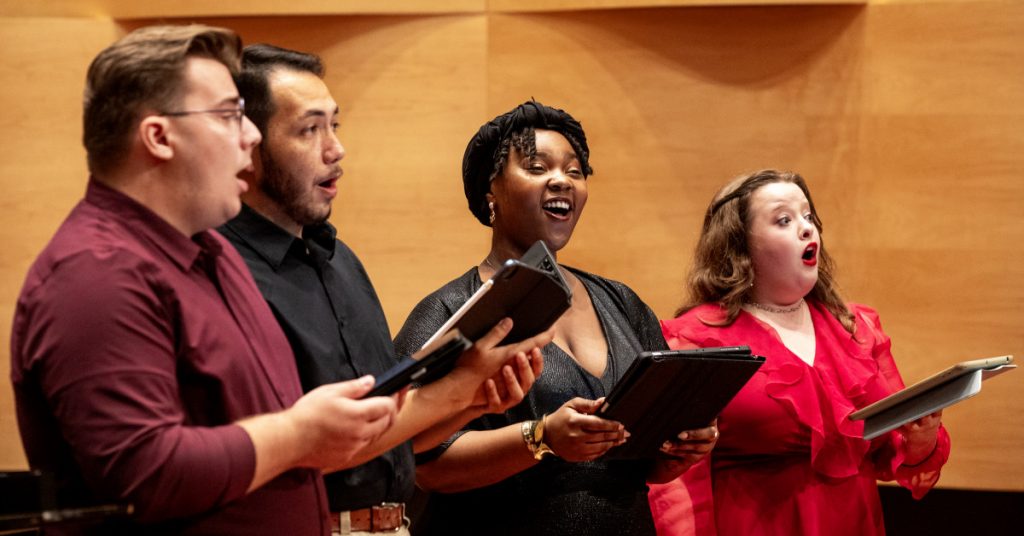
From left, Chautauqua Opera Company Young Artists Ryan Michki, tenor, Christopher Walters, baritone, Audrianna Hughes, mezzo-soprano, and Faith Adams, soprano, rehearse Tuesday for their Afternoon of Song performance today in Fletcher Music Hall.
LAYLA VINSON
Staff Writer
A selection of pianists and Studio Artists of Chautauqua Opera Company will present an Afternoon of Song at 3:15 p.m. today in Fletcher Music Hall. The debut art song recital of the season will showcase not only the musicians’ musical abilities and repertoire, but also their reverence toward the highly personal program curation in an uniquely intimate setting.
Carol Rausch, Chautauqua Opera Company music administrator, chorus master and one of the event’s pianists, shared her excitement about the preliminary efforts of selecting which pieces will be included in the recital in collaboration with the performing artists.
“It’s important to me to pull out, if possible, the things that I think are standout pieces in the program that the audience will like,” Rausch explained. “It’s important to me that singers get to share a little bit of who they are through their composer choices.”
The four Studio Artists performing at today’s recital — Faith Adams, soprano; Audrianna Hughes, mezzo-soprano; Ryan Michki, tenor; and Christoper Walters, baritone — will prelude their songs with an anecdote transcending mere translation and offering the audience their individual interpretation of the selected piece.
“You pick up on their personal vibe. They’re not giving you heavy-duty musicological information; it’s more about ‘I love these because,’” Rausch continued. “It makes what is already a very personal art form even more personal.”
Hughes said she hopes to expose audiences to new music they may not have heard before, outlining her particular repertoire as commendatory both musically and in its historical recognition of prominent Black composers.
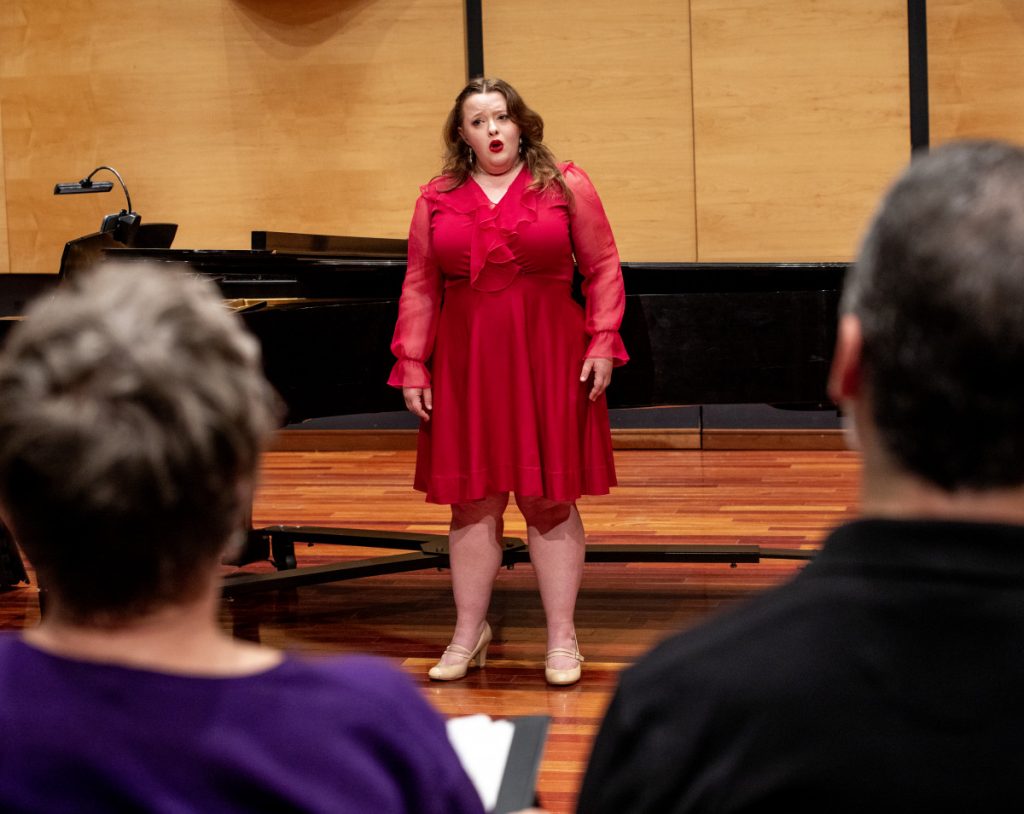
Adams performs a solo piece during rehearsal.
“I’m really excited to present my solo pieces,” Hughes said. “Margaret Bonds and Leslie Adams are both underrepresented composers, so this is also a great way to showcase this with other people who have probably never heard a spiritual or any African American art songs. I’m always happy to share that with anyone.”
With an exceptionally wide variety of composers, the program spans linguistic barriers in its procurement of English, French, German, Italian, Swedish and Russian works. While the audience will be provided printed translations to follow along, conveying the emotional integrity of the piece across languages provides a challenge of its own.
Michki explained that the texts he will perform are in French and German, and said that these languages are not his native one, nor are they the native language of most audience members at Chautauqua. These circumstances make non-verbal communication and body language particularly important in delivering an emotional, authentic performance.
“Finding a way to still convey these really deep and abstract themes and emotions to a new audience, especially with a piece that I’ve done before, it’s very interesting,” Michki said.
Pianists for the recital — Miriam Charney, Rick Hoffenberg, Nathaniel LaNasa, Allison Voth and Rausch — each harbor their own emotional attachment to art songs, with many of their early roots growing from the specific genre of music.
“When we play for an opera, we’re playing a reduction of an orchestral score. And sometimes, frankly, it’s a little awkward to play as a pianist because it wasn’t written for a pianist,” Hoffenberg explained. “But when we’re playing recital repertoire, we’re playing music that was written for the instruments, written for pianos, written for the touch and colors of that instrument. And so it’s very gratifying to play that music as a pianist.”
Just as the song selection from singers offer insight into their personality, so too can the pieces each pianist chooses to perform. The synergy between pianists and singers brought to the spotlight in art song recitals further fosters the intimacy of the performance for the performers and audience alike.
“I really enjoyed this particular song segment because piano is so important. There’s so much text painting happening in the vocal line, but we also hear that piano as well,” Adams said in regard to her chosen repertoire, harboring great appreciation for the collaborative and personal nature of the recital. “It’s a true partnership, and I think for me, that’s what makes art songs so exciting.”