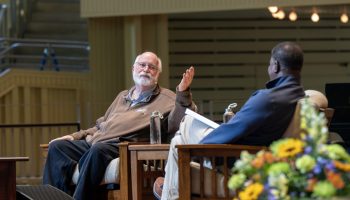

Week Four Chaplain Cantor Olivia Brodsky and Senior Pastor the Rt. Rev. Eugene Taylor Sutton invite Chautauquans to sing “Down by the Riverside” Wednesday during Brodsky’s Faith Journeys Service in the Hall of Philosophy.
Column by Mary Lee Talbot
Cantor Olivia Brodsky grew up in West Bloomfield, Michigan, in an observant Conservative movement Jewish home. “We kept Kosher and celebrated Shabbat dinners. My father still calls me on Friday night to give me the priestly blessing,” she said. Brodsky shared her faith journey at the 9:15 a.m. Thursday morning worship service in the Hall of Philosophy. Bishop Eugene Taylor Sutton asked her questions about her journey.
She attended a Conservative day school and found that questions were not encouraged. “This is not the Jewish tradition, and I had genuine questions. When I would ask, ‘why?’ the teachers would tell us, ‘because God told us to,’” she said.
In fifth grade, Brodsky received detention because she asked a question. Her class was reading the first part of Genesis and translating it from Hebrew to English. As they were reading, she realized that there were two creation stories about Adam and Eve.
“I asked, which one is it: created in God’s image or created from dust (Adam) and Adam’s rib (Eve)? I got detention because the teacher said I was trying to sow doubt about the divine nature of the Torah in my classmates,” Brodsky said. “If I am going to obey, I want genuine understanding.”
Sutton asked if the stories in the Bible are true. Brodsky said some of them can be proved archaeologically, like the site of the First and Second Temples at the Dome of the Rock. Others are divinely inspired and could be interpreted in a variety of ways.
Brodsky said she thinks of herself as an agnostic about the existence of God. “I can feel the Spirit in nature, acts of kindness and so I practice my faith as if God does exist. I believe we can grow spiritually if we engage in practice over time. It was Abraham Joshua Heschel who said that we can pray with our feet and to engage in social justice is a Godly act.”
When asked about her Wednesday sermon on the biblical roots of Zionism, Brodsky said that to say the land belongs solely to Israel or solely to Palestinians is not correct. “Jews have an historical commitment to the land and so do others. We should be pro both peoples, living side by side in peace, safe and secure and with sovereignty for both.” The congregation applauded.
Sutton asked Brodsky if she felt safe in the United States today. “I grew up in a Jewish bubble and I did not hear the ‘k-word’ until high school. October 7 was a rude awakening; I am discouraged at how prevalent antisemitism is. But I won’t allow that to prevent me from being proud of my heritage. I hope this attitude does not bring me physical trouble.”
Another issue Sutton raised was about security at temple services. Brodsky said she did not know of any temple that did not have armed security. “It is a sad reality, but it is better to hope for the best and prepare for the worst.”
Some people, Sutton said, ask how one can believe in God when the people attacking temples or Christian churches say they are doing God’s work. Why should they believe in God?
Brodsky answered, “I would tell them that they could believe in God, not that they should. Believing in God could enrich their life. I would also tell them that [these attacks] are not the work of God. We, as humans, have free will and we are free to misinterpret God’s will. That is a reflection of the fallibility of humans.”
East End Temple, where Brodsky serves as cantor, is “on the small side,” with 400 families. She described it as warm, low-key, tight-knit and a place that fosters genuine connections and “inspires people to act righteously.”
She concluded, “I hope my legacy will be that my life will reflect my Jewish and spiritual journey. There is no right or wrong way to be Jewish or religious. Find the hook in your religious community and latch on to it. Find a home, a community, because no one is judging.”
The Rt. Rev. Eugene Taylor Sutton, senior pastor of Chautauqua, presided. Flutist Colleen Law played “Pastorale” by Germaine Tailleferre and “Suite Modale” by Ernest Bloch. Sonya Subbayya Sutton, interim director of Sacred Music, provided piano accompaniment. The Rev. Laura Harris-Adam, chaplain at the Baptist House this week, led the morning prayers in English. Renee Andrews, who coaches bar and bat mitzvah students at Temple Rodef Shalom in Falls Church, Virginia, explained the history of the song “Mi Shebeirach” by Debbie Friedman. Cantor Olivia Brodsky sang “Mi Shebeirach” as part of the morning prayers. Friedman was one of the first composers to combine Hebrew and English in her compositions for Jewish services. Support for this week’s chaplaincy and preaching is provided by The J. Everett Hall Memorial Chaplaincy and The Randell-Hall Memorial Chaplaincy.