LILY RESLINK
Staff Writer
Leah Naomi Green lives in the mountains of Virginia, where she grows her own food and writes a lot of poems. This lifestyle, she said, is rooted in spiritual presence and embodiment of living in accordance as a part of Earth’s resources.
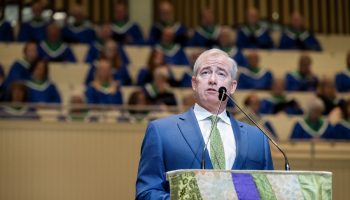
Green closed out Week Four’s “The Ethics of Enough” with a lecture titled “Don’t Just Do Something, Sit There.” At 2 p.m. Thursday in the Hall of Philosophy, Green delivered a talk that explored the meaning and impact of being present on Earth.
Green said she felt profoundly moved by a quote from her friend, a Buddhist nun, who said: “The present is where I know what to do.”
In her lecture, Green covered points relating to connection with the present, humanity’s understanding of its place in the world and poetry as a form of spiritual meditation. Throughout the lecture, she intertwined her own poems with her reflections.
Looking out into the audience to find eyes closed in contemplation, Green said she appreciated this action: “If you get anything from this talk, may it be a moment of peace.”
Green’s first main goal was to instill in the audience an understanding that environmental problems are not problems with the environment, but rather problems with humans in the environment.
She explored the distinction between “real scarcity” and “manufactured scarcity” — she said only the latter troubles her. She said the sun is a resource that represents true abundance and sources “perpetual renewable” nourishment for all on Earth. Behind “manufactured scarcity,” she said, is humanity’s perception of “natural resources” as “products or commodities” rather than gifts.
For humans to operate in the best interest of the environment, she called for a more spiritual understanding of this resource exchange. While emphasizing that science is extremely important, she said, beyond science, “there’s a missing link between data and behavioral change.” She said this link is precisely what Chautauqua Institution is calling “spiritual responses” to the problem of throwaway culture.
She said “economy” and “ecology” share a Greek root, oikos, which means “household.” She said both of these concepts are rooted in the exchange of goods and services, and the conceptual separation of a “human world” and “natural world” has muddled reality: the fact there is only one world that provides resources for both economy and ecology. She said the link between these concepts matters because, to quote Walt Whitman, the way humans live determines whether or not all other life on Earth lives.
In this same vein, her second point suggested that how humans conceptualize the world, such as through language, has real-world implications. She drew from writers who argue that humans must change their language in ways that contribute, rather than detract, from life forms’ interconnectedness.
To illustrate this point, Green quoted Wendell Berry, saying, “… people exploit what they have merely concluded to be of value, but they defend what they love. To defend what we love we need a particularizing language, for we love what we particularly know.”
Green’s third point, she said, is that “effective action requires real, deep spiritual presence.” Regarding the name of her lecture, “Don’t Just Do Something, Sit There,” she said though the quote presents the message in good humor, the true challenge sets in. She said this quote comes from Zen Master Thích Nhất Hạnh, who, amid bombs dropping, practiced mindfulness and meditation.
“In wanting to take the most effective action possible, he took spiritual action,” Green said. She said this applies to everyone.
Green used spoken-word poetry to evoke imagery of energy of the land supplying energy to her body, which she said places all humans in a cycle where “there’s no avoiding connection.”
In her experience living alone, she said, “I didn’t become more interconnected with the world when I moved into the woods, I just became better able to see those connections.”
Green presented the idea of presence as an intentional form of resistance, saying that presence “is the only place where I can make the choice to not throw the world away.”
As a form of being present, Green said poetry is powerful in its ability not only to ground individuals in their own selves, but also to connect humans to one another. Through poetry, she said humans can translate their abstract ideas and feelings into concrete imagery and experience.
This connected to her fourth point of the lecture, which she said explored poetry as a practice of attention and a way of spiritually responding.
Referencing Ada Limón’s quote about poetry provides the ability to inhabit one another’s minds, Green said poetry offers humanity in uncertain times by making room for individual differences in how humans think.
She closed by giving advice on how to be engaged in the present moment — even without poetry.
Not interacting with one’s senses, she said, prevents humans from recognizing the connections they have to all that surrounds them. Transcending time and place, she said human senses “bring us back to what is here.”
Whether one eats a homegrown vegetable or fast food, there is no need to feel guilt, she said; all food comes from the Earth, and thus carries its energy. She said staying present while eating is one way to embrace connection with the Earth and reconnect “with the one we feel we have harmed.”
This mindset, she said, represents broader shifts toward humans adopting mindsets that reinforce an obligation to the Earth’s well-being as it relates to their own.
“There are ecological implications to the loneliness epidemic. Until we realize that we need connection to survive, abstract ideas like environmentalism will always feel optional,” Green said.
She said this is an era when distraction is commonly used to “throw away the world.” She called for humans to resist distraction.
“We can remember that we are connected and here and alive,” Green said. “Meditation and prayer are not about escaping. They are the opposite of distraction.”
To end the talk, she thanked the audience for their time and attention: “They are your most valuable resources. May we use them well.”