CODY ENGLANDER AND LAYLA VINSON
Staff writers
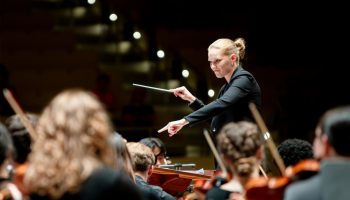
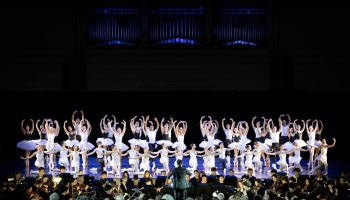
The talents of the Music School Festival Orchestra and Chautauqua Opera Conservatory will merge into a combination of surrealist comedy and poignant drama in their double-bill performance at 8 p.m. tonight in the Amphitheater. Shining a light on prominent French composers Claude Debussy and Francis Poulenc, the schools will showcase the lush harmonies and shimmering orchestral colors of L’Enfant Prodigue and Les Mamelles de Tirésias.
“There’s a real sonic thrill to the way that the voice and the orchestra work together to create drama, and so I think they’re actually a very beautiful pairing,” stage director Emma Griffin said. “And I actually think it’s the difference between the two that will make it such a delicious evening of theater.”
Conducted by Timothy Muffitt, the collaboration is an incredibly unique and special circumstance, Griffin said; working on Les Mamelles de Tirésias is particularly special, as it is performed so rarely that she has never seen it in person until now.
“To hear [Mamelles] with a full orchestra is really special. It’s often done with a reduced registration — there’s a very famous two-piano version that’s done very frequently. So to hear it with the full orchestra is a treat,” Griffin said.
Through developing the program in the selection process, Griffin and Muffitt worked to find pieces to exemplify as much of the orchestra and opera as possible.
“From the instrumentals perspective, it’s important to involve everything,” Muffitt said. “Part of the selection process for the works was to examine pieces that can involve most of the orchestra.”
Despite the age of both operas, Griffin firmly believes both the classics and their messaging stand the test of time, crediting the surrealist humor of Les Mamelles de Tirésias as one of its greatest strengths in making that possible.
“Surrealist comedy has a little bit more longevity because it’s just so dang wacky. I mean, the show is wacky,” Griffin said. “There’s a silliness … and there’s something about its wild silliness that I think is eternal.”
Griffin cited concerns surrounding a declining birth rate in the post-WWII era as a prevalent theme in the storytelling that transcends time, as similar concerns in the Western world have begun to rise at present.
“There’s a lot of people who feel anxious about a declining birth rate. So, it’s just funny that the things that people are upset about are eternal,” Griffin said.
The collaboration is also an effort to bring the best out of opera and orchestra students, who will work together to exhibit the heights of their skills on stage.
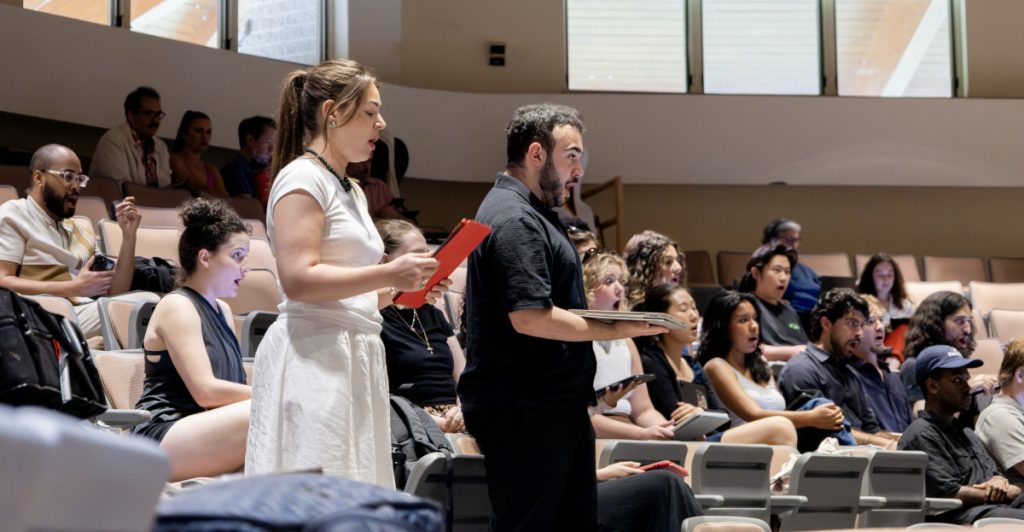
“It’s beneficial on a few levels. One is just the experience of putting together something as complex as an opera with an orchestra,” Muffitt said. “That is a highly involved process, and it challenges the musicians, both those on stage and those in the pit, to bring a heightened sense of awareness about their musical surroundings. It’s really great for developing sensitive musicians.”
There’s a second component to this, as well; Muffitt noted how both opera singers and orchestra performers can learn from each other and exceed each other’s expectations.
“All of the coloristic potentials that exist on stages with vocalists and in the pit for the orchestra when the players and the singers are in the thick of it — I think they glean a lot from their colleagues in production that applies to their own artistry,” Muffitt said.
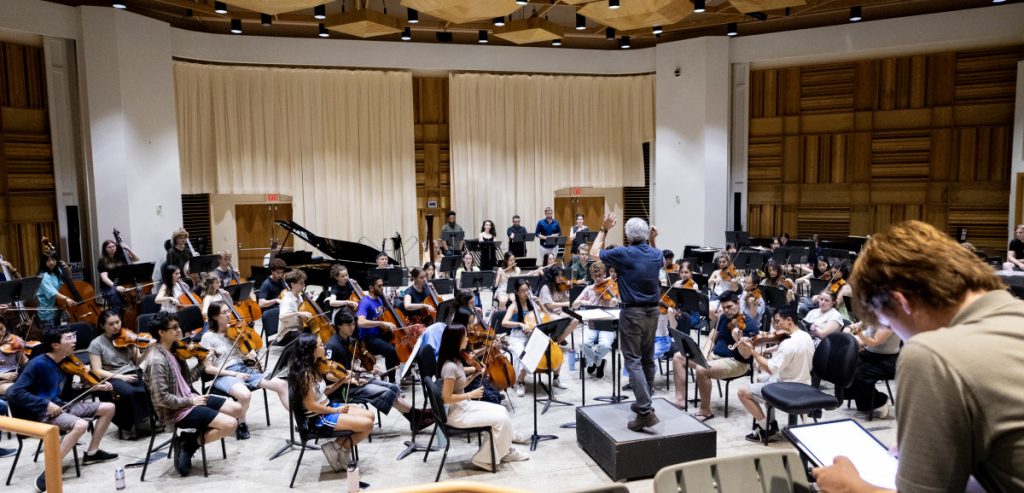
He worked with both the opera and orchestra during the rehearsal process, so when it was time to bring the two artistic bodies together, their performances became that of a single, cohesive entity.
“To be developing the program musically in coordination with what’s happening with staging, so that when it’s time to put the singers and instrumentalists together in the same room, there is someone — me — who has been working on both sides of the equation,” Muffitt said. “Sort of like when you build a railroad, one side starting in the east and the other in the west, making sure the tracks meet in the middle.”
As managing artistic director of Mannes Opera, Griffin views the teaching experience as an equal partnership and “two-way street” that fosters learning on both ends. Bearing witness to students harnessing their talents and energy to breathe life into a role is what she deems both a “privilege and an honor.”
“[Chautauqua Institution] is such a unique and special place for a young artist to come,” Griffin said. “The kind of support they’re getting, the sort of faculty that they are exposed to, the sort of focused, genuinely idyllic life that they have here — I cannot think of another summer program like this. It feels really special.”