MARY LEE TALBOT
Staff writer
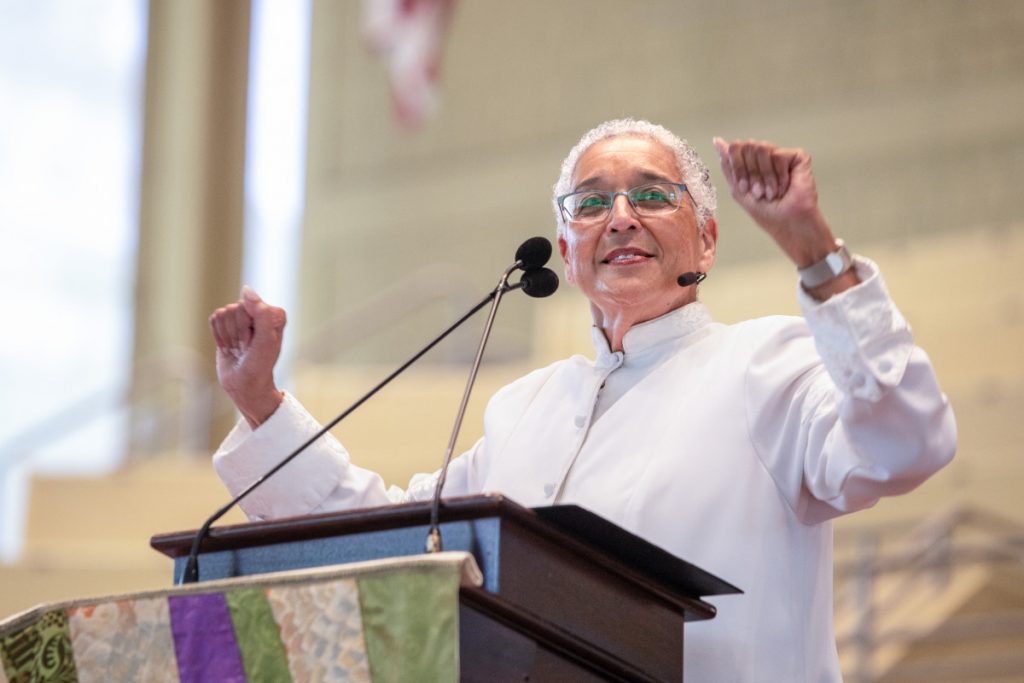
“What do you think of when you hear the word ‘broken’?” asked the Rev. Zina Jacque. “In this season of the 250th birthday of our country, I think we need to consider broken afresh. Is our nation broken? If I tell the truth, my soul gives a defeated no and not a defiant yes.”
Jacque preached at the 9:15 a.m. Monday morning worship service in the Amphitheater. Her sermon title was “Only Interrupted,” and the Scripture reading was John 4:7–30.
To be broken usually means to be divided into pieces, for someone to stand outside their original intention, whose given call is not an option. This person is often an outcast.
“We have fractures of our highest ideals, that all people are created equal,” she said. “Instead of one out of many, we are many out of one.” Jacque said she has a friend who is moving to Panama where she can be out of the reach of Immigration and Customs Enforcement, away from a nationalism “in the name of a savior who would not recognize it. Are we broken? Some say we are not, but when I hear ‘My Country Tis of Thee,’ I don’t know whether to put my hand on my heart or on my ears.”
The piece of art work Jacque shared during the sermon is called “Gibraltar” by Theaster Gates. He went to Japan to study kintsugi, an art of renewal through pottery repair in which broken pieces are glued back together with a gold lacquer and the pottery is fixed. The philosophy of kintsugi is to take what is broken and repair the rupture to return the piece to wholeness.
Jacque said, “For many, that is the experience of life. All people pass through a time of breaking, but that is not the end; it is a phase along the way. We are transformed into something more beautiful and more viable.”
The English language also teaches an older meaning of broken that means only interrupted, Jacque said. There was applause. What Jesus was teaching the woman at the well in John 4 was though she might have been broken by the system, handed around from husband to husband and been at the well alone at midday, was that she was not useless.
“She is not shattered; she is only interrupted, not ruined, not lost. She is a vessel to be made whole,” said Jacque. There was applause. “Theaster Gates’ piece of art is a solid sign and testimony that what is broken need not be discarded; it is part of the next piece.”
Jesus put truth, presence and hope in front of the woman at the well. Jesus told her the truth about her life and what caused it to fall apart, but that is not where her life stopped. He had to name the truth in order for her to build her life back.
Jesus put back the pieces for grace and renewal. “And he covers her with the golden lacquer of hope. When Jesus says, ‘I will give you living water,’ it is in the future perfect tense, meaning it is already done,” Jacque said.
In our day and age, she told the congregation, “We need to see what is broken by the Voting Rights Act erasure that can be repaired, that what is broken by hate and division can be restored. We cannot give up, give in, give out. We must see our nation not as hopelessly broken. We must see our nation as that which is only interrupted.”
Jacque continued, “I am not afraid of the truth; I am afraid of burying it. I am not afraid of presence because I have looked in people’s eyes and I saw humanity. I am a believer in the confident expectation of the coming good. That’s the theological definition of hope.”
She told the congregation that she refuses to see the nation as hopeless — only interrupted. To build a nation is hard work. “So bring your truth, the truth Jesus told the woman at the well. Bring the truth because we’ve got enough going to fix these cracks.”
Bring your presence, she said, not the presence of the people who arrived after the mending is finished, but the presence of the master craftsman who will get their hands dirty, presence that will not give up if the crack cracks again because there is enough gold.
Jacque continued, “Bring your hope, a steadfast willingness to stand until we can see the pieces cohere we can honor our nation’s truth. Our nation is not shattered. It is not finished. It is interrupted. You are the artists who stand against the odds. You and I, we are the ones with the gold in our hands.”
For the spiritual practice, she instructed the congregation to take a piece of paper and tear it into three pieces. On the first one, write “truth,” and below it, write a truth that you believe our nation needs to tell. On the second piece, write “presence,” and say how you will be present in the kintsugi. On the third piece, write “hope” and write what you hope for the nation. Carry it with you, she told the congregation, and pull it to remember Chautauqua and the people you have looked in the eye.
Jacque concluded, “As we reclaim our nation, the breaking is not our shame; the breaking is our testimony. The breaking is not our fault; the breaking is our defining. The breaking is our beginning. Art and artists against the odds is who you are. Do not give up; the world is in need of your gold.”
The Rev. John Morgan, pastor of Williamsburg Presbyterian Church, presided. The Rev. Paul Davis, a United Church of Christ pastor from Greensboro, North Carolina, read the scripture. Sonya Subbayya Sutton, interim director of music, played the prelude, “If Thou But Suffer God to Guide Me,” by Sigfrid Karg-Elert, on the Massey Memorial Organ. The Motet Choir, under the direction of Owen Reyda, organ scholar, performed “If Thou But Suffer God to Guide Thee,” by Jody Lindh, for the anthem. The choir was accompanied by Sutton on the Massey Organ. Reyda played “Allegrésse, Op. 26,” by Joseph Ermend Bonnal, on the Massey Organ. Support for this week’s chaplaincy and preaching is provided by The Robert D. Campbell Memorial Chaplaincy and The Jackson-Carnahan Memorial Chaplaincy.